Instagram user thegeekygastro shared a video on Monday listing what she considers the advantages of traveling on Singapore’s public transport network.
She highlighted the air-conditioned trains and stations, describing them as comfortable, “super clean” and free from “weird and mechanical smells,” AsiaOne reported.
She also pointed to One-North MRT station, where restaurants and shops are located just outside the station, as an example of the convenience offered by the network.
|
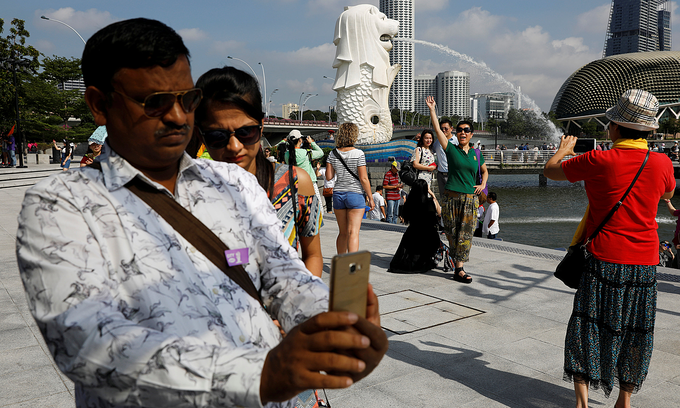
Tourists take photos at the Merlion Park in Singapore, Jan. 11, 2017. Photo by Reuters |
She said trains arrive about every three minutes and praised stations that connect directly to shopping malls.
“I don’t think a lot of people really understand how many luxuries are in a simple MRT ride especially near busy hubs!” she wrote in the caption.
Comparing the experience with public transport in the United States, she said many of these conveniences were absent from American stations, which she described as “hot with no airflow”, “unsafe” and “filthy”.
Her video had attracted more than 94,000 views, drawing mixed reactions from netizens.
“Honestly, Singapore’s public transport system is among the best in the world. It is consistently well-maintained and clean, and the country has done a very good job managing it,” a netizen wrote.
“Actually most trains in most Asian cities don’t have weird smells,” another wrote.
Others also complained about bad experience on the New York subway.
“I remember seeing rusted beams, rats and spider webs on the New York subway, as well as occasional unpleasant smells, particularly in the lifts.”
However, another user said the comparison should take into account the age of the two systems.
“To be fair, the New York subway system is much older than Singapore’s.”
The New York subway opened in October 1904, while Singapore’s MRT began operations in November 1987.
Singapore’s mass rapid transit network covers more than 200 km, with six operational lines and over 140 stations across the city-state.
With its 146 stations, it serves around 3.5 million passenger trips daily.
According to Singapore’s Land Transport Authority (LTA), 99.4% of trains ran on schedule in 2025.