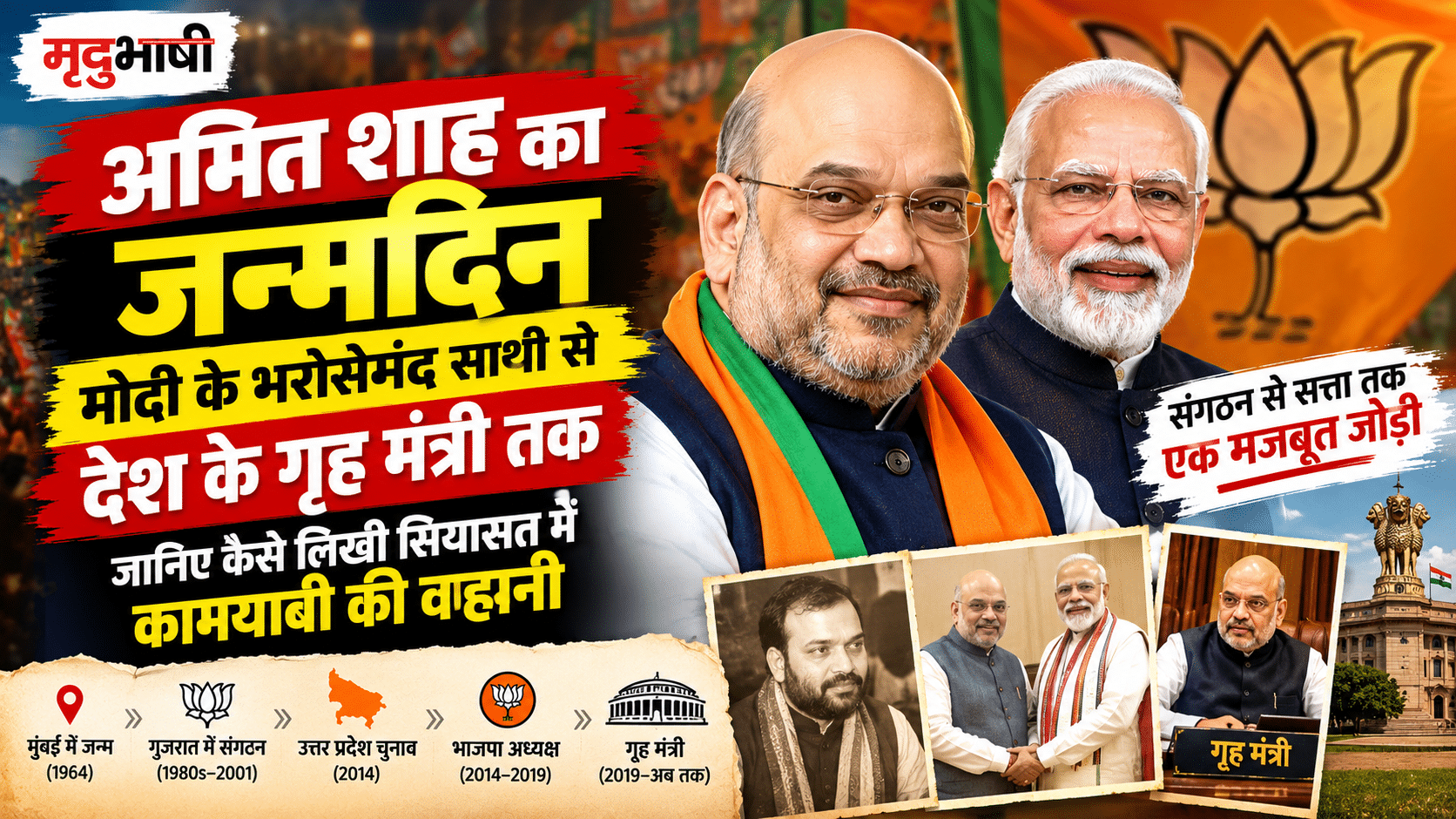
Born in Mumbai, beginning with organizational politics in Gujarat and election command of Uttar Pradesh in 2014—Amit Shah's strategy gave new strength to BJP in national politics. His decades-old partnership with Prime Minister Narendra Modi is still one of the most talked about partnerships in Indian politics.
New Delhi. In Indian politics, some leaders are known for their speeches, while others are known for their ability to build organizations and make election strategies. Union Home Minister Amit Shah's name figures prominently in the second category. From the organizational expansion of the BJP to the rise of Narendra Modi to national leadership, Shah's role has been crucial in many decisive political developments.
Born on 22 October 1964 in Mumbai, Amit Shah is celebrating his 62nd birthday on Thursday, 22 October 2026. On this occasion, many leaders including Prime Minister Narendra Modi congratulated him. The Prime Minister praised his administrative understanding and said that this has made India's internal security system more effective.
But Amit Shah's story is not limited to becoming the Home Minister only. This is a journey starting from organizational work in Gujarat politics to assuming the responsibility of National President of BJP and one of the most important ministries of the Central Government.
Modi and Shah duo: How did the political journey reach from Gujarat to Delhi?

The political partnership of Narendra Modi and Amit Shah has its roots in Gujarat. The contact between the two strengthened in the 1980s in the political-organizational circles associated with the Rashtriya Swayamsevak Sangh and the BJP. Over time, the combination of Modi's leadership and Shah's organizational ability became an important part of the BJP's strategy.
During Narendra Modi's tenure as the Chief Minister of Gujarat, Amit Shah held many important responsibilities in the state government. He has worked on responsibilities related to Home, Law and other departments. During this period, the political coordination and trust between the two became stronger.
While Modi was considered an expert in reaching out to voters through public meetings and broad political messaging, Shah focused on organisation, election management and activating workers at the booth level. This coordination later became an important part of BJP's election strategy in national politics.
2014 Uttar Pradesh elections: Shah's strategy gets national recognition
The year 2014 proved to be a big turning point in Amit Shah's political career. Before the Lok Sabha elections, BJP handed him the responsibility of Uttar Pradesh. At that time, Narendra Modi was the party's prime ministerial candidate and the BJP faced the challenge of winning one of the biggest electoral battles in the country.
In Uttar Pradesh, Shah worked on a strategy of activating the organisation, focusing on electoral areas and strengthening the political campaign up to the booth level. In the results, BJP won 71 out of 80 Lok Sabha seats in the state. Its ally Apna Dal got two seats. This performance contributed significantly to BJP reaching majority at the national level.
This was the election after which Amit Shah started being counted among the key strategists of BJP. The party's national success under Narendra Modi and Shah's organizational management in Uttar Pradesh have brought the duo into the spotlight across the country.
It would be more accurate to say that Modi's public support, the BJP's broader organization, the efforts of other party leaders and workers, and Shah's election strategy together contributed to the 2014 victory.
Became BJP President, then repeated the big election performance in 2019
After the 2014 Lok Sabha elections, Amit Shah was made the national president of BJP. Under his leadership, the party expanded its political presence in many states and emphasized on strengthening the organization.
BJP once again registered a big victory in the 2019 Lok Sabha elections. The party secured 303 seats and Narendra Modi became Prime Minister for the second consecutive time with an absolute majority. In this election also, Amit Shah's organizational role and election management was considered important.
In this way, the political partnership of Modi-Shah, which started from Gujarat, left its mark in BJP's two consecutive Lok Sabha victories at the national level. However, voter support, party organization and many other political-social circumstances were also important behind the electoral success.
Responsibility of Home Minister in 2019, will take over the ministry again in 2024
In 2019, during the second term of Narendra Modi, Amit Shah was made the Union Home Minister. Even after the formation of the third Modi government in 2024, he was given the responsibility of Home Ministry. He is also handling the responsibility of Cooperative Ministry.
During his tenure as Home Minister, major decisions of the Central Government on removal of most of the provisions of Article 370 from Jammu and Kashmir, Citizenship Amendment Act (CAA) and issues related to internal security have been in the news. Both political support and opposition have been seen regarding these decisions.
The government has also included action against Naxalism, stopping drug trafficking and strengthening the security system among its priorities. In the birthday message, Prime Minister Modi specifically mentioned Shah's contribution in ending the menace of Maoism and furthering the goal of a drug-free society.
Amit Shah's early life: Birth in Mumbai, political beginning in Gujarat

Amit Shah was born on 22 October 1964 in Mumbai in a Gujarati family. His father's name is Anilchandra Shah and mother's name is Kusumben Shah. His family later settled in Gujarat. Shah received his education in Gujarat and became involved in student politics and organizational activities in Ahmedabad.
He worked with the student organization Akhil Bharatiya Vidyarthi Parishad (ABVP) and then played an active role in the BJP. In the initial years his responsibilities were related to the local organization. Gradually he rose to key positions in Gujarat BJP and later his role in national politics increased.
Shah's political journey shows how the work started at the local level in the party organization can reach responsibility at the state and then national level.
PM Modi's message on birthday: Emphasis on internal security and drug-free society
Prime Minister Narendra Modi, while wishing Amit Shah on his birthday on social media platform X, praised his administrative understanding. He said that Shah has contributed in making the country's internal security system more effective.
The Prime Minister described eliminating the threat of Maoism and advancing the goal of a drug-free society as his notable priorities. Modi also wished him a long and healthy life.
Leaders from Assam to Puducherry congratulated
Assam Chief Minister Himanta Biswa Sarma congratulated Amit Shah calling him a leader dedicated to the country. He said Shah has paid special attention to Assam and has supported efforts to reduce crime and development in the state. Sarma also assured Assam's support in the campaign against drug networks.
Puducherry Chief Minister N. Rangasamy also wished Shah good health, long life and success. Protem Speaker A. Anbalagan expressed his good wishes while appreciating his commitment towards safeguarding national unity.
Amit Shah's political legacy: organization, strategy and responsibility of power
Amit Shah's political career can be understood in three major stages—creating the organizational base in Gujarat, playing an important role in the BJP's strategy in the 2014 and 2019 Lok Sabha elections and assuming the responsibility as Home Minister in the Central Government.
His partnership with Narendra Modi has been a major story of the last decade of Indian politics. Shah's organizational strategy along with Modi's leadership and public relations contributed to strengthening the BJP at the national level. At the same time, his decisions as Home Minister will also continue to be evaluated in the broader context of security, governance, law and democratic debate.