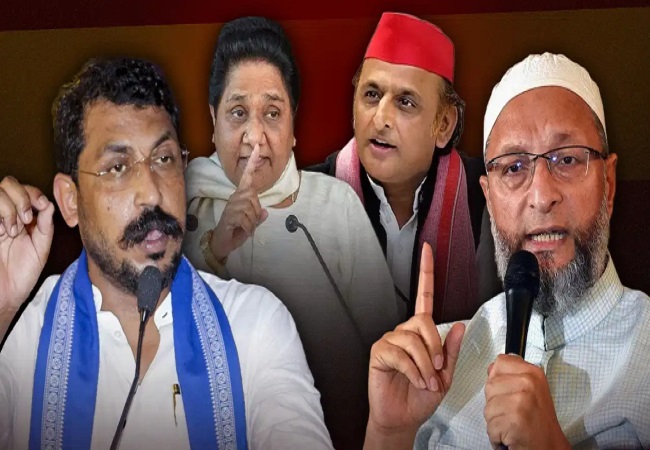
Lucknow. The coming together of Asaduddin Owaisi and Chandrashekhar Azad in the politics of Uttar Pradesh is not just an alliance of two political parties, but an attempt to create a new pole in the social justice based politics of the state. The formation of Social Change Front before the 2027 assembly elections and the announcement of contesting elections on all 403 seats has placed a new piece on the political chessboard of the state. By declaring Chandrashekhar Azad as the chief ministerial face, this alliance has also made it clear that its objective is not just to get some seats in the elections, but to claim a share in power.
Read :- Akhilesh Yadav said that SP discovered 25 lakh duplicate voters, will soon submit the list to the Election Commission, EC should reward us.
This alliance also has political importance because the combined social base of Dalit and Muslim voters in Uttar Pradesh is considered to be around 40 percent. But converting this number directly into electoral strength is not so easy. The bulk of Muslim voters' political share has long been with the Samajwadi Party, while the traditional leadership of Dalit politics has been in the hands of the Bahujan Samaj Party and Mayawati. In such a situation, the challenge of Owaisi and Chandrashekhar is not only to compete with BJP, but also to make their place in the established political base of SP and BSP.
Social equations and electoral mathematics
The 2024 Lok Sabha elections had exposed the changing nature of social equations in the politics of Uttar Pradesh. According to the post-poll survey of CSDS-Lokniti, 92 percent Muslim voters in the state supported the India alliance. This support was 82 percent among Yadav voters, 56 percent among non-Jatav Dalits and 25 percent among Jatav voters. In contrast, 79 percent of upper caste voters and 59 percent of non-Yadav OBC voters supported the NDA.
These figures show that in 2024, the SP-Congress alliance had succeeded in adding Muslim votes along with a section of Dalits and backward classes. Now Owaisi and Chandrashekhar are searching for their independent political space in this social base but there is a fundamental question here. Will Muslim voters, who largely rallied to the SP in the last elections to stop the BJP, now accept a different political option under Owaisi? Similarly, will the traditional Jatav voters of BSP and the non-Jatav Dalit voters who have joined SP accept Chandrashekhar as their new political leadership? These questions cannot be answered merely by social identity and political slogans. For this, confidence in the credibility of the organization, leadership and the possibilities of electoral victory is also necessary.
Read :- UP News: Deployment of 12 IPS officers, Shivank Chaudhary got responsibility in Lucknow Commissionerate, read the list.
Examination of PDA equation of SP
The first major political challenge of this alliance is before the Samajwadi Party. Akhilesh Yadav has made PDA i.e. backward, Dalit and minority politics the central basis of his political campaign. SP's victory on 37 seats and Congress's success on six seats in the 2024 Lok Sabha elections was the result of this broad social alliance and electoral coordination between the two parties.
The new front of Owaisi and Chandrashekhar is claiming political stake within this PDA. If a section of Muslim voters moves towards Owaisi and a section of Dalit voters moves towards Chandrashekhar, then the mathematics of contest on many seats may change for SP. Especially on those seats where the margin of victory and defeat is less.
AIMIM's total vote percentage in the 2022 assembly elections may have been around 0.49 percent, but the votes received by its candidates on some seats were more than the margin of defeat of SP. SP lost the seat by 217 votes, while AIMIM got 8,541 votes. SP's defeat margin in Ramnagar was 261 and AIMIM's votes were 4,940. In Sultanpur also, SP lost by 1,009 votes, while AIMIM got 5,251 votes.
These figures do not prove that if SP had got all the votes of AIMIM, the result would have changed, but it is clear that its electoral impact can be decisive in some areas.
Read :- UP becomes the first state in the country to fulfill all five skill standards of vocational education under NEP.
SP will now face the challenge of maintaining its Muslim voter base along with increasing its acceptance among Dalits and non-Yadav backward classes. It will also have to decide whether to see the new front only as a division of anti-BJP votes or to maintain scope for dialogue with it for broader opposition unity.
Challenge of BSP's legacy and leadership before Chandrashekhar
This alliance is an opportunity for political expansion for Chandrashekhar Azad, but his path is not easy. His victory from Nagina Lok Sabha seat in 2024 made him a prominent face of Dalit politics at the national level. He defeated BJP's Om Kumar by 1,51,473 votes and secured 5,12,552 votes. This victory was important for his personal political identity and the prospects of the Azad Samaj Party.
But Nagina's victory cannot be considered as proof of the support of Dalit voters in the entire state. Dalit politics in Uttar Pradesh has its roots in the long social movement of Kanshi Ram and Mayawati. In 2007, BSP formed the government with full majority by securing 30.43 percent votes. After this his vote percentage continued to decline. In 2022 it will be 12.88 percent and in 2024 Lok Sabha elections it will be around 9.39 percent.
This decline of BSP has definitely created space for new leadership in Dalit politics, but Mayawati's political base has not ended. His historical acceptance, especially among the Jatav community, and the BSP cadre are important political resources even today.
The real challenge before Chandrashekhar is bigger than taking advantage of BSP's weakening electoral performance. He will have to prove that he is not only a symbol of youth Dalit identity but also an option for statewide political leadership and governance. After being declared the face of the post of Chief Minister, a clear vision on employment, education, health, law and order and economic development will also be expected from him.
Read :- Retail Inflation: Retail inflation reached the highest level in two years, Congress said – see the report card of 'Inflation Man' Modi
Both challenge and opportunity for BJP
This new front will also impact the election strategy of BJP. In the 2024 Lok Sabha elections, BJP's seats in Uttar Pradesh reduced from 62 in 2019 to 33. Despite this, its vote percentage remained around 41.37 percent and it remained the party getting the most votes in the state.
A major basis of BJP's political strength is its acceptance among non-Yadav OBC and non-Jatav Dalit voters. It has developed its political base within these communities over the past decade. Therefore, the Dalit-Muslim alliance is not only faced with the question of social numbers, but also the question of challenging this broad social alliance of the BJP.
BJP may see this new front as an opportunity to divide the opposition votes. If SP-Congress and Samajik Parivartan Morcha contest elections separately, a triangular contest may arise on some seats. But it would not be appropriate to consider it automatically beneficial for BJP. If the new alliance ropes in Dalit and Muslim voters in areas where BJP has a strong position, it could also become a new challenge for the BJP.
The BJP's strategy may focus on strengthening its non-Yadav OBC and non-Jatav Dalit base, giving prominence to its claims on welfare schemes and law and order, and making political differences between the opposition parties a part of the election discourse.
Question of leadership before Congress and India alliance
The success of the SP-Congress alliance in 2024 had given the India Alliance new political ground in Uttar Pradesh. Now the formation of Social Change Front is raising a new question before the opposition unity. Chandrashekhar has also invited SP and Congress to join his front. But when he himself is the declared face of the post of Chief Minister, then it will be interesting to see how Akhilesh Yadav and the Congress leadership take this proposal.
Read :- Retail inflation at the highest level in two years, crossed 6 percent in October, crossed RBI's upper limit
The situation for Congress is dual. On one hand it has to save its alliance with SP, on the other hand it also has to strengthen its independent identity in Dalit and minority politics. If the new front contests elections separately, Congress and SP will face the challenge of dividing the opposition votes. If there is a broad opposition agreement at any level, new disputes may arise over the share of seats and leadership.
This situation may create a strategic opportunity for the NDA, while the India alliance will face the challenge of maintaining its 2024 social equation. Due to 80 Lok Sabha seats in Uttar Pradesh, the political developments here are also important for national politics.
The lessons of 2019 and the real test of 2027
In 2019, the alliance of SP and BSP was also formed on the belief that the combined base of Yadav, Jatav and Muslim votes would give a tough challenge to the BJP. But despite the social basis, complete transfer of votes could not take place. BJP won 62 seats, while BSP got 10 and SP only five.
This experience shows that the arithmetic of caste and religious equations does not guarantee electoral success. The political behavior of voters is not determined solely by their social identity. Local candidates, leadership, organization, election issues and chances of winning are equally important.
The same test will be faced by the Social Change Front also. Announcing to contest on 403 seats and preparing effective organization, candidates and booth management on all the seats are two different things. Owaisi's party has not yet achieved widespread electoral success in Uttar Pradesh and Azad Samaj Party has also not been able to prove its capability at the level of statewide organization. In such a situation, the real strength of the alliance will be assessed only by its candidates and grassroots activism.
New competition within the opposition or a new chapter of Bahujan politics?
The coming together of Owaisi and Chandrashekhar has again brought the question of representation to the center stage in the politics of Uttar Pradesh. The question is who will claim the political stake of the Dalit and Muslim communities and will these communities rely on a new alternative apart from their traditional political leadership?
The success of this alliance will not be measured only by how many seats it wins. It also has to be seen to what extent it influences the discussion of Dalit leadership, Muslim representation and social justice in the politics of the state. However, creating influence in political discourse and gaining electoral power are two different achievements.
At present it is clear that this front has raised new questions in front of SP's PDA equation, BSP's traditional Dalit politics and Congress's social justice strategy. For BJP too, this development is not just an opportunity to divide opposition votes, but a challenge to work afresh on the changing social equations.
The real question in the 2027 fight will go beyond BJP versus the opposition and also be about leadership and political representation within the opposition. Owaisi and Chandrashekhar have presented their claims. Now the test is whether their common political platform can go beyond social slogans and election announcements and gain the trust of voters, the strength of the organization and become a credible alternative to power or not. This will decide whether the Samajik Parivartan Morcha will write a new chapter in the politics of Uttar Pradesh or become another reason for the scattering of opposition votes.
Report-Rajeev Tiwari Baba