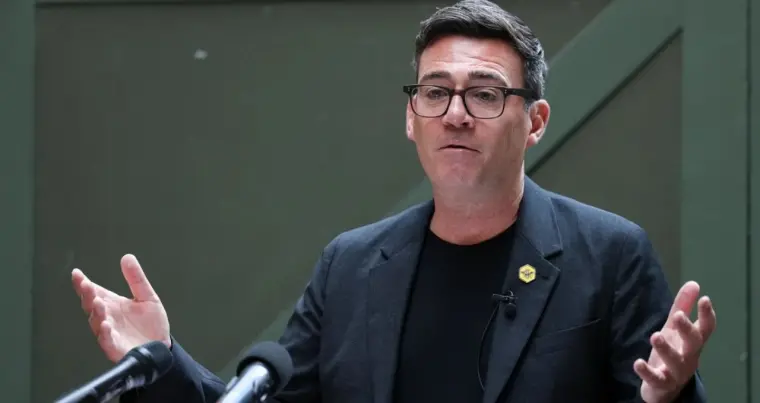
British Prime Minister Andy Burnham will face questions from MPs in the House of Commons for the first time. His government faces the challenge of increasing control over public services and rising government borrowing costs. The 10 year gilt yield has reached 5.23%.
London: British Prime Minister Andy Burnham will directly face questions from MPs in the House of Commons for the first time on Tuesday. It is being considered a key political moment for the Burnham government with the return of MPs after the summer parliamentary recess. After a relatively calm initial phase as Prime Minister, now his first major face in Parliament will be questions from the opposition and MPs from his own party.
In his address, Burnham can give prominence to the plan to increase public and government control over essential public services. The government argues that it is necessary to give priority to public interest to operate important services in a better way. However, this does not mean every service or company coming under direct government ownership.
Preparation to increase control over public services
The role of public services is important on the agenda of the Burnham Government. A prime example of his model is the bus system of Greater Manchester, where the public authority did not take over the full operation of buses. Instead timetables and fares were publicly controlled and contracts were awarded to private companies to operate services at fixed fees.
The objective of this system was not to completely remove private companies, but to operate the transport system in accordance with public interest. The government may consider the possibility of implementing a similar model in other areas also.
However, the situation is different in the rail sector. The government is already moving forward with the process of bringing back into public ownership those rail franchises whose existing contracts are expiring. This has intensified the discussion about the difference between public control and full nationalization.
Thames Water a big challenge for the government
Thames Water is one of the most complex matters facing the Government in the UK water sector. Questions have been raised for a long time regarding the financial condition and services of the company. The question facing the Burnham government is whether to temporarily take the company under public control or find some other solution.
Nationalizing Thames Water will not be an easy step, both legally and financially. Even within the government, it is believed that the process of taking a large private company directly under government ownership can be expensive and complex.
The example of British Steel makes this debate more important. During the tenure of the previous government, the company was taken into public ownership, for which the government had to pay a huge financial and political cost. The Burnham administration is therefore likely to view nationalization as a last resort.
Concern increased due to increase in government borrowing costs
Even before Burnham reaches Parliament, a new challenge has arisen before the government on the economic front. The cost of 10-year borrowing for the British government has increased to 5.23 percent. This level is among the highest since the 2008 global financial crisis.
Increase in the yield of government bonds has a direct impact on the interest expenditure on government debt. When a government has to pay higher interest on new debt, it puts pressure on its budget and may limit the financial space available for public services or other schemes.
This change in financial markets is not limited to Britain alone. The US, Japan and parts of Europe have also seen government borrowing rates rise in recent times. One of the main reasons for this is the increasing concern about interest rates, inflation and government debt in the global markets.
Impact of inflation and global tension
Many economic and geopolitical reasons are being cited behind the recent fluctuations in the market. Concerns about inflation have increased due to economic risks related to the Iran war. Apart from this, the demand for long-term financing from big tech companies is also putting pressure on the bond market.
Investors are also worried about the high level of government debt. In such an environment, it may become more challenging for the British government to prepare the upcoming budget.
Britain’s official budget monitoring institution, the Office for Budget Responsibility (OBR), in its March estimate had assumed the 10-year government borrowing rate to be around 4.5 percent. The current rate of 5.23 percent is well above that estimate. This may put additional pressure on the financial calculations of the government.
Government defends economic performance
Finance Minister John Healey meanwhile attended the meeting of global finance ministers and central bank chiefs in the US. He presented a positive picture of Britain’s economy in front of the G20.
According to Healy, so far in 2026, Britain has been the country with the fastest economic growth among the G7 countries. He also claimed to have improved productivity and reduced government borrowing at the fastest pace among major economies.
However, rising bond yields in the markets remain a matter of concern for the government. Despite positive economic growth data, if government debt costs remain high for a long time, pressure on fiscal policies could increase.
Increasing crowd in jails is also a priority for the government.
The Burnham government is also facing problems related to the prison system. The government is working on a plan to convert vacant offices, laundries and storage spaces into new cells to increase capacity in prisons.
But a section of jail employees have raised questions on this plan. He says that there are a large number of cells in existing jails which cannot be used due to security issues. In such a situation, instead of creating new spaces, more attention needs to be paid to repairing old cells.
According to a 2024 National Audit Office report, almost a quarter of prison capacity in Britain, or about 23,000 places, did not meet fire safety standards. This figure highlights the chronic fundamental problems of the prison system.
Keir Starmer decides to step down as MP
Meanwhile, Burnham’s predecessor Prime Minister Keir Starmer has also made a big change in British politics. Starmer announced that he would resign as MP for Holborn and St Pancras. He had been representing this London seat since 2015.
After leaving the post of Prime Minister, it was initially believed that Starmer would continue his tenure as MP, but now he has changed his decision. In a statement given to local media, he said that leaving the post of MP will give him the opportunity to focus on other areas like international affairs, defense and security.
After Starmer’s resignation, there will be a by-election for his London seat. This has prepared the ground for another important electoral contest in British politics after Burnham becomes Prime Minister.
Burnham faces both economic and political challenges.
Burnham’s first major address to Parliament is coming at a time when his government has to respond on several fronts simultaneously. Plans to increase government role in public services, overcrowding in prisons, water sector problems and rising government borrowing costs are major issues facing the government.
Regarding the policy of public control, Burnham will have to clarify in which areas the government will intervene directly and where private companies will continue to play a role. At the same time, rising bond yields in the financial markets may put pressure on the government’s expenditure and future budget.
Burnham’s first major test in Parliament is important because his answers could indicate the direction of the government’s priorities and economic strategy in the coming months. At present, the biggest challenge before the Prime Minister will be to keep the rising debt and financial market concerns under control while carrying forward his agenda of improving public services.