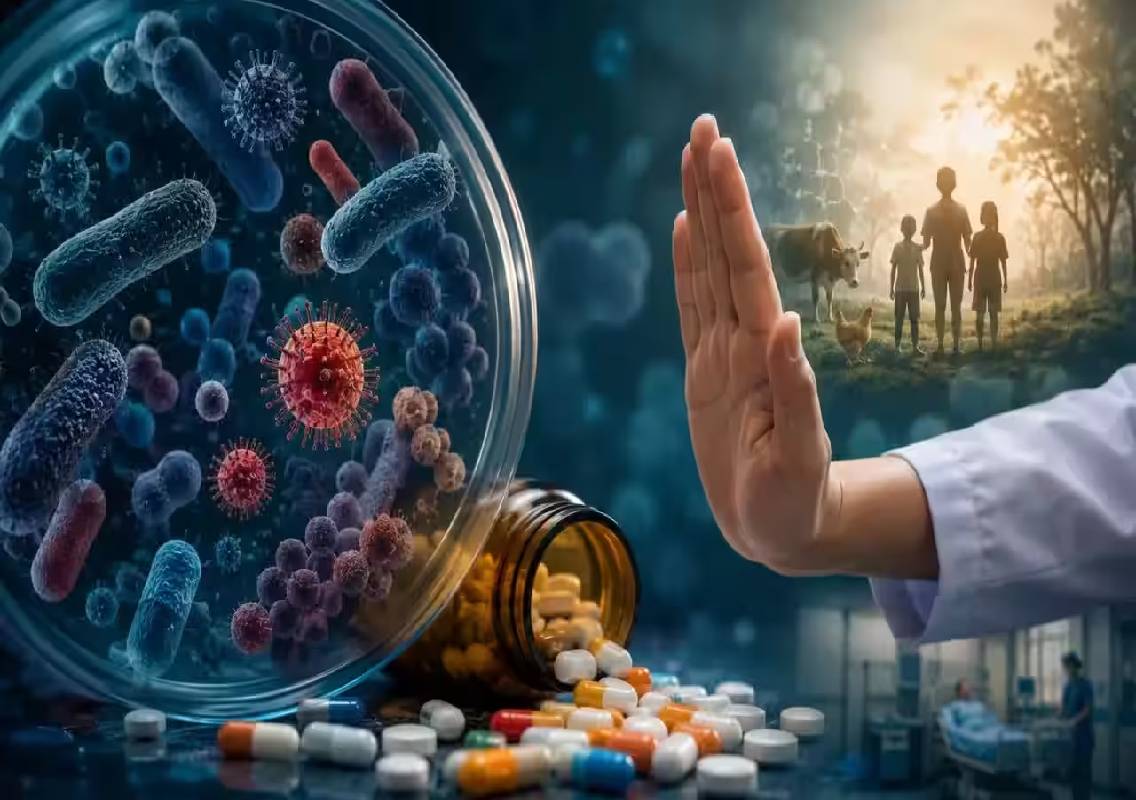
New Delhi: Antimicrobial resistance (AMR) is emerging as one of the most serious public health challenges worldwide, as disease-causing microorganisms increasingly become resistant to medicines designed to treat them. Often described as a “silent pandemic”, AMR can make common infections harder to treat, increase hospital stays and treatment costs, and raise the risk of severe illness and death.
Unlike a conventional pandemic, AMR does not necessarily arrive as a single rapidly spreading disease. Instead, resistance develops gradually as bacteria, viruses, fungi and parasites evolve, while inappropriate or excessive use of antimicrobial medicines accelerates the process.
The World Health Organization estimates that bacterial AMR was associated with more than 4.7 million deaths globally in 2021. In 2023, approximately one in six laboratory-confirmed bacterial infections worldwide was resistant to antibiotics.
What is antimicrobial resistance?
Antimicrobial resistance occurs when microorganisms change in ways that make medicines used against them less effective or ineffective.
Antibiotic resistance is one part of the wider AMR problem. Antibiotics act against bacteria, while antimicrobial medicines also include drugs used against certain viruses, fungi and parasites.
When microorganisms become resistant to several medicines, infections can become particularly difficult to treat. These resistant organisms are often referred to as superbugs.
A person can therefore develop an infection that previously would have been relatively easy to treat but now requires stronger medicines, longer treatment or specialised hospital care.
Why is AMR called a silent pandemic?
AMR develops largely out of sight.
There is no single event that marks the beginning of antimicrobial resistance, and resistant organisms can spread through communities, hospitals, animals, food systems and the environment.
This makes AMR different from a conventional infectious disease outbreak. The problem can grow steadily while antibiotics continue to appear available.
However, when resistance becomes widespread, medicines that doctors have relied upon for decades may no longer work reliably.
The result can be longer illnesses, increased healthcare expenditure and a greater risk of complications and death.
Overuse of antibiotics is a major driver
One of the most important factors behind AMR is the misuse and overuse of antimicrobial medicines.
Using antibiotics when they are not needed can expose bacteria to medicines without providing a corresponding health benefit. Over time, this creates conditions in which resistant organisms can survive and multiply.
WHO also identifies antimicrobial use in animals and agriculture as part of the wider AMR challenge. The problem therefore cannot be addressed only inside hospitals or doctors’ clinics.
Antibiotics do not work against viral infections
A common misconception is that antibiotics can treat any infection.
Antibiotics work against bacteria, not viruses. Therefore, illnesses caused by viruses generally do not improve simply because a person takes an antibiotic.
Taking antibiotics unnecessarily can contribute to resistance while exposing the individual to possible side effects.
Patients should therefore avoid self-medicating with antibiotics and should use them only when prescribed by an appropriate healthcare professional.
Stopping self-medication can help
Easy access to medicines can sometimes encourage people to start treatment without medical advice.
A person may use leftover antibiotics from an earlier illness, take medicine prescribed to someone else or stop and restart treatment without consulting a doctor.
Such practices can contribute to inappropriate antimicrobial use.
The safest approach is to seek medical advice when an infection requires treatment and follow the prescribed medicine and dosage instructions.
Hygiene is an important defence
Preventing infections in the first place can reduce the need for antimicrobial medicines.
Simple measures such as regular handwashing, safe food and water practices, appropriate sanitation and infection-control procedures can reduce the spread of infectious diseases.
WHO’s updated global AMR strategy places strong emphasis on prevention, including infection prevention and control, water, sanitation and hygiene, vaccination and other measures that reduce infections before antimicrobial treatment becomes necessary.
Vaccination can reduce antibiotic use
Vaccines also have an important role in tackling AMR.
By preventing infections, vaccination can reduce the number of people who need antimicrobial treatment. Fewer infections can mean fewer opportunities for resistant organisms to emerge and spread.
This is one reason the global response to AMR increasingly focuses on prevention rather than relying exclusively on developing new medicines.
Hospitals face a particular challenge
Healthcare facilities can become environments where resistant organisms spread quickly, particularly when infection-control measures are inadequate.
Patients who are seriously ill or have weakened immune systems may be particularly vulnerable to resistant infections.
Hospitals therefore need strong infection-prevention systems, appropriate diagnostic testing, antimicrobial stewardship programmes and surveillance of resistance patterns.
WHO has highlighted diagnostic stewardship as another important tool because using the right test at the right time can help doctors make more appropriate treatment decisions.
India is also strengthening its AMR response
India has been working on AMR through its national action plan and surveillance initiatives.
WHO India supports activities including AMR surveillance, monitoring antimicrobial consumption and use, infection prevention and control, antimicrobial stewardship, awareness programmes and research.
India’s National Action Plan on Antimicrobial Resistance 2.0, launched in November 2025, adopts a One Health approach involving human health, animals, agriculture and the environment. The plan runs from 2025 to 2029 and includes performance indicators intended to track progress.
AMR is not only a human-health problem
Antimicrobial resistance crosses the boundaries between human health, animal health, agriculture and the environment.
Antimicrobial use in livestock and agriculture can contribute to resistance, while resistant microorganisms can move between humans, animals, food systems and environmental sources.
This is why health authorities increasingly use the One Health approach, which brings different sectors together rather than treating AMR as only a medical issue.
Wastewater can also contribute to the problem
Environmental contamination is another concern.
Research highlighted in WHO India’s AMR publications has identified antibiotic residues and antimicrobial-resistance genes in urban sewage in India. Such findings underline the importance of monitoring wastewater and strengthening environmental measures as part of AMR control.
This means that tackling AMR requires action beyond pharmacies and hospitals.
The world has adopted a new AMR action plan
In May 2026, the World Health Assembly adopted an updated Global Action Plan on Antimicrobial Resistance for 2026–2036.
The plan provides a global framework for tackling AMR through a One Health approach. It calls for stronger surveillance, responsible antimicrobial use, infection prevention, vaccination, innovation, sustainable food systems and better monitoring of progress.
The updated strategy reflects growing recognition that resistance cannot be solved by simply developing new antibiotics.
New medicines alone will not solve AMR
Developing new antibiotics and other antimicrobial medicines remains important, but new drugs can also lose their effectiveness if they are misused.
The response therefore has to combine new treatments with responsible use.
Doctors need reliable diagnostic tools, health systems need surveillance networks, governments need effective policies, and patients need better awareness about when antimicrobial medicines are appropriate.
What can people do to help?
Individuals can contribute to reducing antimicrobial resistance through simple steps:
- Do not take antibiotics without medical advice.
- Do not use someone else’s antibiotics.
- Do not keep leftover antibiotics for future illnesses.
- Follow a healthcare professional’s instructions about prescribed medicines.
- Maintain good hand hygiene.
- Keep vaccinations up to date.
- Follow food-safety and sanitation practices.
- Avoid demanding antibiotics when a doctor says they are not required.
These measures may appear small, but preventing unnecessary antimicrobial exposure is an important part of slowing resistance.
Why urgent action is needed
AMR threatens some of the basic achievements of modern medicine.
Treatments for serious infections, surgery, cancer care, organ transplantation and other medical procedures depend on effective antimicrobial medicines.
If infections become increasingly resistant, procedures that currently rely on antibiotics to prevent or treat infections could become more complicated and risky.
The WHO’s latest data shows why the problem requires immediate attention: resistant bacterial infections are already widespread, while misuse and overuse of antimicrobials continue to drive resistance.
Conclusion
Antimicrobial resistance is a slow-moving but potentially devastating global health threat. Unlike a conventional pandemic, it does not depend on one new pathogen appearing suddenly. Instead, resistance builds as microorganisms evolve and antimicrobial medicines are misused or overused.
The solution requires action at every level — from patients avoiding unnecessary antibiotics to doctors using diagnostics and prescribing medicines responsibly, and from hospitals strengthening infection control to governments improving surveillance and regulation.
With the WHO’s new 2026–2036 Global Action Plan and India’s continuing One Health approach, the focus is increasingly shifting towards prevention, responsible antimicrobial use, surveillance and innovation.
The fight against AMR is ultimately about preserving the effectiveness of medicines before infections that are treatable today become much harder to control tomorrow.