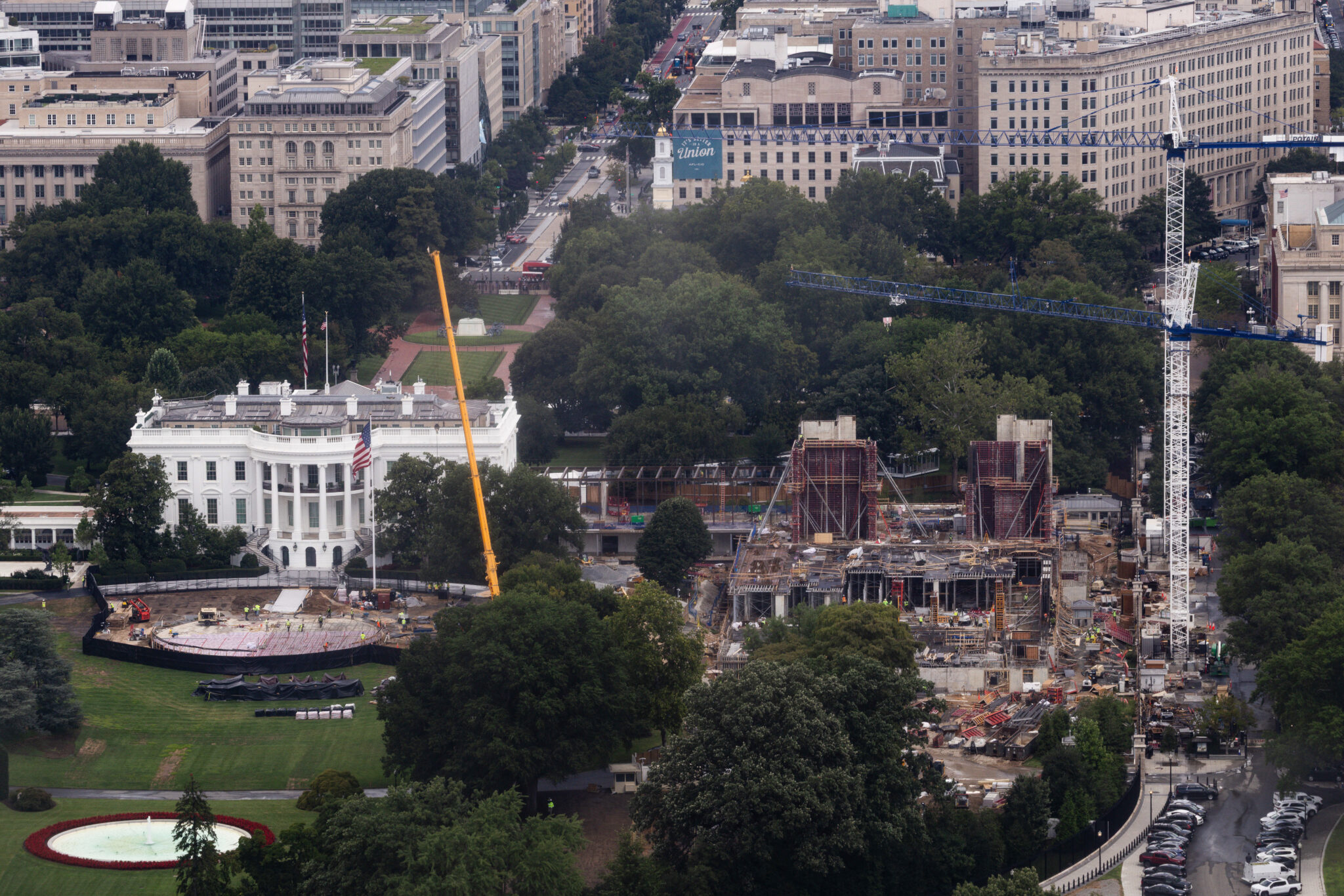
Appeals Court Blocks Trump’s $400M White House Ballroom Without Congress Approval/ TezzBuzz/ WASHINGTON/ J. Mansour/ Morning Edition/ A federal appeals court ordered the Trump administration to stop above-ground construction of its $400 million White House ballroom unless Congress approves it. The 2-1 ruling said Trump lacks unilateral authority to build the 90,000-square-foot structure where the demolished East Wing once stood. The court delayed enforcement for two weeks to give the administration time to appeal to the Supreme Court, while permitting underground security work to continue.

Quick Look
- A federal appeals court blocked above-ground ballroom construction.
- The project is expected to cost $400 million.
- The planned ballroom would cover 90,000 square feet.
- It would stand on the former site of the White House East Wing.
- Trump ordered the East Wing demolished in 2025.
- The ballroom would accommodate 999 people.
- The court ruled 2-1 in favor of historic preservationists.
- Judges Patricia Millett and Bradley Garcia supported the decision.
- Trump-appointed Judge Neomi Rao dissented.
- The ruling is stayed for two weeks pending a potential Supreme Court appeal.
- Underground bunker and national security work may continue.
- The administration says the project includes protection against drones and missiles.
- Preservationists say the ballroom is not a national security emergency.
- The National Capital Planning Commission approved the project April 2.
- A district court will continue hearing the underlying lawsuit.

Deep Look
Appeals Court Halts Ballroom Construction
WASHINGTON — A federal appeals court ordered the Trump administration Friday to halt above-ground construction of a planned $400 million White House ballroom unless it obtains congressional authorization.
The U.S. Court of Appeals for the District of Columbia Circuit ruled that President Donald Trump cannot unilaterally build the massive addition.
A three-judge panel decided the case by a 2-1 vote.
Ballroom Planned for Former East Wing Site
The proposed ballroom would cover 90,000 square feet, or approximately 8,400 square meters.
It would occupy the site where the White House East Wing stood before Trump ordered its demolition.
The president has said the new venue would accommodate 999 people.
The project would represent the most significant structural change to the White House in more than seven decades.
Court Says Congress Must Decide
The appellate court sided with the National Trust for Historic Preservation, which sued to stop the project.
The majority said a construction project of this scale required authorization from Congress.
“Whether or not a massive ballroom should be constructed is for Congress to decide and is not a matter for Executive self-help,” the court wrote.
Judges Say Ruling Is Not About Ballroom’s Merits
The court emphasized that its decision did not evaluate whether the ballroom would be useful or desirable.
“This holding has nothing at all to do with whether the proposed ballroom is desirable, or not, as a matter of policy. This ruling does not even necessarily mean that the Defendants may not ultimately construct the ballroom.
“What it does mean,” the court continued, “is that the Defendants may not do so during the district court’s expeditious litigation without securing Congress’s authorization, as the Constitution and laws require.”
The ruling leaves open the possibility that construction could proceed if Congress approves the project or the administration ultimately prevails in court.
Ruling Delayed for Two Weeks
The appeals court agreed to stay its own decision for two weeks.
The temporary delay gives the Trump administration time to ask the U.S. Supreme Court to intervene.
Until that period expires or the Supreme Court acts, the administration may have a limited opportunity to challenge the ruling before work must stop.
District Judge Previously Blocked Work
The panel upheld an April 16 order issued by U.S. District Judge Richard Leon.
Leon barred the administration from continuing above-ground construction while the legal challenge moves forward.
President George W. Bush nominated Leon to the federal bench.
Underground Security Work May Continue
Leon allowed the White House to continue underground construction.
That work includes a bunker and other facilities the administration describes as essential to national security.
The ruling distinguishes between underground protective infrastructure and the above-ground ballroom structure.
Trump Attacks Leon on Social Media
Trump condemned Leon’s ruling in a social media post.
The president called him a “Trump Hating” judge who “has gone out of his way to undermine National Security, and to make sure that this Great Gift to America gets delayed, or doesn’t get built.”
Trump has promoted the ballroom as an important improvement to the White House and a lasting contribution to the country.
Ideologically Mixed Panel Decides Case
The appeals court panel included Judges Patricia Millett, Neomi Rao and Bradley Garcia.
President Barack Obama nominated Millett.
Trump appointed Rao, while President Joe Biden nominated Garcia.
Millett and Garcia formed the majority, while Rao dissented.
Preservation Group Filed Lawsuit
The National Trust for Historic Preservation challenged the ballroom project in December 2025.
The organization filed its lawsuit one week after the White House completed demolition of the East Wing.
The group argues that the administration began an unprecedented alteration of the historic complex without securing the legally required approval from Congress.
Government Cites National Security Features
Justice Department lawyers have argued that the ballroom project includes essential security improvements.
They say the upgrades are designed to protect the White House against threats including drones, ballistic missiles and biological hazards.
“These upgrades, alterations, and improvements are essential to protecting the President, his family, and his staff, as well as the White House itself, and the entire project flows from them,” government attorneys wrote in a court filing.
Preservationists Reject Emergency Claim
Attorneys for the National Trust argued that the absence of a White House ballroom does not create a national security emergency.
They said the administration could proceed with necessary underground protective measures without constructing the above-ground event space.
“That commonsense conclusion is not clearly erroneous, and there is no basis to disturb it,” they wrote.
Appeals Court Previously Requested Reconsideration
Leon initially ruled that above-ground ballroom construction could not continue without congressional approval.
The government appealed that decision.
The appeals court then instructed Leon to reconsider whether stopping construction could create national security risks.
Leon Narrows Construction Ban
After reviewing the security arguments, Leon issued a narrower ruling.
He prohibited only above-ground ballroom work while explicitly allowing underground facilities to proceed.
Those permitted projects include bunkers, military installations and medical facilities.
Judge Rejects Broad Security Exception
The administration argued that security needs justified allowing the entire construction project to move forward.
Leon rejected that interpretation.
“Defendants argue that the entire ballroom construction project, from tip to tail, falls within the safety-and-security exception and therefore may proceed unabated,” the judge wrote. “That is neither a reasonable nor a correct reading of my Order!”
Planning Commission Approved Project
Trump’s ballroom received final approval April 2 from the National Capital Planning Commission.
The 12-member body reviews construction projects on federal property throughout the Washington region.
The appeals court ruling means that planning approval alone is insufficient for above-ground work to continue while the lawsuit proceeds.
Legal Battle Could Move to Supreme Court
The administration now has two weeks to seek emergency relief from the Supreme Court.
If the justices decline to intervene, above-ground work will remain suspended during the district court litigation.
Congress could also authorize the project, which would address the central legal problem identified by the appeals court.
More on US News