0
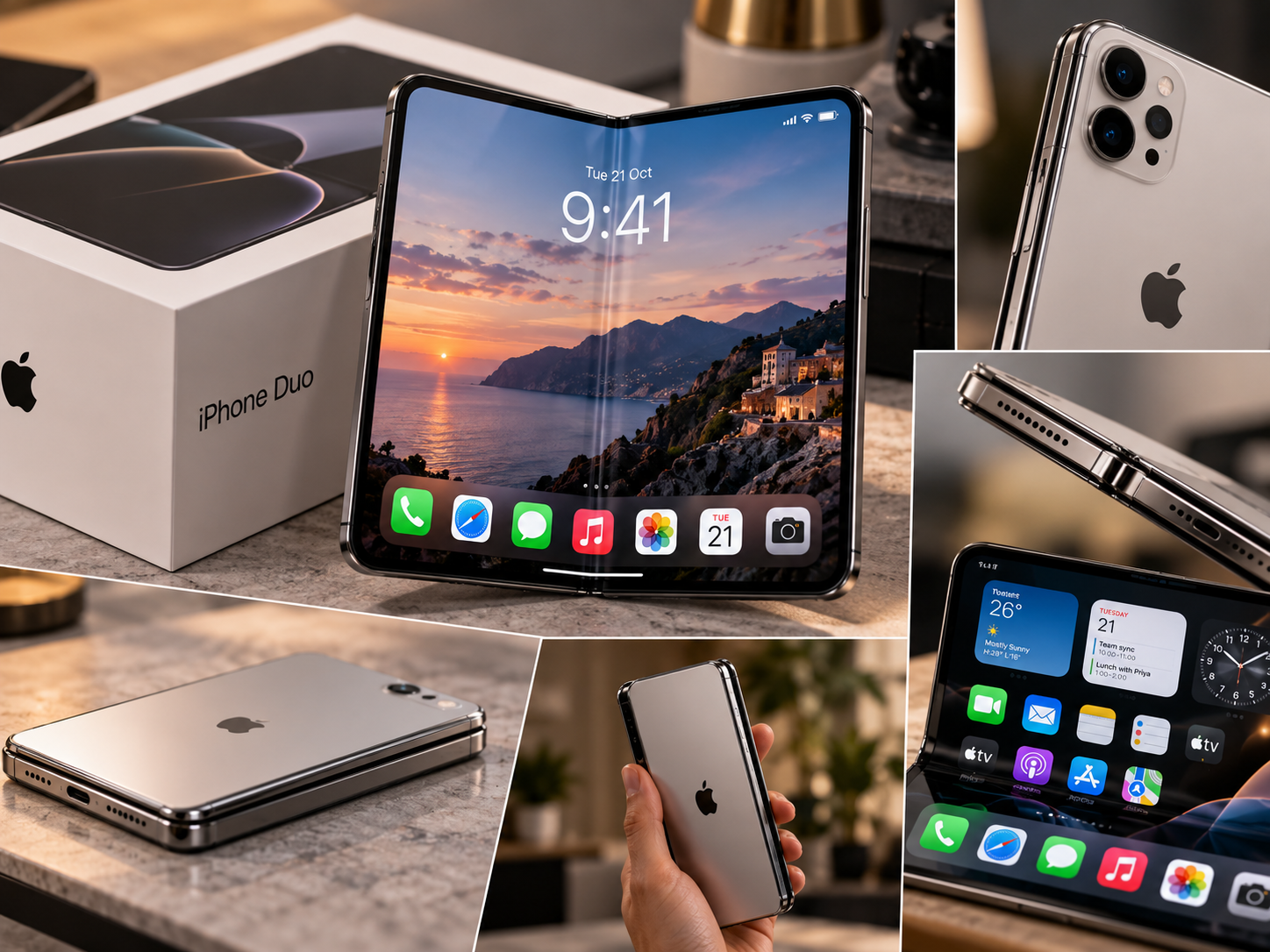
Apple has officially entered the competitive foldable smartphone landscape with the long-awaited launch of the iPhone Duo, presenting a passport-sized device that marries sophisticated hardware with intuitive software integration. As initial unboxing videos surface across digital platforms and premier technology outlets release their initial evaluations, the device has already secured high praise and industry accolades, including a CNET Editors’ Choice Award.
Despite arriving later to the foldable market than competing manufacturers like Samsung and Google, Apple’s inaugural folding handset has immediately captured public fascination through its refined form factor, matte inner display, and deep operating system synergy.
We can’t wait for the world to experience the iPhone Duo next week! Pre-orders start today.
— Tim Cook (@tim_cook) October 16, 2026
Apple Duo Review: How Does Design Of iPhone Duo Function?
The physical architecture of the iPhone Duo centres around a compact 5.4-inch cover screen that expands into a sprawling 7.6-inch tablet-like inner display when unfolded. Weighing in with a slim profile that measures 11.3 millimetres thick when closed and a mere 5.2 millimetres when open, the device breaks away from traditional bar-style designs without feeling bulky or cumbersome in everyday pocket storage. Senior technology reporter Abrar Al-Heeti stated in her CNET product evaluation that “the iPhone Duo makes a compelling case for it being the most practical – and fun – foldable design.”
Early unboxing videos published on YouTube demonstrated that the handset uniquely ships in its open, unfolded configuration and comes in striking colour options including Star White and Night Sky. Reviewers have highlighted the matte surface of the inner screen, which effectively minimises ambient glare and renders the central crease virtually invisible during standard media consumption and daily scrolling. Furthermore, the hinge mechanism allows the device to hold its position stably at various angles, enabling convenient tabletop viewing modes without requiring external stands.
Apple Duo Review: What Are Software And Multitasking Capabilities?
Operating on Apple’s latest iOS 27 software, the iPhone Duo delivers a remarkably fluid user experience across both differently sized screens, avoiding the software stutter that has occasionally plagued first-generation foldables from rival brands. The operating system intelligently splits keyboards and repositions camera controls when the device is partially folded, ensuring that no essential interface elements are obscured by the central crease.
When opened fully, the inner display supports multitasking with up to two applications running simultaneously in a split-screen configuration. However, software limitations remain present; users cannot dynamically resize individual application windows to occupy unequal portions of the screen when operating in landscape mode, restricting multitasking flexibility compared to competing Android foldable devices. Nonetheless, the ability to seamlessly drag and drop images and files between open applications provides a fluid workflow for mobile professionals and digital creators alike.
Apple Duo Review: How Do Cameras And Biometrics Perform?
The photographic capabilities of the iPhone Duo are anchored by a 48-megapixel wide and ultrawide camera array, paired with an under-display FaceTime camera on the inner screen that disappears entirely when inactive to preserve immersion. While the primary sensors capture crisp and vibrant imagery, the absence of a dedicated telephoto lens, ProRAW, or ProRes recording capabilities means the device’s optical versatility is somewhat scaled back compared to standard slab flagship models like the iPhone Pro.
Biometric security introduces a notable departure from recent Apple design philosophy, as the iPhone Duo omits Face ID entirely in favour of Touch ID integrated directly into the side power button. While the side-mounted fingerprint scanner operates with high speed and accuracy, industry analysts note that the absence of facial recognition feels like an unexpected compromise on a device commanding such a premium market positioning.
Apple Duo Review: What Are Technical Specifications And Pricing Details?
A rigorous examination of the device’s technical specifications reveals a carefully engineered hardware suite designed to balance thinness with structural durability. Below is a comprehensive breakdown of the core specifications and pricing tiers for the iPhone Duo:
-
Cover Display: 5.4-inch OLED display optimised for one-handed messaging, notifications, and quick photography.
-
Inner Display: 7.6-inch matte foldable OLED panel designed to minimise glare and conceal the central crease.
-
Dimensions: 11.3 millimetres thick when folded; 5.2 millimetres thick when unfolded.
-
Camera System: Dual 48-megapixel rear array (wide and ultrawide) alongside an under-display inner FaceTime camera.
-
Biometrics: Side-mounted Touch ID integrated into the power button (Face ID is omitted).
-
Software: Powered by iOS 27 with dedicated foldable multitasking and split-screen support.
-
Pricing And Storage: Starting at $1,999 for the 256 gigabyte model, scaling up to $3,199 for the 2 terabyte storage configuration.
Positioned at the apex of the mobile market, the iPhone Duo commands a substantial financial investment. While this pricing structure aligns closely with rival high-end folding handsets, initial pre-orders demonstrated staggering consumer demand that rapidly depleted available stock. For dedicated ecosystem users seeking a pocketable device that transforms into a productive mini-tablet, the refined engineering and software harmony largely justify the cost, cementing the Duo as a landmark release for the Cupertino-based technology giant.