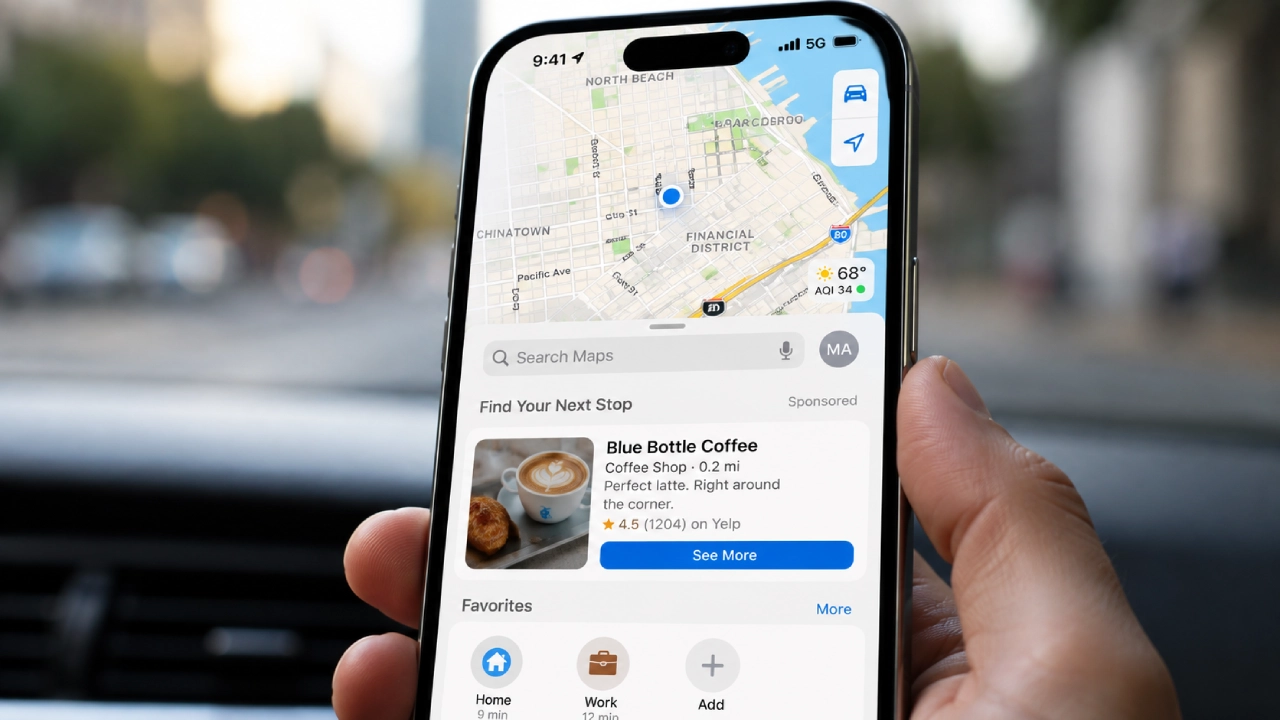
If you open Apple Maps on your iPhone this week and notice a business you didn’t search for sitting at the top of your results, that’s not a bug. Apple has officially begun rolling out advertisements inside Apple Maps across the US and Canada, confirmed to 9to5Mac and corroborated by AppleInsider, Digital Trends, iPhone in Canada, and MacObserver. The rollout started quietly over the past few days, and Apple says it will continue expanding to reach all eligible iPhone and iPad users over the coming weeks.
Apple first announced the feature back in March as part of its broader Apple Business advertising push, setting a tentative summer 2026 launch window. With ads now live as summer winds down, Apple has met that self-imposed timeline almost exactly.
Where the Ads Actually Show Up
The two placements target different moments in how people actually use Maps. Suggested Places surfaces sponsored businesses passively, before a user has expressed any specific intent, similar to how a recommendation feed works. The search results placement is more directly tied to intent: if a business has purchased an ad for a relevant keyword or category, like “coffee” or “pharmacy,” their listing can appear above organic results Apple considers relevant to that search. Apple has said ad formats can include single-image, three-image, or text-only placements, giving businesses some flexibility in how their sponsored listing is presented.
Visually, Apple has kept the ads close to standard business listings, with only a small blue “Ad” label distinguishing sponsored content from organic results, a design choice that keeps the interface uncluttered but also makes ads less immediately obvious than more aggressive ad formats elsewhere on the web.
No Toggle to Turn Them Off
This is the detail drawing the most attention, and it’s confirmed directly by Apple: there’s currently no setting anywhere in Maps to disable these ads. That puts Apple Maps in the same category as other Apple first-party apps that already carry advertising, including the App Store, Apple News, and Stocks, none of which offer a way to opt out of sponsored content either. For users who’ve come to associate Apple’s ecosystem with a more premium, ad-light experience compared to Google’s products, this rollout narrows that gap somewhat, even if the ad density here remains far lower than what’s typical in Google Maps.
Apple’s Privacy Framing
Apple has been explicit that it’s trying to differentiate this ad system on privacy grounds. According to Apple’s own statements, ad targeting relies on on-device signals, and ad interactions and location data aren’t tied to a user’s Apple Account. This mirrors the privacy architecture Apple already uses for ads in the App Store and Apple News, where on-device processing determines ad relevance without building a server-side profile tied to an individual’s identity.
Whether that framing holds up to independent scrutiny once security researchers get a closer look at the actual implementation remains to be seen, but it’s a meaningfully different approach than the account-linked, cross-app tracking model that’s standard across most other ad-supported map and navigation products.
Why This Matters for Apple’s Business Strategy
Apple Maps advertising represents a new revenue stream for a division that has historically operated as a supporting service. It also puts Apple Maps into more direct competition with Google Maps specifically on monetization, an area where Google has generated substantial local-business ad revenue for years. For businesses, it opens a new paid discovery channel within Apple’s ecosystem, one that reaches iPhone users specifically at the moment they’re actively looking for a nearby service or location, arguably one of the highest-intent moments in the entire user journey.

What to Watch Next
The clearest thing to track is how quickly this expands beyond its current US and Canada rollout to additional markets, and whether Apple eventually introduces a way to reduce or manage ad frequency, even without necessarily disabling ads outright. It’s also worth watching whether Apple’s on-device privacy claims get independently verified as more users and researchers get hands-on access to the live ad system.