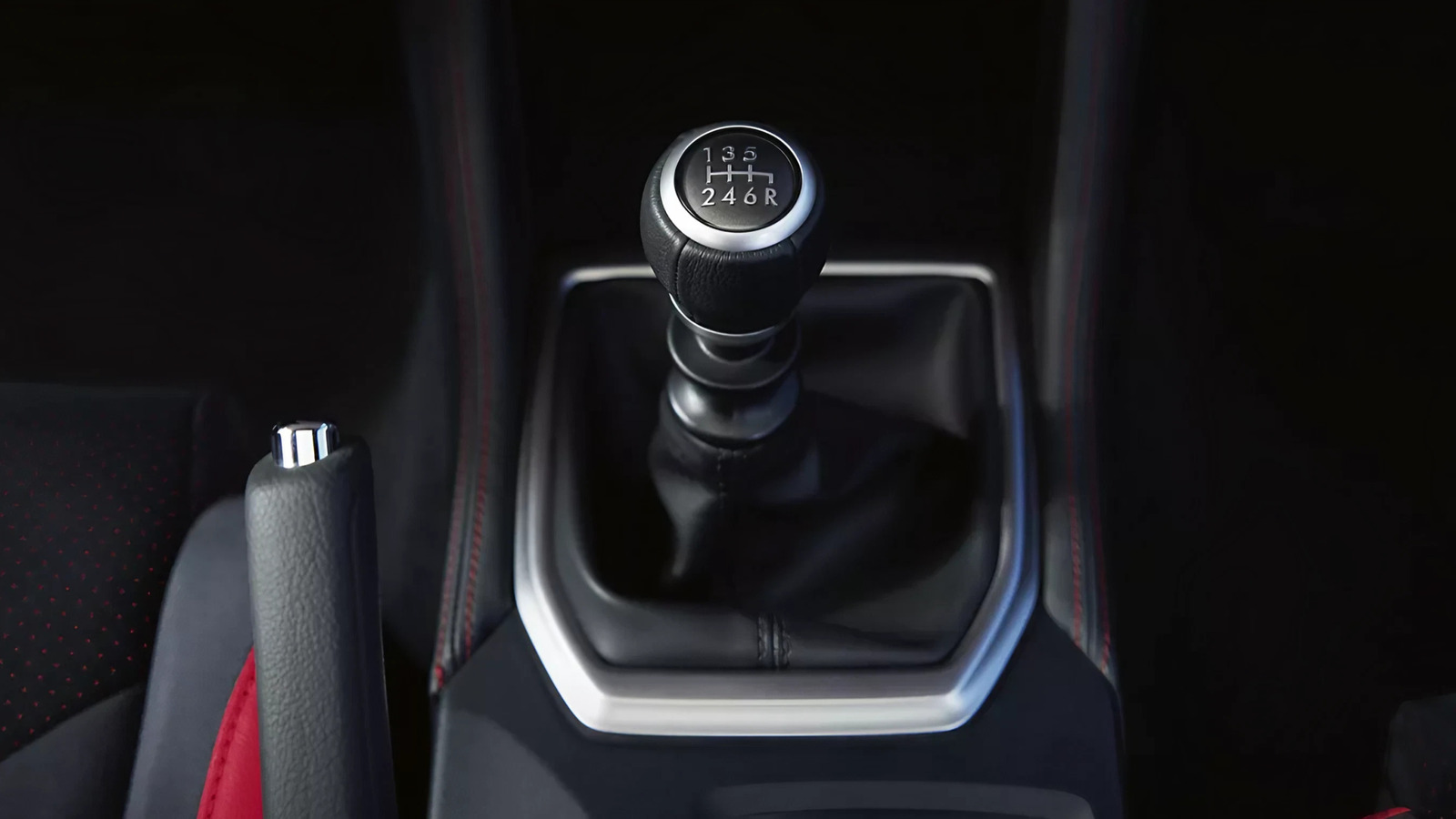
Today, most drivers would agree that automatics offer better mpg compared to manuals. Still, even if manuals only make up about 1% of all new U.S. vehicles built, surely they’ve also seen efficiency gains over the years, right? Well, yes, just not as quickly, according to the Department of Energy. The agency found that model year 2016 was the point where automatics pulled ahead on average mileage. The main reason for this, according to that same analysis, was that automatics kept gaining extra gears year after year. That boosts efficiency because each extra gear gives the engine another chance to run at a speed where it wastes less fuel. Meanwhile, manuals mostly stayed at five or six.
Today, there’s a decreasing list of manual cars available each year, but let’s take the Versa as an example — one of the cheapest cars in the USA – which offered a five-speed manual until Nissan pulled it in 2025. Buyers could previously choose between that five-speed manual and a CVT. A CVT slides through effectively unlimited ratios between its lowest and highest setting, which isn’t too different from having more gears, boosting efficiency. Case in point, while the manual carried an EPA-estimated 30 mpg combined, the CVT posted 35.
Of course, fuel economy and carbon emissions are basically two views of the same measurement. A gallon burned puts out the same amount of carbon dioxide, whichever gearbox burned it. So the transmission burning more fuel automatically becomes less eco-friendly. That said, automatics don’t offer better mileage due to more gears alone.
Why more gears is only half the answer
One example of an automatic offering better mileage without a CVT or more gears is the Subaru BRZ, whose plain automatic offers 25 mpg versus the 22 mpg of its manual variant despite both having an equal six gears. So whatever is going on there, counting gears alone doesn’t explain it. Regardless, it’s clear automatics are more eco-friendly than manuals going by mpg alone.
The reason why cars like the BRZ are able to offer more mileage is that there are several other optimizations that come with automatics, which is actually quite impressive considering automatics are fundamentally less efficient, or are at least supposed to be. Since manuals are simpler, they need fewer parts. In fact, a National Academies committee that reviewed fuel economy technology for federal regulators found a manual loses roughly 4% of an engine’s output on the way to the wheels, against about 13% for a conventional automatic.
And yet, an automatic still manages to pull ahead — mostly because it makes better decisions. That same committee describes the small computer inside an automatic working continuously through every gear it could be in, then picking whichever one puts the engine nearest its efficient zone for the power being asked of it. At the same time, that computer got a better hardware setup to work with, too. As automatics gained gears, their top gears got taller, meaning the engine turned over slower at any given road speed, and slower turning burns less fuel.
Transmission aside, here’s what actually decides how green your car is
It’s fair to think that there might be somewhere else the simplicity with manuals pays off, since it should result in a smaller footprint. After all, something built from fewer materials ought to carry a lighter environmental cost. However, the difference isn’t as major as you might think. While a manual does weigh less than an automatic, the more important factor is the overall weight of the car. And since a gearbox is a tiny fraction of a whole car, those few pounds barely register against the two tons around them. Indeed, the International Council on Clean Transportation (ICCT), an independent group advising governments on vehicle policy, ties a vehicle’s manufacturing emissions closely to its overall weight.
That said, while gearboxes may help decide which variant of a vehicle is more eco-friendly, they pale in comparison to various other factors. One major deciding factor is body style, and SUVs and big trucks, heavy as they are, are the biggest offenders here. In fact, according to the EPAan average new pickup in 2024 returned 20.5 mpg that year against 33.5 for sedans and wagons. To put things in perspective, that 13 mpg spread is more than double the Versa’s transmission gap. Your driving style also plays a role. Aggressive driving costs 15% to 30% of fuel economy at highway speeds and up to 40% in stop-and-go traffic. But it’s the powertrain that perhaps plays the biggest role: the ICCT puts a hybrid SUV’s life-cycle emissions about 27% below a gasoline one.