
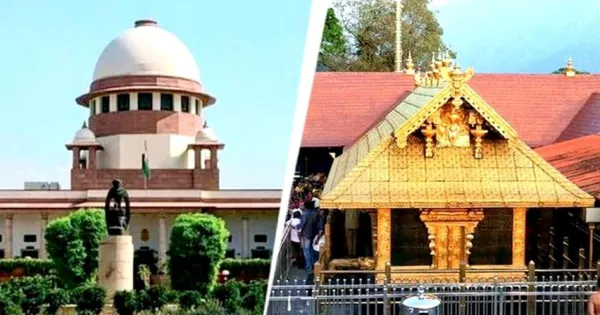
Supreme Court raised questions on religious interference in the hearing of Sabarimala temple case.

New Delhi. The Supreme Court on Thursday said during the hearing of the Sabarimala temple case that if religious practices and customs are continuously challenged in the court, it could have a wide-ranging impact on both religion and society. A nine-member Constitution bench headed by Chief Justice Surya Kant said that if this happens, every religious tradition will start being challenged in the court and this may lead to hundreds of petitions.
During the hearing, Justice BV Nagarathna said that Indian society is deeply connected with religion. In such a situation, if every person starts questioning religious practices, it can have an impact on the social structure. He also said that the biggest question before the court is whether religious reforms should come from within the society and sects or through the interference of the government and the court.
Senior advocate Raju Ramachandran, appearing for the reformists, argued that social and secular activities of any religion do not come within the ambit of full protection under Article 25 of the Constitution. On this, the bench expressed serious concern over the extent and process of challenging religious traditions.
Earlier, the court had also raised questions on the manner of challenging the 1962 decision related to the tradition of boycott in the Dawoodi Bohra community. On May 5, the court had reprimanded the 2006 petition of the Indian Young Lawyers Association, terming it as misuse of the law.
It is noteworthy that on September 28, 2018, the Supreme Court had given its verdict in favor of the entry of women into the Sabarimala temple by a majority of 4-1. The court had said that discrimination against women on religious grounds is against the fundamental rights of the Constitution.

Comments are closed.