
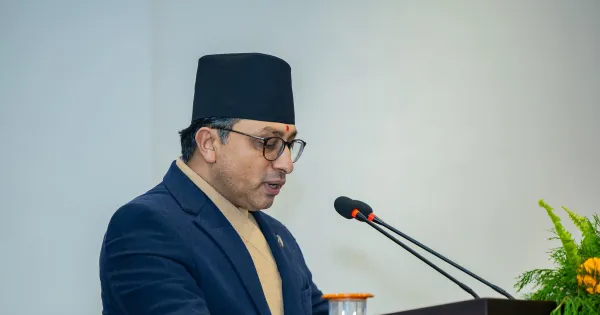

Kathmandu. The government of Nepal has presented a total budget of Rs 2.124 trillion for the economic year 2026-27. The budget announced comprehensive fiscal, tax, economic and sectoral reforms aimed at stimulating economic growth, improving public services and attracting investment. The government has also set a revenue collection target of Rs 1.405 trillion for the upcoming financial year.
Presenting the Union Budget in Parliament, Finance Minister Swarnim Wagle announced comprehensive reform programs related to tax system, capital markets, agriculture, health, infrastructure and good governance. Under the tax reforms, the personal income tax exemption limit has been increased from Rs 6 lakh to Rs 10 lakh.
Its objective is to reduce the tax burden on the middle income group. Capital gains tax on listed securities will now be treated as a final tax, simplifying the tax process for investors and eliminating additional tax liability.
The government has also announced to allow non-residential Nepalese (NRNs) to participate in the secondary securities market. Along with this, reforms will be made in the foreign investment approval process, profit repatriation rules and investment accounting system, so that capital investment flow can be increased.
Under financial discipline, a 21 percent increase in the salaries of government employees has been announced. The minimum salary has been fixed at Rs 40 thousand and the maximum salary has been fixed at Rs 1 lakh.
Rs 32.46 billion has been allocated for chemical fertilizer subsidies in the agriculture sector, up from Rs 28.82 billion last year. Its objective is to ensure continuous supply of imported fertilizers.
The government will also study the possibilities of domestic fertilizer production. Apart from this, Rs 46.42 billion has been allocated for the Ministry of Agriculture and Animal Husbandry Development and Rs 2.07 billion for Agricultural Modernization.
In the health sector, Rs 13.15 billion has been budgeted for social health protection programs to provide better access to essential health services to the vulnerable and deprived sections. The government has also announced systematic policy interventions to address the problems related to landlessness and unsettled settlements within the economic year 2026-27.
In the tourism sector, it has been planned to develop Nepal as a global wellness tourism hub. Luxury hotels and resorts will be encouraged.
Also, regulatory and licensing functions will be separated by reorganizing the Nepal Civil Aviation Authority to ensure better adherence to aviation safety and international standards.
Under cultural conservation, efforts will be made to include sites like Tilaurakot, Gokarneshwar and Janakpurdham in the World Heritage List. Apart from this, Rs 4.3 billion has been allocated for the sports sector, which also includes the provision of lifelong health care support for players who win medals at the international level.
Overall this budget focuses on fiscal balance, investment promotion, expansion of various sectors and structural reforms, aimed at strengthening long-term economic stability and growth.

Comments are closed.