

Raipur. In Chhattisgarh, the state government has taken a major step towards security of personal data of citizens, reliability in digital services and strengthening data governance.
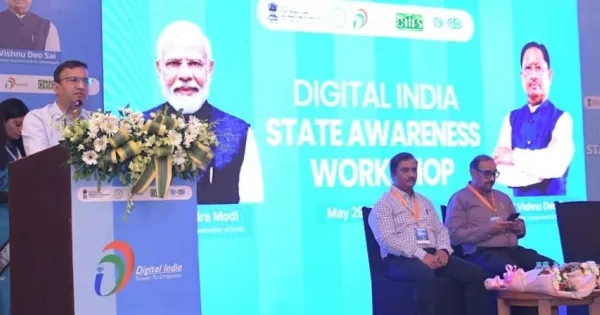
A one-day state level Digital India consultation workshop was organized on Friday in the capital Raipur under the joint aegis of Chhattisgarh Infotech Promotion Society (CHIPS) and National e-Governance Division of the Government of India.
In this workshop, strict and clear guidelines were issued to various government departments regarding effective implementation and technical compliance of the ‘Digital Personal Data Protection (DPDP) Act, 2023’.
Addressing the workshop, CHIPS Chief Executive Officer Mayank Agarwal reiterated the resolve of the state government. He clarified that privacy of citizens’ personal data and expanding secure digital services is the main priority of the government.
The DPDP Act is not just a legal provision, but it is a revolutionary and important change in the governance system towards ‘Privacy by Design’ and ‘Citizen Centric Data Governance’.
Sharing the technological progress of the state, Agarwal said that the Chhattisgarh government has successfully integrated the ‘Seva Setu’ platform with national digital platforms like DigiLocker, Umang and My Scheme.
Through this, citizens are easily getting various certificates and government services digitally. He said that in the coming phase, all departments will have to adopt “Digital by Default” approach, so that more and more services can be linked to the National Digital Public Infrastructure (DPI).
Sunil Jain, Director of National e-Governance Division, New Delhi, underlined the departmental responsibilities in the workshop. He said that the DPDP Act, 2023 defines new and strict data management responsibilities for all government entities.
Strict compliance with this Act will not only bring transparency and accountability in departmental processes, but will also give unprecedented strength to the cyber security system of the state.
P. Rama Rao, senior scientist of National Informatics Centre, Raipur, alerted the departments about data security in the digital age. He said that mobile numbers, email IDs and other personal identification information are the main targets of cyber criminals these days.
To avoid this, he strongly advised all departments to adopt data minimization, log monitoring and security reviews at regular intervals.
Detailed guidance was given by experts in various technical sessions during the workshop. Nitish Kalra from National e-Governance Division presented on key provisions of the Act, role of data fiduciary, consent management and citizen grievance redressal mechanism.
Ashish Jaiswal of CHIPS and Vishal Virmani of National e-Governance Division highlighted the integration of departments, secure document sharing and utility of digital certificates with DigiLocker.
Kirti Gupta and Mahesh Kumar shared strategies to increase the reach of citizen services to the last person through Umang and My Scheme platforms.
At the conclusion of the workshop, Chips’ Joint Chief Executive Officer Anupam Ashish Toppo expressed his gratitude to all the guests and participants.
He announced that based on the important suggestions received from this workshop, a phased departmental action plan of 30, 60 and 90 days will be prepared for all the departments.
Through this scheme, effective compliance of the DPDP Act will be ensured in the state and the expansion of secure digital services will be accelerated.

Comments are closed.