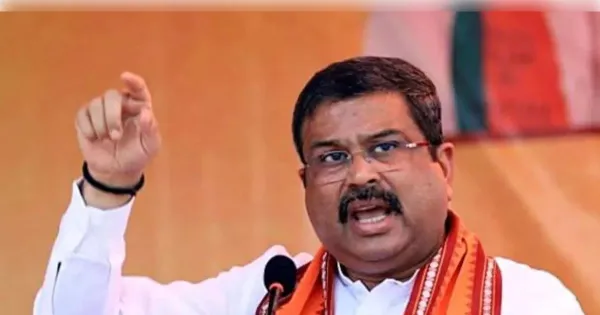
The political battle over Minerals and Minerals (Development and Regulation) Amendment Act, 2026 (MDMR Amendment Act, 2026) has intensified in Odisha. Sambalpur MP and former Union Minister Dharmendra Pradhan has strongly defended the Amendment Act while replying to a letter written by Leader of Opposition in the Assembly and Biju Janata Dal (BJD) President Naveen Patnaik to Odisha MPs.
Dharmendra Pradhan said that political debate is a natural process in a democracy, but misleading the people of Odisha by hiding facts and creating an atmosphere of false fear is not acceptable. He said that as the voice of Odisha in Parliament, the primary responsibility of MPs is to protect the broader economic and structural interests of the state along with national development.
Describing the MDMR Amendment Act, 2026 as a historic step, he said that it will play an important role in promoting economic growth and infrastructure, protecting the state revenue and protecting local industries and common citizens from the pressure of inflation. About 90 percent of the state’s mining revenue will be safe.
Dismissing Naveen Patnaik’s apprehensions that the new law could deprive Odisha of its revenue share, Pradhan said about 90 per cent of the total revenue generated from the mining sector will go directly to the state treasury.
He said that Odisha will continue to receive 110 percent of its auction premium, 15 percent of royalty and the entire amount received under the District Mineral Foundation. Pradhan claimed that the new provisions will boost economic activities in the mining sector while protecting the financial interests of the state.
Mining revenue increased tenfold after 2015 reforms: Pradhan
Dharmendra Pradhan also mentioned the increase in Odisha’s mining revenue during the last decade. He alleged that before 2014, the allocation of mining leases was not done in a transparent manner and as a result, the state’s annual mining revenue remained limited to around Rs 5,000 crore.
According to Pradhan, following the MDMR reforms undertaken by the Prime Minister Narendra Modi-led central government in 2015, the transparent e-auction system was implemented and the royalty rate was increased from 10 per cent to 15 per cent. He claimed that as a result of these reforms, Odisha’s annual mining revenue increased almost tenfold to about Rs 50,000 crore.
Mentioned the pressure on industries due to uncontrolled taxes
On the issue of uncontrolled and arbitrary levy of fees on mineral lands, Pradhan said that this could have an adverse impact on mining and industrial activities in industrial districts like Kendujhar, Sundargarh, Jharsuguda, Angul and Jajpur. He said that such additional charges would have increased the cost of mining and manufacturing units, which could have threatened the employment of lakhs of youth.
Pradhan also said that the increase in cost of minerals would impact sectors like steel, cement, power and coal and ultimately the burden could fall on common middle class families. Due to this, there would be a possibility of increase in the cost of house construction, electricity rates and prices of essential commodities. He said that Section 9D of the amended law places a fixed limit on such uncontrolled taxes, thereby eliminating such risk.
Odisha got more than Rs 37,000 crore under DMF
Pradhan also mentioned the funds provided for the development of mining affected areas of Odisha through the District Mineral Foundation (DMF). He said that since 2015, Odisha has received more than Rs 37,000 crore through DMF for the development of mining areas. This amount is to be used in sectors like drinking water, health, education and rural infrastructure.
However, Pradhan raised serious questions citing the CAG report on the utilization of DMF funds during the previous BJD government. He alleged that Rs 983 crore was spent in 976 villages not affected by mining, while 584 villages directly affected were not given funds for any project. He also claimed that 1,730 projects were implemented without taking the approval of the Gram Sabha.
Dharmendra Pradhan also targeted the former BJD government regarding the ORISED Act. Dharmendra Pradhan also raised questions on the former BJD government regarding the Odisha Rural Infrastructure and Socio-Economic Development (ORISED) Act, 2004.
He said that after the High Court struck down the ORISED Act in 2005, instead of bringing the necessary amendments in the Assembly to plug the legal loopholes, the then government pursued the case in the Supreme Court for 18 years. Pradhan raised the question that when there were legal shortcomings in the law, why amendments were not brought in the Assembly to remove them.
MPs supported the bill in the interest of the state and the youth. Dharmendra Pradhan said that the MPs of Odisha have supported the MDMR Amendment Bill, 2026 in the Parliament keeping in mind the larger interest of the state, industrial development and security of employment of the youth.
He appealed to Naveen Patnaik to rise above party politics and support this law. Pradhan said that this law will prove to be important in Odisha’s economic development, industrial prosperity and ensuring long-term employment opportunities for the youth.