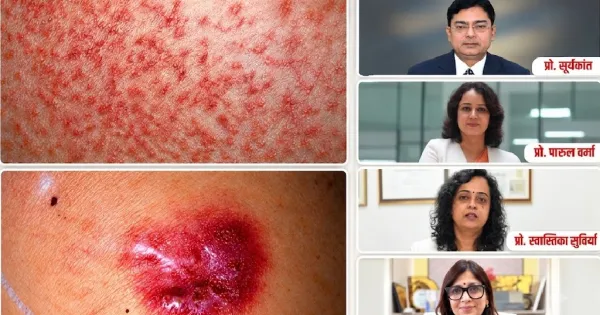
When the name TB is mentioned, lung disease usually comes to mind, but its infection can also affect other parts of the body. TB occurring in the skin is called skin TB or extra-pulmonary TB. A study by KGMU has raised new concerns regarding this disease. Research has found resistance to drugs in some patients suffering from skin TB, which has revealed the need for extra vigilance regarding treatment and diagnosis of the disease.
The Department of Dermatology of King George’s Medical University conducted a study on 54 skin TB patients between 2019 and 2022. The age of these patients was between 20 to 40 years. The study found seven patients in whom drug-resistant TB was confirmed. All patients were HIV negative.
MDR-TB confirmed in six patients
Six of the seven drug-resistant patients in the study were found to be resistant to the main drug used to treat TB. These patients were given treatment tailored to multi-drug-resistant (MDR-TB) TB. In another patient, resistance to the second major anti-TB drug was found and he was treated as per the prescribed standards.
Research revealed that within about a month of starting the treatment, the patients’ condition started showing improvement. In patients who completed the full course of treatment, their skin lesions also healed completely.
The disease appeared in four different forms
Four different forms of skin TB were found in seven patients who were found to be drug-resistant. Three patients were suffering from lupus vulgaris, which can cause red-brown lesions or rashes on the skin. Two patients were found to have scrofuloderma, in which the lumps may drain pus. Tubercular abscess, a pus-filled lump under the skin, was found in one patient and tubercular chancre was found in one patient.
The biggest challenge before the experts was that the number of TB bacteria in skin TB lesions is sometimes very low. In such a situation, it may be difficult to identify the infection and the drug resistance present in it by simple culture test. This is why modern molecular testing plays an important role in such cases.
Just treating it as a skin disease can be costly.
Founder in-charge of KGMU Center of Excellence for Drug Resistant TB, Prof. According to Suryakant, it is not right to consider skin TB as a disease limited to the skin only. Ignoring the possibility of drug resistance can increase problems for the patient. He described tests like gene analysis, histopathology, culture and drug susceptibility testing as important in cases of skin TB.
According to him, if drug-resistant TB is identified in time, the patient can be given the right treatment. This also helps prevent the disease from spreading further.
Normal TB medicine will not help
KGMU Professor Dr. Parul Verma said that the symptoms of drug-resistant skin TB can appear similar to normal skin TB. Therefore, it is not easy to differentiate between the two on the basis of external symptoms only. In such cases, drug resistance status is clarified by tests like CBNAAT and culture.
He said that even if drug-resistant TB is confirmed, if normal TB medicines are given then the expected benefits will not be achieved. The infection can spread beyond the skin and affect other parts of the body as well. The situation can become serious if the infection reaches the chest or brain. Therefore, proper diagnosis and treatment is necessary in the early stages of the disease.
Identification will be better than WGS in future
Dr. Swastika Suvirya, Professor and Head of the Department of Dermatology, KGMU, said that some genetic changes in TB bacteria can make them resistant to drugs. It is not possible to identify all types of resistance with simple molecular testing.
In such a situation, advanced technology like Whole Genome Sequencing i.e. WGS can prove useful in future in more accurate identification of drug-resistant TB bacteria.
If the wound does not heal for four to six weeks, get it checked.
Dr. Jyoti Bajpai, Associate Professor, Department of Respiratory Diseases, KGMU, advised not to ignore long-lasting wounds and ulcers on the skin. He said that if a wound does not heal for four to six weeks despite normal treatment, then the possibility of skin TB should be examined.
He said that the treatment of skin TB can last for nine to 18 months depending on the condition of the patient. There is also a risk of re-emergence of infection in patients with weak immunity. At the same time, leaving the course of medicines incomplete can increase the problem of drug resistance.
Many experts involved in research
Prakriti Shukla, Amita Jain, Urmila Singh, Soumya Singh, Atin Singhai and Srishti Tripathi were also involved in this study. The findings of the study have been published in the Indian Journal of Dermatology, Venereology and Leprology.