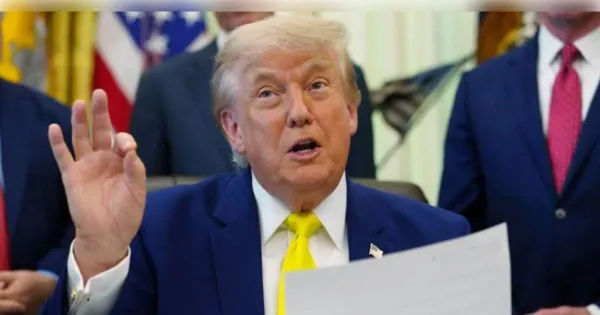
Washington. US President Donald Trump on Friday (local time) ‘Lindsay O. Graham signed the ‘Sanctioning Russia and Iran Act of 2026’ into law.
The new law gives the US President broad authority to impose up to 100 percent import duty (tariff) on countries purchasing crude oil and natural gas from Russia.
According to the British newspaper The Guardian, ‘Lindsay O. It has become law after the US President signed the ‘Graham Sanctioning Russia and Iran Act of 2026’. This week, the House of Representatives approved it by 262-159 votes.
The US administration says its aim is to weaken Russia’s economic capacity and put pressure on its resources related to the Ukraine war.
In this, there is a provision to impose 100 percent tariff on countries purchasing oil and gas from Russia. Under whose scope mainly India and China can come.
The law also gives the President the authority to grant waivers in specific circumstances, including certifying to Congress that the waiver is in the national interest.
The law also extends sanctions on Iran’s energy and weapons sectors for another five years. The bill was passed in the US Senate in August by a wide margin of 86-11.
After this, this week the House of Representatives also approved it by 262-159 votes. The bill has been named after Republican leader Senator Lindsey Graham, who was one of the main supporters of this proposal.
America says that the new law has made the sanctions already imposed on Russia even more stringent. Under which the scope of action has been expanded against Russian government officials, financial institutions, networks related to the defense sector and ships used in energy transportation.
This step of America may impact the global energy market and international trade including India and China.
However, India made it clear even before this development that it will keep its national interests paramount as per its energy needs and will continue to buy oil or energy resources from those countries from where it gets it at the right price without coming under any external pressure.
Especially in the context of the Russia-Ukraine war and the subsequent sanctions imposed on Russia by Western countries, India made its stand very clear on the global stage.
India argues that being a developing country, it has the first responsibility to ensure affordable and uninterrupted energy security for its vast population.
Whereas after it was passed in the House of Representatives this week, China said that it strongly opposes unilateral sanctions which are not based on international law.
Such sanctions are not even supported by the United Nations Security Council. China said that there should be no interference or pressure from third parties in its normal trade and economic cooperation with any country.