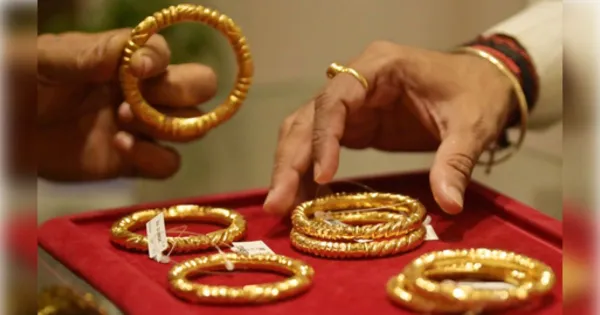
New Delhi. CAIT i.e. Confederation of All India Traders (CAIT) said on Sunday that the effect of Prime Minister Narendra Modi's appeal to avoid non-essential gold purchases for a year is now visible in the import data. The organization said that during April to October 2026, there has been a decline of about 40 percent in India's gold import bill.
Welcoming this, CAT Secretary General Praveen Khandelwal said that during April-October 2026, the country's gold import declined from $ 41.24 billion to $ 24.78 billion. Due to this, India has saved foreign exchange worth about 16.46 billion dollars.
He said this decline in imports reflects the increasing participation of the public in the “nation first” approach of the government. He said that behavioral changes made by consumers in support of national economic priorities are now visible in concrete economic results.
The decline was even greater in October, when gold imports declined from $14.72 billion in October 2025 to $5.51 billion in October 2026, representing a decline of about 62.6 percent on an annual basis.
Khandelwal said that the impact of the appeal made by the Prime Minister in a recent program organized in Lucknow can be clearly seen in these figures. He described this as an example of the growing “Nation First” sentiment among consumers.
He also reminded that India's gold imports have remained at a consistently high level in recent years. In the financial year 2025-26, the country had imported gold worth about $ 71.98 billion, while in the financial year 2024-25 this figure was $ 58.01 billion.
However, looking at the current trends, CAT estimates that India's total gold imports may decline to the range of $35-40 billion in the financial year 2026-27, which will be much lower than the previous financial year.
CAT National President B.C. Bhartia said the Prime Minister's appeal was not limited to just reducing gold purchases, but was also aimed at encouraging judicious consumption in the national interest. He said the positive response from the public shows that people are becoming more aware of the country's economic priorities.
At the same time, Pankaj Arora, National President of All India Jewelers and Goldsmiths Federation (AIJGF) said that gold is an important part of Indian culture, marriage tradition, family savings and social life. But a large part of the country's demand is met through imports, which puts huge pressure on the foreign exchange.
He said exercising restraint in gold purchases can help India manage foreign exchange reserves better and keep the trade deficit under control. It will also strengthen the overall economic stability of the country.