
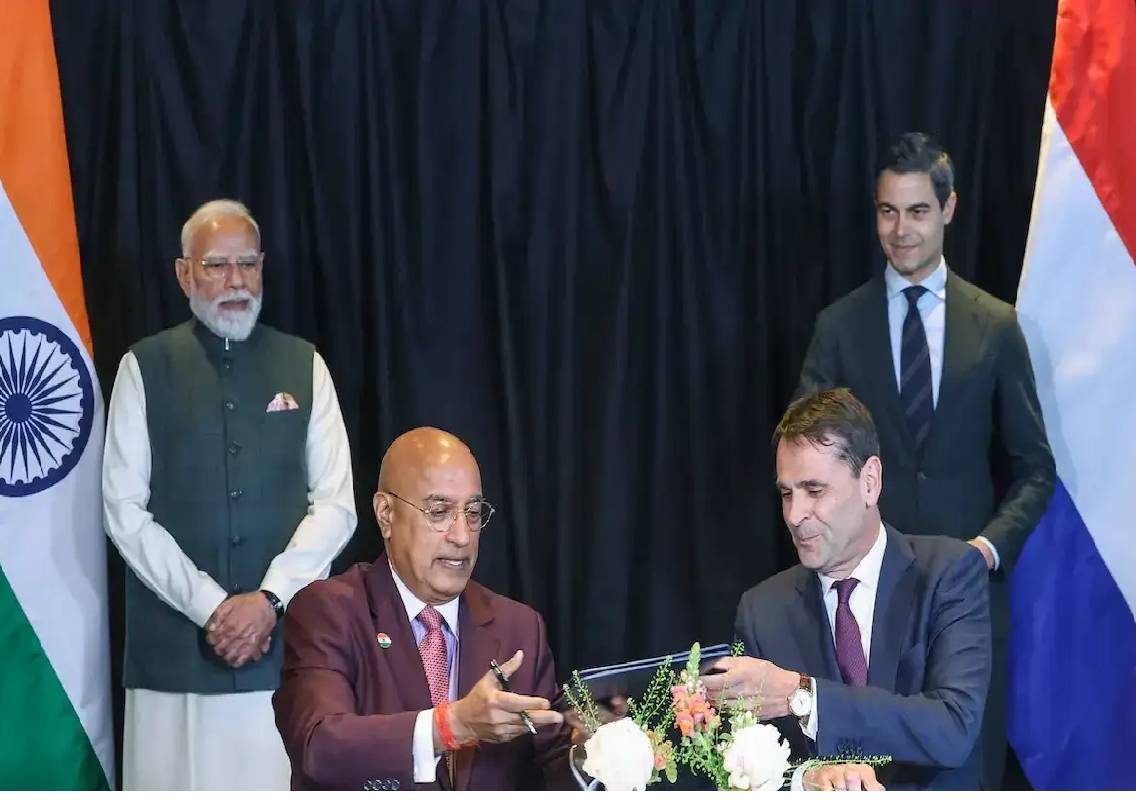

The Hague: A major step in India’s semiconductor ambitions was taken on Saturday as Tata Electronics signed a Memorandum of Understanding (MoU) with ASML in the presence of Prime Minister Narendra Modi during his official visit to the Netherlands.
The agreement is seen as a significant boost to India’s semiconductor ecosystem, which is currently being developed as part of the country’s long-term technology and manufacturing strategy.
Prime Minister Modi is on a multi-nation tour, with the Netherlands being the second stop, followed by Sweden, Norway and Italy.
Tata–ASML partnership strengthens semiconductor roadmap
The MoU between Tata Electronics and ASML focuses on cooperation in advanced lithography technologies, which are critical for semiconductor chip manufacturing.
ASML is one of the world’s most important suppliers of semiconductor equipment, particularly extreme ultraviolet (EUV) lithography systems used in advanced chip production.
Industry leaders believe the collaboration will support India’s efforts to establish its first major semiconductor fabrication ecosystem.
According to ASML CEO Christophe Fouquet, the partnership is intended to provide technical support, technology access and expertise to help strengthen India’s semiconductor capabilities.
India pushes for global semiconductor investments
During the visit, Prime Minister Modi held discussions with top executives of leading Dutch companies across sectors including energy, ports, agriculture, healthcare and technology.
He also urged global firms to invest in India’s rapidly expanding manufacturing and technology ecosystem.
Modi highlighted India’s reforms in taxation, labour laws and governance aimed at improving ease of doing business and attracting foreign investment.
India positions itself as global manufacturing hub
The Prime Minister emphasised that India is becoming a major global destination for manufacturing and innovation due to its scale, talent pool and policy stability.
He said the country’s infrastructure development and digital transformation are helping position India as a competitive global manufacturing hub.
Modi also noted that sectors such as space, mining and nuclear energy have been opened to private participation, signalling broader economic liberalisation.
Semiconductor sector remains strategic priority
India has been actively working to develop a domestic semiconductor ecosystem to reduce dependency on imports and strengthen supply chain resilience.
The collaboration between Tata Electronics and ASML is expected to support India’s first semiconductor fabrication plant initiative.
Experts say such partnerships are crucial for building technical expertise, especially in advanced chip manufacturing technologies that require high precision and global collaboration.
Strengthening India–Netherlands economic ties
The agreement also reflects deepening economic cooperation between India and the Netherlands, particularly in high-tech industries.
Both sides have expressed interest in expanding collaboration in emerging sectors such as clean energy, artificial intelligence and advanced manufacturing.
With semiconductor demand rising globally, India is positioning itself as a key player in the future of chip production.
The MoU is expected to be a stepping stone toward larger investments and technology partnerships in the coming years.

Comments are closed.