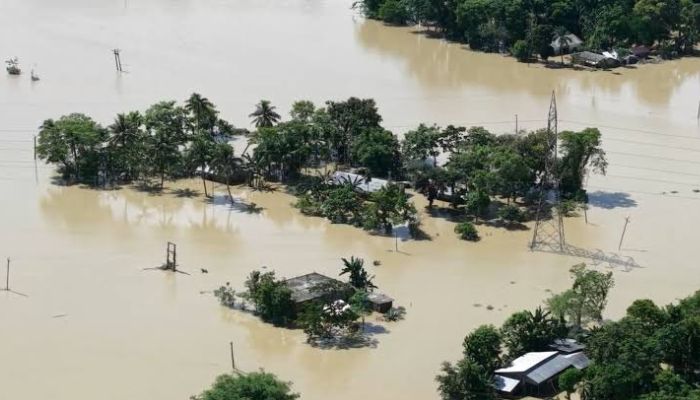
The northeastern state of Assam is hit by natural calamities every year, but this time the situation has been extremely severe and terrifying. Heavy rains in the hills of Nagaland led to flash floods in the Dikhou river, inundating several districts including Shivsagar and Charaidev. So far 103 innocent people have lost their lives in this natural disaster and more than 7 lakh citizens have become homeless. With thousands of people still sheltering in relief camps, the horrific disaster has shaken the economic and social fabric of the entire state.
Heavy destruction in villagesEven after the flood waters receded, traces of devastation and painful scenes are clearly visible in the affected areas. In villages like Natun Basti, Hilni and Singel Basti, thick mud and debris have accumulated inside people’s houses, completely destroying leftover grains, clothes and children’s precious books. The walls of many houses have collapsed and a large number of dumb animals have been dragged into the water. During the initial crisis, local sailors risked their own lives to save about 1,500 lives by boat.
Agriculture and EducationThese devastating floods have not only severely affected residential houses but also the state’s agriculture and the future of millions of children. According to reports, crops on more than 10,884 hectares of fertile land have been completely destroyed, threatening the livelihood of farmers. Even the education of young children has come to a halt as books and school supplies have been damaged in the flood waters. At present, around 49,000 displaced people are living in difficult conditions in 125 relief camps in the state and massive assistance is required to resettle them.
Reconstruction is a major challengeAssam Chief Minister Himant Biswa Sarma has said that a huge sum of over Rs 1,000 crore will be required to compensate the extensive damage caused by the floods and to properly rehabilitate the affected families. The biggest responsibility now lies with the government and various relief agencies not only to deliver relief materials, but also to repair broken houses, restore employment and resume education for children. Getting out of this serious crisis and bringing normal life back on track is proving to be the biggest and toughest challenge for the system at this stage