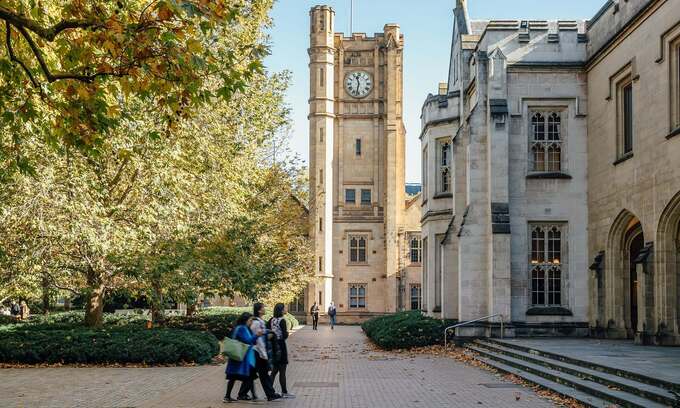
The University of Melbourne has circulated a workforce reduction proposal to various departments in recent weeks, outlining plans to eliminate 179 positions.
The cuts are expected to mainly affect fundraising and alumni relations, information technology, financial planning, and biomedical sciences. Most affected employees work in administrative roles, The Sydney Morning Herald reported, citing the university as saying its recent financial results are “disappointing and unsustainable”.
The move comes after the university’s operating expenditure exceeded revenue by 3.7%, or A$124 million (US$84 million), last year. It expects to remain in deficit this year, marking a fifth consecutive year of financial pressure.
A university spokeswoman said Melbourne had already taken measures to reduce “discretionary” spending and “unnecessary” travel, after suspending work on its $2 billion Fisherman’s Bend campus last year.
“The changes affecting international students… have put considerable financial pressure on universities across the country,” she told Times Higher Education (THE).
|
The University of Melbourne as seen in a photo on its Facebook page. |
Figures from Australia’s Department of Education show that international education is the country’s fourth-largest export industry, contributing nearly A$54 billion to the economy in the 2024–2025 academic year. However, international student numbers as of August had fallen by about 10% from a year earlier.
“As university revenue falls due to lower international student revenue this will inevitably cause job losses. More universities will announce cuts over the coming months,” Andrew Norton, a higher education policy expert at Monash University, told Brisbane Times.
According to THE, several universities have announced or forecast budget deficits ranging from A$90 million to A$250 million.
Adelaide University has proposed a voluntary early retirement scheme and flagged a possible future round of voluntary redundancies to cope with a projected A$90 million shortfall in earnings from new international students.
Charles Sturt University has also warned it may need to cut net staffing levels by about 100 full-time positions due to a plunge in international tuition fee revenue “that used to subsidize our operations.”
Deakin University plans to offer voluntary redundancies to address a projected 16% slump in revenue.
Its acting vice-chancellor, Susan Elliott, told THE that the move was one of several “early” measures to address a projected revenue decline of A$200 million to A$250 million by 2029.
“That scale of difference requires a considered, substantive change in the way we operate, plan and prioritize,” she told staff. “International student numbers have fallen across the sector, and the change is structural.”
Earlier this year, the Australian government announced it would maintain its target of 295,000 new international student commencements in 2027, unchanged from last year, despite a continued slowdown in overseas student visa applications under tighter migration policies.
In a joint press release, Minister for Education Jason Clare, Minister for Skills and Training Andrew Giles, and Assistant Minister for International Education and Citizenship, Customs and Multicultural Affairs Julian Hill said maintaining the National Planning Level would provide “stability and certainty” while keeping Australia’s international education sector resilient, high quality, and globally competitive.
The announcement follows a recent 25% increase in student and temporary graduate visa fees, raising the Subclass 500 student visa application fee to A$2,500, the highest among the “Big Four” study destinations, including the U.S., the U.K. and Canada.
The changes also introduced a separate A$2,050 fee for standalone English Language Intensive Courses for Overseas Students (ELICOS), reduced fees for applicants from ASEAN countries and non-award courses, and retained lower fees for students from Pacific nations and Timor-Leste.
International student numbers in Australia totaled 845,933 in the 2025 calendar year, down 1% from 2024, according to Department of Education data. China remained the top sending market, followed by India, Nepal, Vietnam, and the Philippines.