
Why is Balochistan demanding independence? Kalat was independent in 1947 – had Jinnah abandoned his own client?

Balochistan is once again in the eyes of the world. Amidst new claims of independence from separatist organizations and increasing violence, 78-79 years old history is again in the news. The question is arising whether Balochistan was ever a part of Pakistan? This debate begins in 1947, when the Kalat state declared itself independent on 11 August. The surprising thing is that Mohammad Ali Jinnah, who had once put forward the legal side of the independent constitutional identity of Kalat, was seen standing in favor of its merger a few months after the formation of Pakistan.
After all, how did Kalat join Pakistan? Was this a legal process or a decision taken under pressure? Today, amidst the new demand for independence of Balochistan, let us understand the story of this entire controversy.
Why is Balochistan in discussion again?
Balochistan is once again in the headlines at the international level. In recent days, separatist organizations have issued statements on social media under the name “Republic of Balochistan”, claiming that they have established a parallel administration. These claims have not been independently confirmed, but after this the security operation has intensified in Balochistan, Pakistan’s largest province. These incidents have again brought the merger of Kalat State into Pakistan in 1947-48 and the controversy related to it at the center of discussion. Even today, Baloch nationalists claim that their independence was snatched away, while Pakistan considers it a legitimate merger.
Kalat Palace of Mir Ahmed Yad Khan
What is Balochistan and how was Kalat different from it?
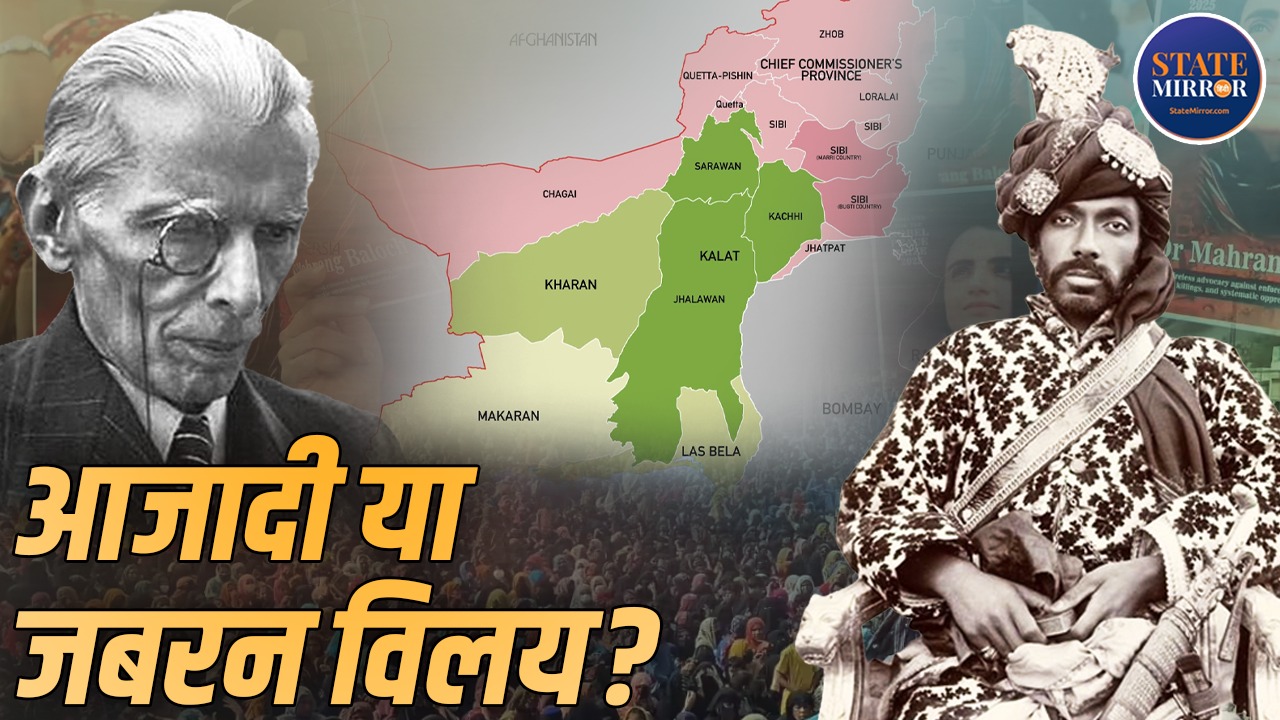
Balochistan is not a single country or historical principality, but a vast geographical and cultural region of South Asia. Most of it is in Pakistan today, while some of its areas are also spread in Iran and Afghanistan. In 1947, present-day Baluchistan was divided into several different administrative units. The largest and most influential princely state among these was Kalat. Apart from this, princely states like Las Bela, Kharan and Makran and British Baluchistan which was under direct British rule also existed.
Why was the constitutional status of Kalat different?
Unlike most of the princely states of British India, Kalat had a treaty-based relationship with the British Crown. This was the reason why Kalat’s ruler Mir Ahmed Yar Khan claimed that after the departure of the British, his kingdom would automatically become independent. Due to this special status, the case of Kalat was considered different from other princely states of India and later it also became its biggest political and legal debate.
11 August 1947: When Kalat declared itself independent
Following agreements reached just before the end of British rule, Kalat declared its independent status on 11 August 1947. Later, Mir Ahmed Yar Khan also created a two-house parliamentary system to run an independent government. His objective was to establish Kalat as an independent state. However, this independence could not last long and after a few months the conflict with Pakistan started.
Mohammad Ali Jinnah and Mir Ahmed Yar Khan
Did Jinnah ever stand in favor of Kalat?
This is the most interesting aspect of this entire controversy. Mohammad Ali Jinnah, the founder of Pakistan, was a renowned barrister before the creation of Pakistan and served as legal advisor to the Khan of Kalat. Jinnah’s argument was that Kalat was not an ordinary princely state, but a treaty entity with the British Crown. Therefore, after the end of British rule, it should be considered an independent state. This was not the advocacy of any criminal or civil case, but the legal aspect of the constitutional status of Kalat.
Then what happened that Jinnah’s attitude changed?
After the formation of Pakistan, the situation started changing rapidly. The new government wanted the strategically important Kalat (Balochistan) to become a part of Pakistan. Negotiations continued for several months, but no agreement could be reached. Meanwhile, Pakistan signed separate merger agreements with Kalat’s neighboring states – Makran, Las Bela and Kharan. Due to this, the geographical position of Kalat weakened and political pressure increased on it.
Could Kalat have become a part of India?
According to historical documents and some research, the ruler of Kalat had also tried to establish contacts with India. He had sent envoys to India to explore the possibility of merger or at least defense cooperation. However, the then Prime Minister of India Jawaharlal Nehru did not accept this proposal. It is believed that due to geographical distance, military challenges and complex political circumstances of that time, India did not pursue this option.
How did Kalat join Pakistan?
In March 1948, tension between Pakistan and Kalat reached its peak. On 27 March 1948, Khan Mir Ahmed Yar Khan signed the Instrument of Accession and the next day Pakistan announced the annexation of Kalat. Pakistan says that this was a legal and legitimate process. On the other hand, Baloch nationalists claim that this decision was taken under military and political pressure. The controversy continues from this point till today.
Did Jinnah betray Mir Ahmed Yar Khan?
This question is the subject of debate today. Baloch nationalist historians say that Jinnah first gave legal arguments in favor of the independence of Kalat and later supported the merger of the same Kalat after the formation of Pakistan. That’s why they consider it ‘cheating’.
At the same time, Pakistani historians argue that this decision was taken due to the changing political situation and national security needs and the merger was completely legal. Therefore the term “deception” is a historical interpretation, not a universally accepted fact.
Why did the first Baloch rebellion break out after merger?
Soon after Kalat acceded to Pakistan, Khan’s younger brother Prince Abdul Karim started an armed rebellion. This is considered to be the first major incident of separatist movement in Balochistan. After this, many insurgencies took place at different times and Balochistan became one of the most sensitive security challenges of Pakistan.
Why has the controversy not ended even today?
Balochistan is the largest province of Pakistan and rich in natural resources. There are large reserves of natural gas, copper, gold and other minerals here. Baloch organizations allege that local people do not get the benefit of resources and political rights are also limited. On the other hand, the Pakistani government says that it is continuously investing in development projects, infrastructure and security and blames separatist and extremist organizations for the violence.
What is the whole controversy about?
To understand the current situation of Balochistan, it is important to know the history of 1947-48. One side says that Kalat was an independent unit, which was merged with Pakistan under pressure. The other side calls it a legal and constitutional process. This is the reason why even after seven decades, the question of Balochistan remains not just a security issue but a debate related to history, constitution, identity and political rights.

Comments are closed.