
Led by Bangkok Governor Chadchart Sittipunt, the project is targeted for completion by 2030, according to a recent announcement by the Bangkok Metropolitan Administration.
The bridge, which will connect pedestrian routes to the MRT network, is envisioned as an urban landmark that will promote a sustainable pedestrian ecosystem while linking the two historic districts Songwat and Khlong San, according to The Nation.
|
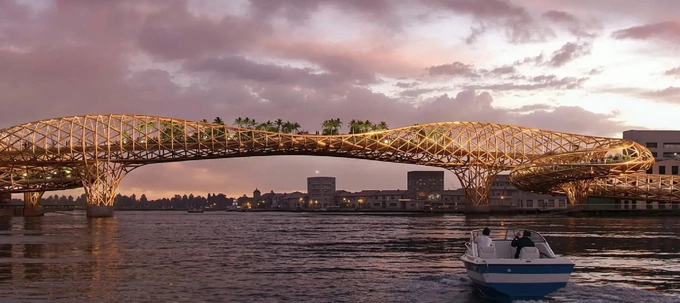
A concept image of a pedestrian bridge crossing the Chao Phraya River in Bangkok. Photo courtesy of the Bangkok Metropolitan Administration |
Crossing the Chao Phraya River has long posed challenges for pedestrians and cyclists. Existing crossings are largely designed for heavy vehicle traffic, while ferry services operate only during limited hours, leaving non-motorized commuters with few and often unsafe alternatives.
Governor Chadchart said the project supports his administration’s policy of developing people-focused infrastructure alongside the city’s major road network.
“I want the city to have a landmark, a bridge across the Chao Phraya River specifically for pedestrians and cyclists, as there are already plenty of bridges for cars,” Chadchart said.
“This will create a context for the surrounding community economy and help reduce disparities between the Phra Nakhon and Thonburi sides, which were often overlooked in the past.”
The bridge will be 300 meters in length and up to 10 meters wide. Project planners said no additional land expropriation will be required, minimizing disruption to long-established riverside communities.
 |
|
A concept image of a pedestrian bridge crossing the Chao Phraya River in Bangkok. Photo courtesy of the Bangkok Metropolitan Administration |
The design also includes plans to use rooftop spaces on connecting buildings for community shops and street food vendors to support local businesses.
Pichai Wongwaisayawan, dean of the Faculty of Architecture at Bangkok University, described the bridge as essential “social infrastructure” that connects people, cultures, and transportation systems rather than simply providing a physical crossing.
“The true value of this bridge lies not in the structure itself, but in its ability to connect all transport systems together – be it trains, boats, walkways, or bicycles,” Pichai said, as cited by Bangkok Biz News.
“Bangkok today does not lack landmarks; it lacks an interconnected network of public spaces,” Pichai said. “If this bridge serves merely as a destination, it will succeed to a certain degree. But if it marks the beginning of a network of riverfront walkways connecting communities and public transit, it will become a lasting urban legacy.”