
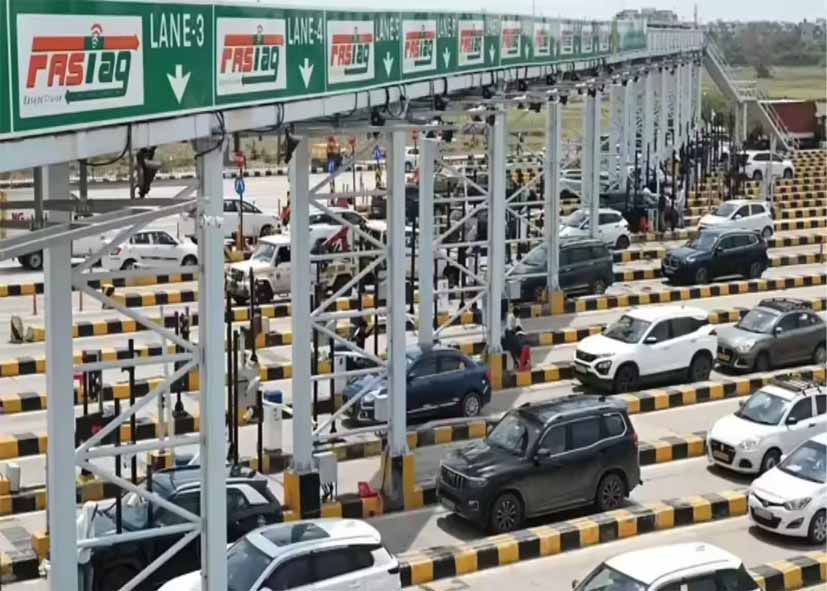
Barrier-free toll plaza inaugurated in Delhi, now vehicle will not have to be stopped for payment

Giving great relief to the people commuting in the capital Delhi, the Central Government has started the national capital’s first ‘Multi-Lane Free Flow’ (MLFF) tolling system. After the implementation of this new system, drivers will not need to stop at toll plazas and pay tax. Union Road Transport and Highways Minister Nitin Gadkari on Monday inaugurated this state-of-the-art system at UER-II toll plaza located in Mundka-Bakkarwala, Delhi. Toll collection will be done completely digitally through MLFF technology. In this, vehicles will not have to stop in front of any barrier. High-speed cameras and sensors will identify the vehicle and deduct toll charges directly. This is expected to provide relief from long traffic jams at toll plazas.
During the inauguration, Nitin Gadkari himself started this technique by removing the barrier of the toll gate with his own hands. Under this new system, drivers will no longer have to stop to pay toll. With the help of high-speed cameras and sensor based technology, toll fee will be automatically deducted as the vehicle passes. On this occasion, Gadkari said that in future this modern system will also be linked with advanced technologies to enforce traffic rules. After this, this system will not be limited to just toll collection, but will also be able to automatically issue e-challan for not wearing seat belt, using mobile phone while driving and violation of other traffic rules.
He said this is the beginning of the expansion of the hassle-free electronic toll collection system in Delhi, the main objective of which is to reduce traffic jams and improve the efficiency of the highways. The government believes that this technology will reduce travel time, save fuel and also reduce pollution.
Delhi-NCR’s first barrier-free toll plaza
Giving information on social media, Nitin Gadkari said that the MLFF system provides a seamless and contact-less tolling framework. This technology combines ‘Automatic Number Plate Recognition’ (ANPR) with the FASTag based electronic toll collection system, which will enable automatic toll collection with minimum human intervention. Under this new system, vehicles will not need to stop at toll plazas. High-speed cameras and sensors will directly deduct the toll amount by scanning the vehicle number plate and FASTag. This is expected to reduce traffic jams, reduce travel time and save fuel. The Union Minister also said that in future this technology will also be integrated with systems related to following traffic rules. Through this, e-challans can be issued automatically for not wearing seat belt, using mobile phone while driving and violation of other traffic rules.
He said that this is an important milestone towards digital national highway system. With this technology, travel will be faster and easier, traffic jams will be reduced, fuel will be saved and pollution caused by vehicles will also be reduced. The Union Minister further said that this initiative is in line with the Prime Minister’s vision of developing a technology-based, efficient and user-friendly highway network across the country.
Till now 17 such toll plazas have been started in the country.
According to the information received, the central government plans to implement this barrier-free technology at about 1,300 toll plazas in different phases by the end of December 2026. Under this new system, drivers will not have to stop at the toll plaza and toll fee will be automatically deducted as soon as the vehicle passes. The Union Minister for Road Transport and Highways had recently inaugurated this state-of-the-art system at Mundka Toll Plaza located on Urban Extension Road-II (UER-II) of Delhi-NCR. It has become the first completely barrier-free toll plaza in Delhi-NCR. Meanwhile, giving information, Santosh Kumar Yadav said that at present 17 toll plazas in the country have been operationalized under this new system, while the tender process (bidding) is going on to implement it at 107 other places.
The country’s first system was started in Gujarat
India’s first fully operational MLFF system was launched this month at Bharuch toll plaza in Gujarat. The initial results found there revealed that this technology has made the movement of vehicles faster and easier than before. Besides, improvement has also been recorded in the toll collection system.
Big success achieved in pilot project
The initial results of the ‘Multi-Lane Free Flow’ (MLFF) based barrier-free toll system being implemented across the country have emerged as very positive. National Highways Authority of India (NHAI) says that this new technology has not only reduced traffic jams, but has also recorded a significant increase in toll collection. Giving information, Santosh Kumar Yadav said that the benefits of MLFF system are clearly visible in the initial phase itself. He said that after the implementation of this technology, an increase of about 10 percent has been recorded in toll collection. He said that earlier during peak traffic hours, vehicles had to wait for at least five minutes at the toll plaza, but now after the implementation of the barrier-free system, this wait has almost completely ended. This has made the movement of vehicles faster and easier. Yadav also said that among the drivers who were sent e-notices for non-payment of toll, about 50 percent of the users deposited their dues within 72 hours and were saved from additional fines.
Follow the LALLURAM.COM MP channel on WhatsApp

Comments are closed.