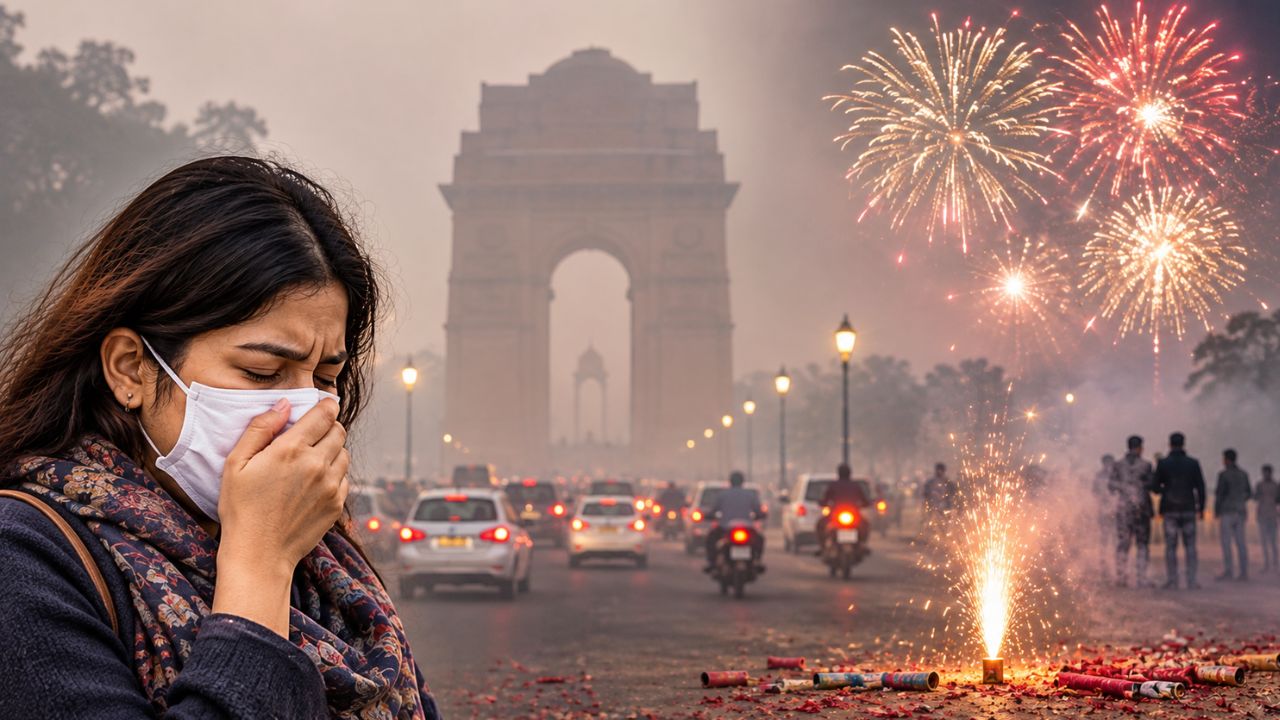
On Saturday evening, a day before Diwali, the pollution level in Delhi reached its worst level in the last 10 years. Today the situation is likely to get worse. On the other hand, incidents of stubble burning in Punjab and Haryana reached the highest level of this season on Saturday. According to information received from the satellite of Indian Space Research Organization ISRO, an increase in cases of stubble burning was recorded for the 10th consecutive day.
The air calmed down after evening on Saturday and within two hours of the start of bursting of crackers at 8 pm, the city's air became 30 per cent more polluted than the previous night. All this happened even before the night of Diwali, when maximum number of firecrackers are burnt in the city.
Also read: Where were most rules broken in the investigation to stop pollution? Know the condition of Delhi NCR
AQI reached 369
The air quality index (AQI) at 4 pm on Saturday was 369, which falls in the 'very poor' category on the Central Pollution Control Board's (CPCB) scale of 0-500. This is the worst level a day before Diwali since 2016, when the AQI was 404. This index, which gives the average of the last 24 hours, was 261 on November 1, which has now increased to 369. The pollution level increased first thing on Saturday morning.
Between 10 and 11 am, the average level of PM2.5 (very fine particles present in the air that can penetrate deep into the lungs) was recorded at 295 micrograms per cubic meter at 59 monitoring stations in Delhi. At 36 of these stations, the level was above 250, which is the beginning of the 'severe' category for PM2.5 according to the CPCB.
Where and how much pollution?
Saturday afternoon was the best this week, as the mixing layer (mixing layer) returned to normal levels after being half the normal for four days. Less mixing layer means there is less space in the air for pollution to spread. However, despite this, the pollution level remained higher every hour from 11 am to 5 pm on Saturday as compared to Friday.
As evening approached, firecrackers started burning. The average level of PM2.5 at 7:45 pm on Saturday at 55 monitoring stations in Delhi, based on Central Pollution Control Board (CPCB) data, was 177 micrograms per cubic metre. It increased to 208 at 8 pm. After this, the pollution level kept increasing every 15 minutes and reached 289 by 10 pm. At the same time, during the same time on Friday, the level of PM2.5 was between 202 to 229. Information about this increase in pollution on Saturday evening will also be revealed in the bulletin released on Sunday.
The biggest increase in pollution was seen in residential areas like Punjabi Bagh. Here the PM2.5 level almost tripled in just one hour. It was 208 at 7 pm, which increased to 593 micrograms per cubic meter at 8 pm. Similarly, PM2.5 level was recorded at 621 at 9 pm in RK Puram. This was more than double the level recorded at the same time on Friday.
At 9 pm on Friday, the PM2.5 level did not exceed 400 at any monitoring station, while on Saturday it was recorded more than 400 at 9 stations. By 10 pm, PM2.5 levels had crossed 250 at half the monitoring stations. Whereas, the pollution level in Mundka was recorded at 718 micrograms per cubic meter.