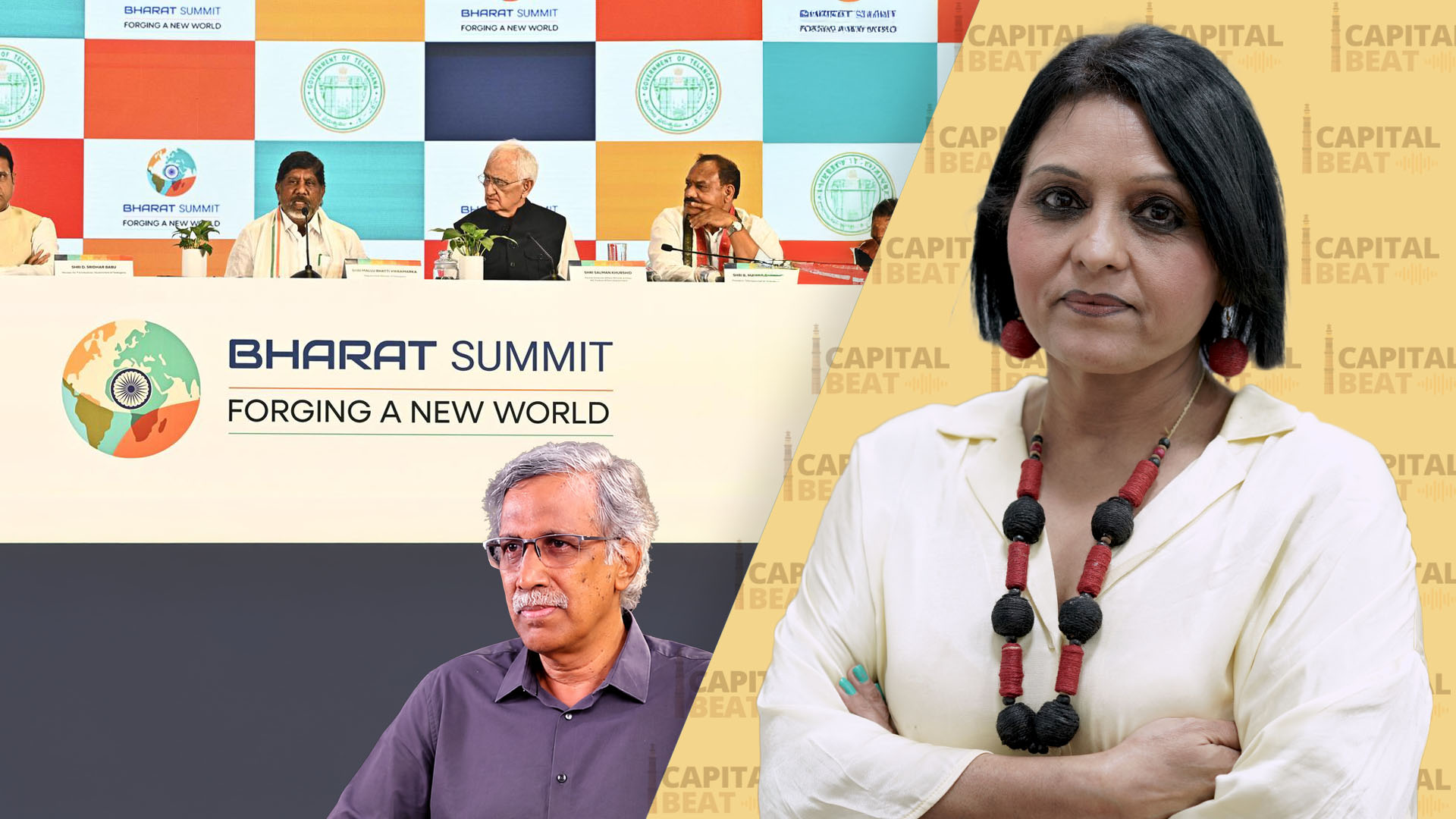
In this conversation on Capital Beat, S Srinivasan, The Federal‘s Editor-in-Chief, speaking from Hyderabad, discusses Bharat Summit’s objectives, its political messaging, the controversy over visa cancellations and the challenges before Congress in bringing together diverse ideological forces.
Edited excerpts.
What is Congress trying to achieve through Bharat Summit? The summit has brought together delegates from several countries. How has the organisation been so far, and what has been your experience since the inaugural session?
It has been a very well-organised conference. Normally, when I have attended conferences organised by the Congress party, I have found a lot of chaos and confusion. But this time, I must say, the conference is impressive.
The venue is in Hyderabad’s HITEC City, and the surrounding infrastructure is very impressive. The summit is being held in a large convention centre, and the arrangements have been made with clockwork precision.
However, when the proceedings began this morning, there was a setback. You could see the organisers running around because many delegates expected to arrive at the airport had not turned up.
As you mentioned, the organisers have put the number of affected delegates at around 113 to 116. They said these participants’ visas were cancelled at the last minute. Shashi Tharoor also said this could have been the handiwork of the Ministry of Home Affairs. He questioned the legal basis for such a decision.
This controversy cast a shadow over the proceedings that were scheduled for the morning. The conference started with some delays, but once the sessions began, the discussions got underway across several conference halls.
There are essentially two parallel conferences taking place. One is the Bharat Summit, which deals primarily with global issues, foreign policy, climate change, artificial intelligence and economic policies. The other focuses more on Telangana, positioning the state as an investment destination and showcasing its development potential.
I spent considerable time attending the first set of discussions to understand what the organisers are trying to achieve and the conference’s broader objectives.
Also read: Rahul Gandhi accuses PM Modi of tapping his phone, renews debate challenge
One of the stated objectives is to present an alternative foreign policy vision from India and explore ways of collaborating with progressive forces across the world. What stood out in the inaugural session, particularly in the way Rahul Gandhi was projected?
One of the conference’s stated objectives is to present an alternative foreign policy vision from India and suggest ways to collaborate with progressive forces globally. That is particularly interesting.
The first session was chaired by former external affairs minister Salman Khurshid, who is also the chairperson of the Congress party’s Foreign Affairs Department. It began with a video that was quite impressive. It was a short film of about three to four minutes, but it was very well produced.
What was particularly interesting about the video was the projection of Rahul Gandhi. It began by discussing India’s foreign policy and the legacy of Jawaharlal Nehru… as the video progressed, Rahul Gandhi increasingly took centre stage.
It moved from Nehru directly to Rahul Gandhi. There were visuals of Rahul participating in the Bharat Jodo Yatra, including in Jammu and Kashmir and parts of southern India. There were also images of him participating in various agitations.
There was only one picture of Priyanka Gandhi Vadra, in which she was seen lying on the ground during a protest in Delhi. Otherwise, the visuals were predominantly of Rahul Gandhi. Even during the deliberations, Salman Khurshid referred to 2029. There is clearly an attempt to project Rahul Gandhi as a potential prime ministerial candidate and pitch him directly against Prime Minister Narendra Modi.
That seems to be the effort, and it was quite evident from the inaugural session itself.
Also read: Can Sonia Gandhi fix broken Congress-DMK ties? What N Ram says
Congress says it wants to collaborate with progressive forces across the world. But there seems to be some ambiguity about what constitutes a progressive force. Congress itself is largely considered a centrist party. Is there any clarity on the ideological definition of progressivism that the party is trying to establish?
That is a very interesting question.
If you look at the recently concluded midterm elections in the United States, the Democratic Party had several progressive elements within it. In the American context, progressive generally refers to the left of centre, with some groups taking more pronounced positions on the left.
When the election results came out, the Democrats received considerable support and votes. Candidates representing progressive elements also won, but their vote share and representation were comparatively lower. That is one of the things we observed in the United States.
However, in the Indian context, there certainly needs to be greater clarity about what the term progressive means.
At times, even the BJP describes itself as a progressive party because of the development activities it has undertaken, such as building roads and constructing bridges. But if you look at the people attending this conference, several left-leaning intellectuals and thinkers are present.
For instance, Jayati Ghosh chaired the economic agenda session, and Thomas Piketty was also expected to participate. I believe he may have joined later via video call, though I am not entirely sure. Several social democrats from different countries, including France and other European nations, were also present.
So, the Congress party will have to define what it means by progressivism. It has said that it wants to evolve new ways of working with progressive parties globally. If that is the objective, it needs to explain the ideological framework behind it.
At the end of the day, Congress is largely a centrist party. It is also a big-tent party that tries to accommodate different ideological positions.
Rahul Gandhi himself has used the expression Shivji ki baraat to describe this approach, suggesting that all kinds of people are welcome to join the larger political movement.
He made that point during an agitation in Delhi. But when the party attempts to create an ideological framework through a conference of this nature, it has to clearly explain what it means by progressivism and how it intends to bring these different forces together.
I think this is only the beginning. We will have to see what happens by tomorrow and how the Congress engages with the delegates from different parts of the world.
Around 1,000 delegates from nearly 70 countries were expected to participate. We will have a clearer picture once the conference concludes and we know how many actually attended.
Perhaps the party will attempt to formulate a broader ideological position through these discussions. Whether it succeeds is something we will have to wait and see.
Clearly, however, there is an attempt to project Rahul Gandhi. He is expected to attend the valedictory session tomorrow, and we will have to hear what he has to say about the conference and its larger objectives.
Beyond the political messaging, several parallel discussions focus on international relations. One of the arguments often made by Congress is that the Modi government has moved away from India’s traditional foreign policy principles. How are these discussions approaching the difference between non-alignment and multi-alignment?
There are several parallel sessions, and if you listen to the discussions, a major theme is the relationship between the Global South and developed countries.
Salman Khurshid, during the inaugural session, was trying to explain the difference between the Non-Aligned Movement and what he described as the present government’s approach of multi-alignment.
India was one of the founding members of the Non-Aligned Movement. However, according to Khurshid, with the arrival of the Narendra Modi government, the country’s approach has increasingly moved towards multi-alignment.
He was attempting to explain the distinction between the two.
In his interpretation, multi-alignment suggests that a country has already aligned itself with certain forces. Although he did not name them, I assume he was referring to countries such as Israel and the United States.
Non-alignment, on the other hand, was presented as an approach in which India maintains peaceful relationships and works with countries on issues where there is agreement, particularly in the interests of developing nations.
However, there is a lot of semantics involved in this discussion.
If you go back to 1991, when economic reforms began, and examine the decisions taken subsequently, one could argue that India’s economic policies also moved in different directions.
Similarly, when India signed the 123 Agreement with the United States during Manmohan Singh’s tenure as prime minister, several important foreign policy decisions were taken.
Therefore, the Congress party will have to present a clear formulation of how it defines these issues and what kind of foreign policy it wants India to pursue.
Nevertheless, it is interesting that the party is attempting to mobilise different groups and create an opinion around these questions.
Congress and Rahul Gandhi are often criticised for merely attacking the Modi government without presenting solutions or offering a roadmap for the country’s future. Do you think Bharat Summit is an attempt to address that criticism and lay out a vision for 2029, particularly on issues such as artificial intelligence, foreign policy, economic justice and equity?
That is a very good question. But you are expecting a lot of things from one summit. For instance, I was listening to the discussions at the climate summit. Some sessions are being held behind closed doors, while the climate discussion I attended was an open session.
Broadly, the Congress party was expressing concern that developed countries are largely responsible for pollution, while countries such as India are bearing the consequences.
The argument was that India has already done considerably more than what is required of it in terms of renewable energy. The country is also trying to increase the use of electric vehicles and improve its environmental performance.
However, there has not been adequate financing to address the damage caused by developed countries through their past actions.
That was broadly the position being articulated from the Indian perspective. But what was interesting was the intervention by a delegate from Nepal. She highlighted the recent landslide in Nepal, which resulted in several deaths.
She said Nepal had written to the United Nations and sought financial assistance from developed countries, but received no response.
So, the discussions included voices from countries that are at the receiving end of climate-related consequences. There was another interesting discussion on artificial intelligence. One of the central questions was whether the capitalism we know today is being replaced by a new form of AI capitalism, where artificial intelligence could become the dominant force.
Will capitalism, as we understand it today, give way to a system dominated by artificial intelligence? That was one of the questions being discussed.
I do not think any definitive answers emerged from these discussions. These are largely deliberative platforms, and one cannot expect concrete solutions to emerge immediately from a conference of this nature.
The speakers were primarily expressing their opinions on the different developments taking place across the world.
There was one particularly interesting observation from a French delegate. He said that during the 2026 municipal elections in France, nearly 20 per cent of voters had turned to artificial intelligence before voting to ask whom they should vote for. That has important implications for a country like India as well.
These are some of the issues the delegates were attempting to examine. There were several questions, discussions and perspectives, but it would be unrealistic to expect all the answers to emerge from a single summit.
If we look at the larger picture, does Bharat Summit help consolidate Congress on multiple fronts — politically, internationally and ideologically? Is the party managing to bring together different forces and strengthen its position through this initiative?
If you look at what Rahul Gandhi said during the agitation in Delhi, his message was that this is a big tent and anybody is welcome to join.
We also saw people from Left-wing parties participating. There were elements associated with the Janata tradition as well, although they were not explicitly named, who could potentially join the agitation against the government. That was the kind of broader political coalition Rahul Gandhi was trying to suggest.
If you look at the second edition of Bharat Summit in that context, it is clearly an attempt to frame the Congress party’s approach as a broader political and ideological outlook. I met a civil society representative at the conference who was raising the issue of tenant farmers in Telangana.
His concern was that the previous BRS government had not paid adequate attention to tenant farmers, while large farmers were getting away without addressing the problems faced by those who cultivate leased land.
When I asked him about the present government, he said that even the current regime had not addressed these issues.
That is an important aspect of the conference. The Congress party is also inviting representatives from civil society who may not necessarily agree with everything the party does or says. They are being brought into the larger discussion.
So, it appears to be an effort to bring different people and ideological positions together.
However, that is going to be quite a challenge. It will be interesting to see how the Congress party manages to bring all these forces together and give them a common political direction.
There is also a political consequence to this approach.
The more the Congress party associates itself with Left-wing elements and progressive policies, the more criticism it is likely to invite from the BJP and the broader right-wing ecosystem.
That is something the Congress will have to contend with. When you align with these forces, you are also likely to face a pushback from the other side.
It is an interesting political exercise, but how it eventually takes shape remains to be seen.