
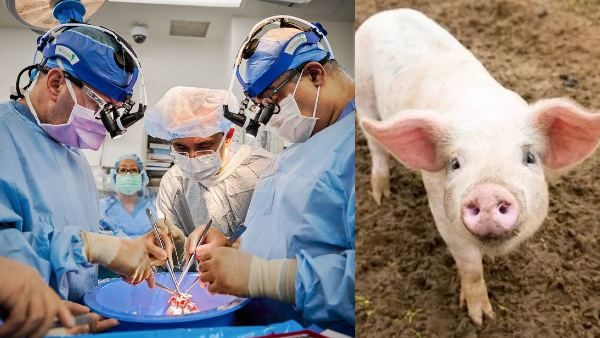
Big breakthrough in organ transplantation, genetically modified pig organs showed miracles in human body.

New Delhi . A historic achievement has emerged in the field of medical science, which has created the possibility of completely changing the direction of organ transplantation in the future. A team of doctors and researchers in China has succeeded in transplanting a genetically modified pig liver and both kidneys together into a human body for the first time. This experiment is not only being considered an example of technological progress in the medical world, but it is also being seen as an important step towards a possible solution to the problem of acute shortage of organs.
Every year, millions of patients around the world suffer from serious diseases like kidney and liver and in many cases, they lose their lives due to non-availability of suitable human organs in time. In such a situation, scientists have been researching for a long time whether animal organs can be safely transplanted into humans. This process is called xenotransplantation, in which organs or tissues are transplanted from one species to another.
According to the report published in Nature Journal, this transplant was done on a 53-year-old brain-dead man, whose research became possible after the consent of his family. Scientists transplanted genetically modified pig organs into the human body and early signs of their function were found to be positive. The organs reportedly functioned normally for about five days after the transplant and there were no signs of major rejection.
Researchers reported that the body did not reject these organs even within 24 hours of transplantation, which was considered an important sign in the direction of this technology. The liver started secreting bile, while the kidneys played a role in controlling creatinine and urea levels in the body. This indicated that genetically modified organs from pigs might be able to perform basic biological functions in the human body.
Experts believe that this achievement can open a new chapter in the field of multi-organ transplantation, because transplantation of multiple organs simultaneously is a technically extremely complex process. Along with this, risks like infection, virus and immune system rejection are also high, which are a big challenge to control.
Although the scientific community has hailed this achievement as encouraging, it has also made it clear that more research is needed before it can be widely applied to humans. It is especially important to ensure that no viruses or infections enter the human body through animal organs. Therefore, there is a need to continue studies on brain-dead individuals and other testing models.
The high demand and limited availability of organ transplants has long posed a challenge to health systems worldwide. In such a situation, this research can become a new hope for millions of patients in the future. If this technology proves to be safe and effective, it could prove to be a revolutionary change in medical science.

Comments are closed.