
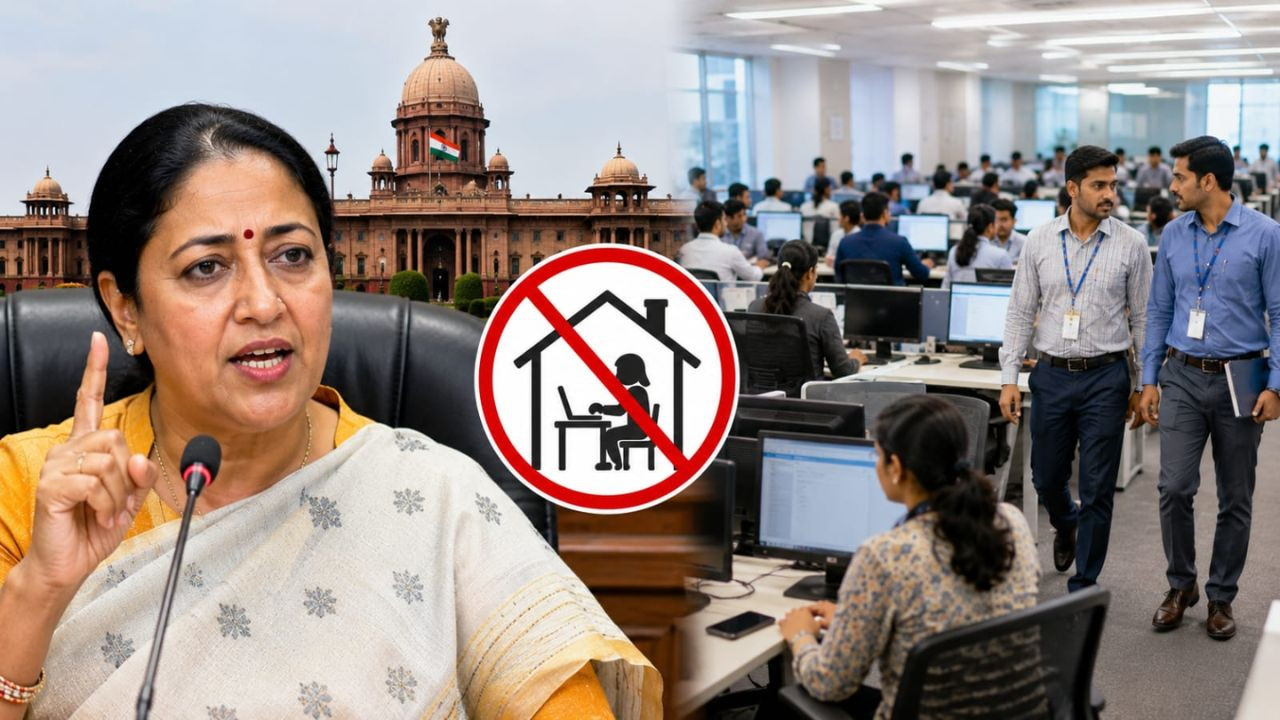
Big decision of Delhi government, work-from-home policy withdrawn, now employees will come to office and work

New Delhi: After the improvement in the geopolitical situation in West Asia and the news of ceasefire between America and Iran, the Delhi government has withdrawn the instructions for work-from-home system and changed office timings implemented for its employees. Chief Minister Rekha Gupta approved this decision on Saturday. Let us tell you that these rules were implemented under a special energy conservation campaign in May this year to deal with the global energy crisis and rising fuel prices.
Decision taken after international situation becomes normal
An official statement issued by the Chief Minister’s Office said that now that the international situation has practically become normal. Chief Minister Rekha Gupta has approved ending the work-from-home system given on Wednesday and Saturday. With the implementation of this new order, all the employees of Delhi Government will now work in their offices at their old and normal time i.e. from 10:00 am to 6:30 pm. There has been no change in the working timings of Municipal Corporation employees and they will continue to work from 8:30 am to 5:00 pm as before.
Hybrid policy was implemented for fuel saving
This hybrid work policy was started in the month of May this year. When the Delhi government had instructed its employees to work from home two days a week. This decision was taken after the appeal made by Prime Minister Narendra Modi. Countrymen were urged to consume fuel and develop the habit of responsible spending.
Strict steps were taken to reduce consumption
Along with the work-from-home policy, the Delhi government had also implemented several other fuel saving measures to ease the growing pressure on the country’s foreign exchange reserves. Under this, half of all official meetings were shifted to virtual mode so that travel could be reduced. Timings of different departments were staggered to control traffic jams and fuel consumption. The government had also reduced the monthly petrol allowance for the vehicles of government officials by 20 percent to 160 liters and put a six-month ban on the purchase of new vehicles.
‘Economic patriotism’
To promote public transport, the administration had also launched campaigns like ‘Metro Day’ and ‘No Car Day’ and had run 58 special buses for government colonies. Government sources clarified that these were not mandatory economic sanctions, but voluntary steps to promote ‘economic patriotism’ to protect the country’s economic interests amid shipping disruptions in the Strait of Hormuz, which have now been withdrawn as soon as the situation returns to normal.

Comments are closed.