
BJP gains 206 seats in West Bengal election as Tejasvi Surya cites resurgence of Vivekananda’s principles

Bharatiya Janata Party MP Tejasvi Surya described the West Bengal Assembly Election results as a turning point in the state’s ideological landscape, stating that West Bengal is witnessing a “resurgence” of the principles espoused by Swami Vivekananda after over a decade of political effort by the BJP.
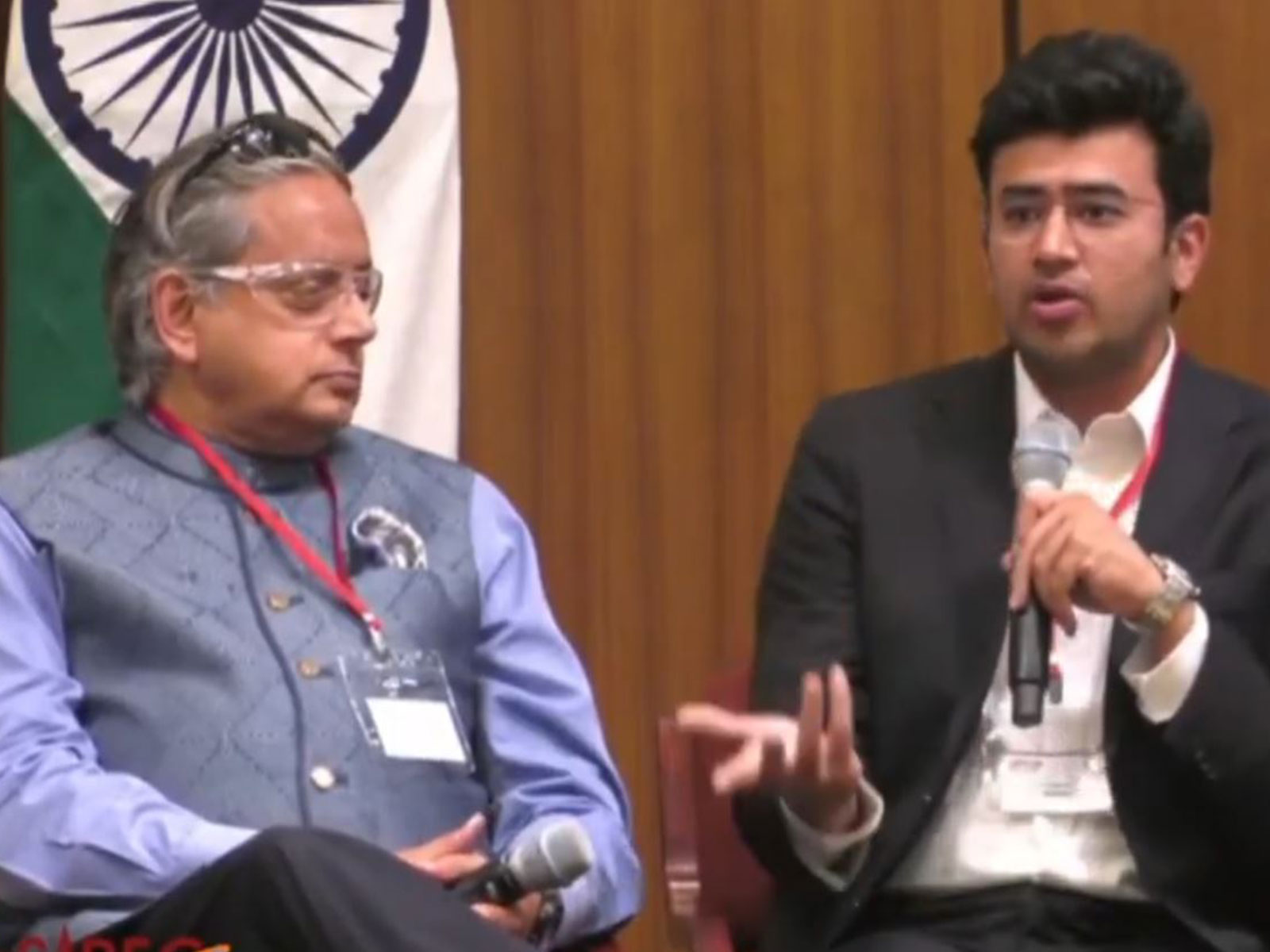
Speaking at the roundtable on ‘India, That is Bharat: Growth Governance and Identity’ at the Stanford India Conference, Surya said, “If you put these kind of opposition to these policies, then the nature of the political conversation has gone so perverse, that those who oppose this or ask for constitution equality are branded as communal, now this is where we are having a fundamental problem…so to reiterate, Shashiji, at philosophical level, there is absolutely nothing to oppose, because what you said. has been this position of Vivekananda and BJP…it took an enormous amount of effort for the last 12 years to reestablish in the birthplace of Swami Vivekananda, his own principles and after the Bengal election results, finally we are seeing the resurgence of the same fundamental principle.”
The 2026 Assembly election delivered a decisive mandate for the BJP with the party securing 206 of the 294 seats, a major increase from its previous 77 seats. The Trinamool Congress (TMC), which had won 212 seats in the last Assembly polls, came second with 80 seats.
Mamata Banerjee’s successor, Adhikari, took oath as the ninth Chief Minister of West Bengal on Saturday. Governor RN Ravi administered the oath during a grand ceremony in Kolkata attended by Prime Minister Narendra Modi, Union Ministers and senior BJP leaders.
Adhikari described the election outcome as the start of a new chapter for the state, declaring the “Sonar Bangla” era had officially begun following the BJP’s sweeping victory.
Surya also criticized the Karnataka cabinet’s approval of a ₹600-crore action plan for the development of minority colonies, arguing that it promotes ghettoisation or alienation of the community. He stated, “The political disagreements come when the state starts addressing or approaching certain sections not as individuals but starts offering special treatment based on a particular community’s religion, and that is what the constitution also abhors. Now there was a recent scheme announced by the Karnataka government which wanted to fund development of particular areas, or assigned particular budget for minority colonies, now that makes us ask a fundamental question that what is this concept of minority colonies, if the country got divided based on 1947 and post that we decided there shouldn’t be any discrimination based on the majority or minority, then what on earth is minority colony development? Isn’t this the state actively promoting ghettoisation or isn’t the state sponsoring alienation of a particular community? This is what Bharatiya Janata Party (BJP), or secularist or constitutionalist in a true sense.
The Stanford India Policy and Economics Club (SIPEC) organized the flagship conversation at the Stanford India Conference 2026 held at the Hoover Institution, Stanford University. The event, themed ‘India, That is Bharat: Growth, Governance & Identity,’ featured prominent speakers including Shashi Tharoor, Tejasvi Surya, and K. Annamalai, fostering an in-depth discussion on India’s future trajectory across economic policy, governance, and identity issues.
Comments are closed.