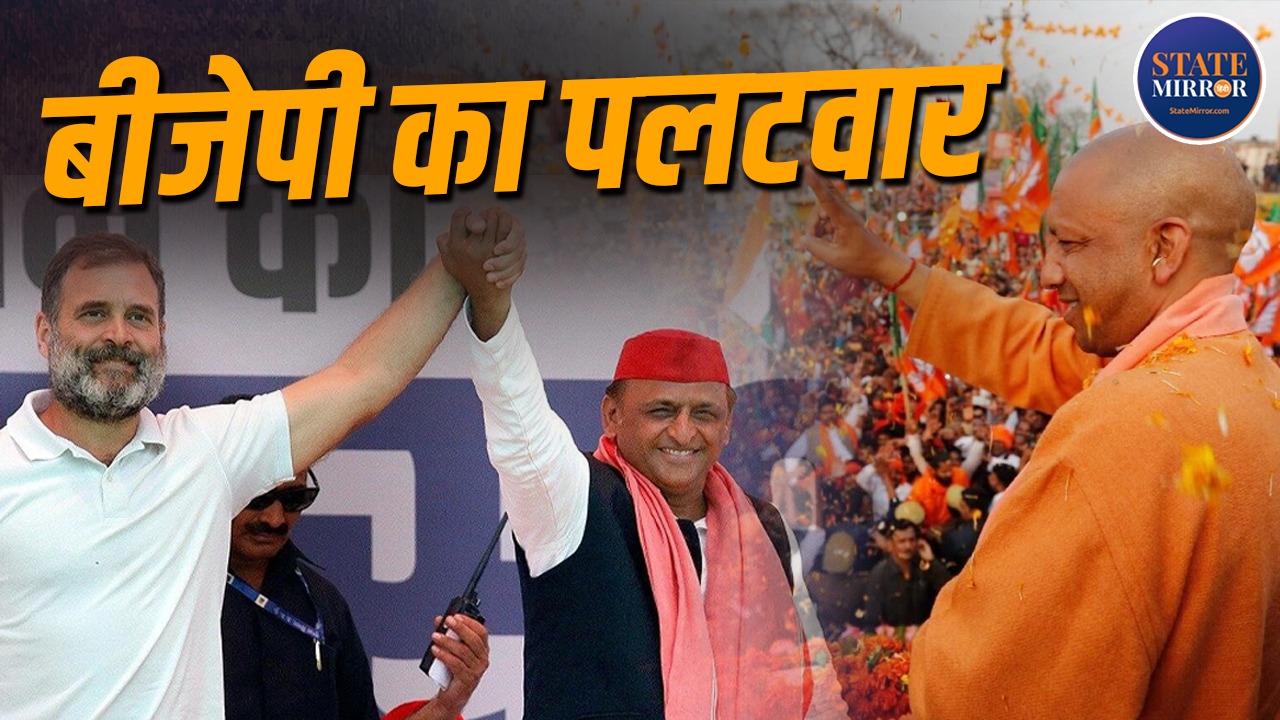
Bharatiya Janata Party (BJP)'s 'Save Democracy, Remove Anarchy' political campaign and march continues across the country. In this sequence, padyatras were also taken out in six cities in the election state Uttar Pradesh from 3 to 5 November. BJP's six padyatras in UP were not just a program to answer the opposition's allegations. From Lucknow to Bareilly, Prayagraj, Gorakhpur, Kanpur and Ghaziabad, the party tried to show strength in its six organizational areas.
This is because every region has its own ethnic makeup and political challenges. At some places non-Yadav backward and Dalit voters are important, while at other places Jat-farmer politics and urban voters play a decisive role. People have taken these padyatras as an attempt to strengthen the organization before 2027 and to answer the allegations of SIR and vote theft by Rahul Gandhi-Akhilesh Yadav.
In these padyatras held between 3 and 5 November 2026, big faces of national and state leadership were given responsibilities of different areas. The question is, which leader did BJP put forward in which region and how many assembly seats are there in these six regions?
What is BJP's political message behind the padyatras?
BJP had set a target of mobilizing at least 25 thousand people in every padyatra. Apart from this, a plan was also made to organize about 200 youth conferences and a banquet with people from the farming community. The aim of the party was to reach out to different social groups as well as to respond to the opposition's allegations of vote theft and the Election Commission. A total of 403 assembly seats fall in these six organizational areas. There are 82 seats in Awadh, 71 in Kashi, 71 in West, 65 in Braj, 62 in Gorakhpur and 52 in Kanpur-Bundelkhand.
Which castes are under focus in Awadh?
On November 3, the Padyatra of Awadh region was taken out in Lucknow. It was led by Union Minister Shivraj Singh Chauhan. Targeting Congress and Samajwadi Party, he raised questions on the politics of Rahul Gandhi and Akhilesh Yadav. BJP's message was that it would give a political answer to the opposition's allegations of vote theft and the Election Commission.
There are 82 assembly seats in Awadh region. Here the role of Brahmin, Thakur, Kurmi, Pasi and Yadav communities is important. Especially Kurmi and Pasi voters can influence the election results on many seats.
After the victory of Samajwadi Party's Awadhesh Prasad on Faizabad seat in the 2024 Lok Sabha elections, the discussion regarding the attitude of Dalit voters had intensified. In such a situation, it is a big challenge for BJP to maintain its hold among non-Yadav backward and Dalit voters.
Was there emphasis on Jat-farmer equation in Braj?
On 4th November, the Padyatra of Braj region took place in Bareilly. BJP National President JP Nadda along with Keshav Prasad Maurya and Jayant Chaudhary also participated in this. Taking aim at the opposition, Nadda said that when he wins the elections, he calls himself smart, but when he loses, he questions the Election Commission.
There are 65 assembly seats in Braj region. Here the political role of Jat, Kurmi, Lodhi, Yadav, Brahmin, Thakur and Dalit communities is important. Through the presence of Jayant Chaudhary, BJP tried to reach out to Jat-farmer voters, while the presence of Keshav Prasad Maurya showed an attempt to send a message to the non-Yadav backward classes.
Who is BJP's Kashi trying to help?
On 4th November, the Padyatra of Kashi region was taken out in Prayagraj. It was led by Deputy Chief Minister Keshav Prasad Maurya. He accused Congress and Samajwadi Party of weakening democracy.
There are 71 assembly seats in Kashi region. Here, along with Kurmi-Patel, Maurya, Nishad, Rajbhar and Yadav communities, Brahmin, Thakur, Dalit and Muslim voters also play an important role. BJP's effort is to keep its hold strong among these communities. Giving responsibility to Keshav Maurya can also be linked to this social equation.
Was the message of unity given from Gornath area?
Padyatra of Gorakhpur area was taken out on 4th November. BJP national president Nitin Nabin, Chief Minister Yogi Adityanath and state president Pankaj Chaudhary were present in it. Through this the party gave a message of unity between the national and state leadership.
There are 62 assembly seats in Gorakhpur region. Here, along with Kurmi-Sainthwar, Maurya-Kushwaha, Yadav, Rajbhar and Nishad communities, Dalit voters also play an important role. The share of OBC voters in this area is about 52 percent and the share of Scheduled Caste voters is about 20 percent.
Yogi Adityanath's old political association with Gorakhpur also makes this area special. With the presence of national and state leadership, BJP tried to increase enthusiasm among the workers.
Urban-rural voters a big challenge in Kanpur-Bundelkhand?
The padyatra of Kanpur-Bundelkhand region took place on 4 November. It was led by Deputy Chief Minister Brajesh Pathak. He accused Congress and Samajwadi Party of doing politics against the Constitution and democracy.
There are 52 assembly seats in this area. In Kanpur, issues related to trade, industry and employment are important, whereas in Bundelkhand, water, farming, employment and migration are big challenges. Here the role of Brahmin, Thakur, Lodhi, Kurmi, Yadav and Dalit communities is important on different seats. BJP faces the challenge of maintaining its hold in both urban and rural areas.
Keeping a close eye on Jat voters from Ghaziabad!
BJP's last padayatra took place in Ghaziabad on 5 November. It was led by Chief Minister Yogi Adityanath. He accused Congress and opposition parties of spreading confusion about constitutional institutions.
There are 71 assembly seats in Western Uttar Pradesh. In the 2022 elections, BJP had won 47 seats here, whereas in 2017 it had won 60 seats. In 2022, the alliance of Samajwadi Party and Rashtriya Lok Dal got 24 seats.
Jat voters can influence the electoral equation on about 30 to 35 seats in this area. Apart from this, Muslims, Dalits, Gurjars, Tyagis and other backward communities also have an important role. After the farmers' movement, Jat-farmer politics has been a special challenge for BJP in this area. Taking out a padyatra under the leadership of Yogi can be considered an attempt to strengthen the party's hold in this area.
Will BJP be able to answer the challenge of 2027?
There are two main objectives of these marches of BJP. First, to answer the opposition's allegations regarding SIR, vote theft and the role of the Election Commission. Second, to reactivate the organization after the loss in Uttar Pradesh in the 2024 Lok Sabha elections.
On the other hand, Congress state president Aradhana Mishra termed these marches as a political show and alleged that BJP wants to divert attention from the main issues. While the BJP has definitely tried to give a political challenge to Rahul Gandhi and Akhilesh Yadav through these six padyatras, its electoral impact will be clear only in the assembly elections.