


As debates around E20 (20% Ethanol-blended) petrol intensify, a top executive at Bharat Petroleum Corporation Ltd has come up with a significant statement. In an interview with ANI, he admitted that Ethanol’s mileage is 30% lower. This validates some of the concerns that we have all been having about the fuel. (Two points to note: He is talking about Ethanol, not E20. E20 petrol contains 20% Ethanol, so it will have a correspondingly lower fuel efficiency of perhaps 3-4% – not 30%)
In the video interaction shared by ANI Newswe see Anurag Saraogi, Executive Director (Biofuels), Bharat Petroleum Corporation Limited (BPCL), talk about India’s bio-fuel journey. He reiterates that the bio-fuel program is here to stay. Soon, the conversation drifts to E20- its journey so far and the concerns about it.
Mid-way through the interview, Saraogi is asked how would address the concerns of E20 users, and if all the worries are rooted in rumours alone. The executive takes this question carefully. He starts by talking about its low Carbon emissions. Then he speaks about the mileage drop. This is where it gets more interesting.
The executive director’s answer is cleverly phrased. ‘Obviously, Ethanol has a lower mileage. So, it has 30% less mileage in the chemical form’- he admits. It should be noted here that he is speaking about pure Ethanol and not E20 petrol.
‘But who says petrol is burnt so cleanly, positively, and every one of us knows what is the ideal mileage shown in the booklet and what we do. It is also dependent on individual habits.’. That sounds like a clever cover-up.
In his closing remarks, Saraogi says that we should all look at Ethanol in a positive way, as it is very emission friendly, and this is something critical for the next generation.
Saraogi said that India’s Ethanol-blending journey started in 2003 as a small pilot program. The journey has been long. He also touched upon the latest milestones in it. 5% Ethanol-blended fuel was being sold in 2021, and in 2026, the blending levels have reached 20%. On June 3rd, Hero Motocorp launched its first flex fuel models. On 4th, Maruti Suzuki launched the WagonR Flex fuel, and on 5th, E85 petrol (a blend of 85% Ethanol and 15% petrol) was introduced in the country.
Saraogi also added that E20 is here to stay for a while and ‘its stability needs to be captured’. In the time ahead, the authorities will take a ‘calibrated approach’ with increasing blending. ‘Going forward, this path (blending) will go up only, but may be a calibrated path’- he says. E85 vehicles, he says, will co-exist with E20 vehicles.
He also speculates that in the next 15 years and beyond, the Ethanol-blended petrol may slightly go down, due to the influx of electric vehicles and other alternative fuel vehicles. It is, however, not going away.
Saraogi also talks about the importance of ensuring energy security. He says that it is important to keep the energy sector independent of and unaffected by global geopolitical changes and tensions. He cited the recent West Asia war as an example.
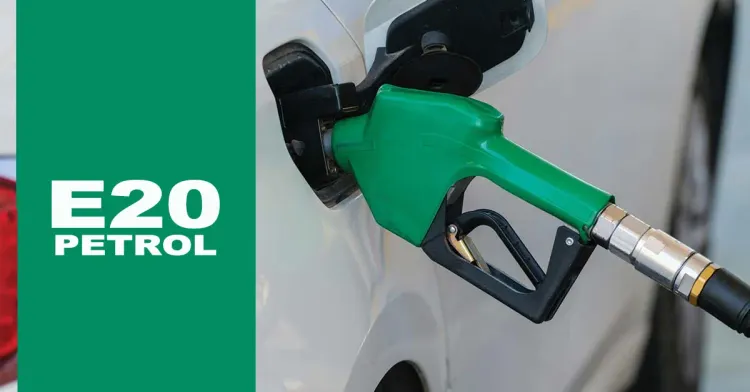
The mileage drop can be attributed to Ethanol’s lower energy density. A litre of Ethanol packs 30-33 percent less energy than a litre of pure petrol. The engine will thus have to burn more blended fuel to do the same amount of work it does with regular petrol. Even a 20% blend packs significantly less amount of energy than pure petrol. E20’s mileage drop will be typically in the range of 6-8%.
Persistent use of E20 petrol may have various adverse impacts on vehicles. Ethanol’s corrosive and hygroscopic nature can cause rusting in fuel tanks, corrode fuel lines and other powertrain components and even cause damages to the engine. These will typically surface in older, non-compatible engines.
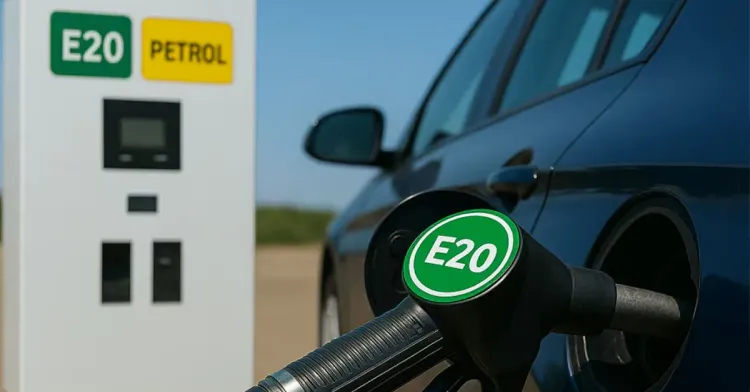
Ethanol-blended petrol burns much cleaner than pure petrol- there are no two ways about it. Emissions are significantly lower. But the problem with India’s E20 program is that the government forced it on vehicle owners instead of offering it as an option. Instead of making E20 the standard petrol in the market, it should have been offered as an option alongside pure petrol. Offering at a lower price than standard petrol may have boosted adoption as well.
In the above case, people who own older, non E20-compliant vehicles would not have to be worried, as unblended petrol is readily available. No fear of engine damage or sharp drop in fuel efficiency. Now, only XP100 is kept Ethanol-free, and is super-expensive.
In addition to forcing E20 on consumers, the government’s reluctance to publish reports of the ‘extensive research’ it says was conducted before rolling out E20 in full scale, makes the whole thing look even more suspicious. All these are now driving sharp criticism and protests from around the country.
Comments are closed.