By: The Obnews Editorial Team
Analysis | September 13, 2026
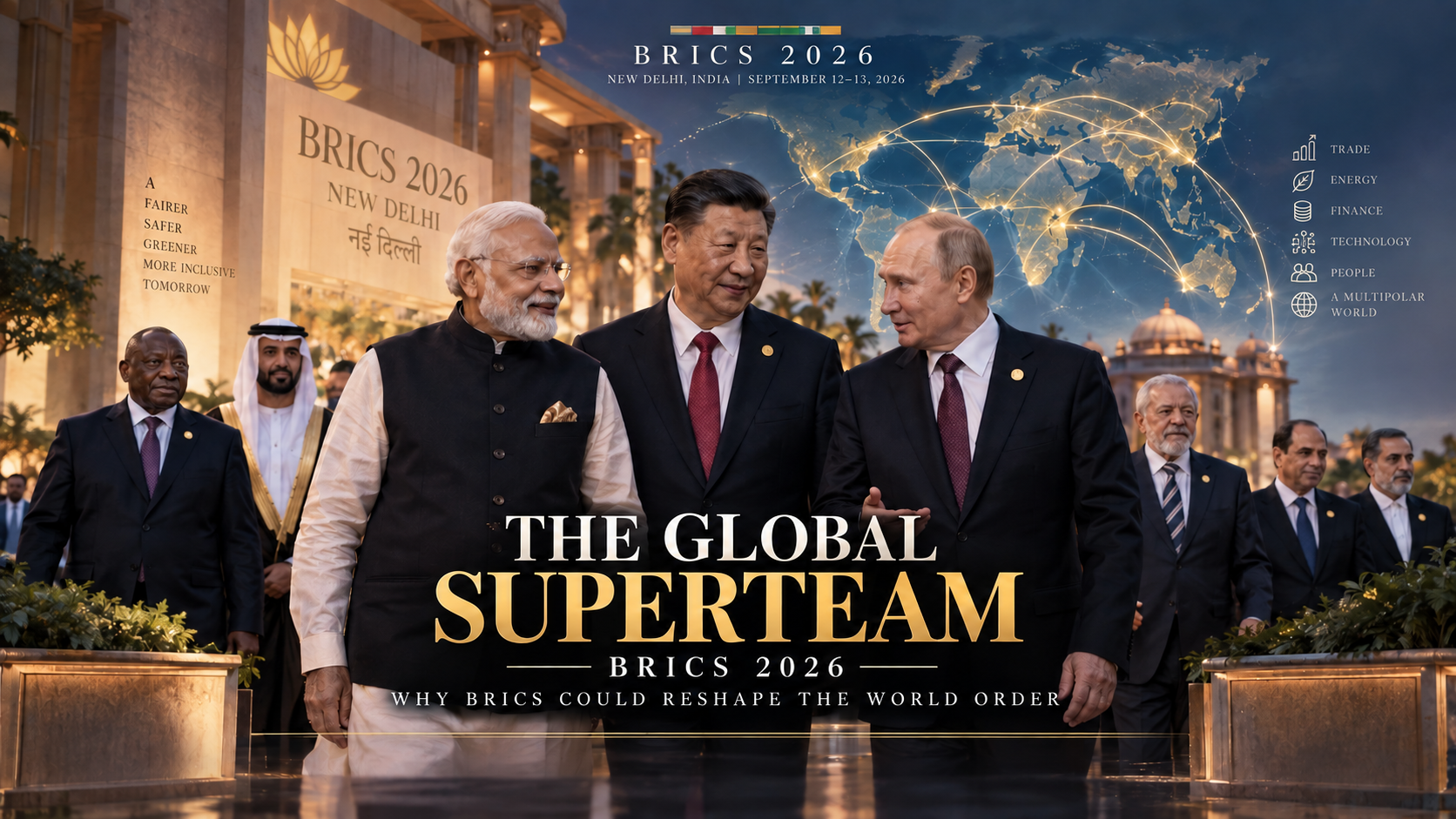
India’s summit brought rival powers into the same conversation, secured agreement across the divide between Iran and the UAE and advanced an agenda spanning finance, trade and artificial intelligence. The case for a more influential BRICS now rests on something more concrete than its size.

One of the most consequential developments at BRICS 2026 involved two countries divided by war finding language they could both accept. At the September 12 and 13 summit in New Delhi, Iran and the United Arab Emirates backed a joint declaration calling for restraint in the Middle East conflict and protection of civilians and commerce. Their agreement gave the gathering a diplomatic achievement against which its ambitions could be judged. Reuters
For The Obnews, that is the strongest basis for calling this a global superteam moment. BRICS demonstrated that major powers with conflicting interests could still use their shared platform to negotiate. Our assessment is that New Delhi strengthened an alternative centre of diplomatic influence, with consequences for how governments seek partners, manage pressure and pursue their interests.
The basketball comparison helps explain the significance. When LeBron James and Chris Bosh joined Dwyane Wade in Miami in 2010, their individual abilities were already established. Bringing them together changed what other teams had to prepare for. The BRICS analogy concerns that possibility of coordinated strength: formidable players combining enough of their capabilities to alter everyone else’s calculations.
The attraction lies in the combination of large consumer markets, manufacturing capacity, energy resources, agricultural production, capital and diplomatic reach. Those assets become more useful when countries can connect them through workable agreements. A supplier gains from dependable access to buyers. An infrastructure project gains from financing. A government under pressure gains another forum in which to negotiate.
The scale is substantial. India’s official summit backgrounder puts the expanded grouping at 49.5 per cent of the world’s population and 26 per cent of global trade. Those figures use India’s eleven country definition, which includes Saudi Arabia. Riyadh’s formal membership remains ambiguous: former Indian diplomat Rajiv Bhatia told Outlook that Saudi Arabia had continued participating without formally accepting membership. That distinction matters when comparing totals. India’s Press Information Bureau, Outlook interview
An NDTV analysis of the IMF’s April 2026 forecasts, reported by bdnews24, places the expanded BRICS grouping at approximately 41 per cent of world GDP measured by purchasing power parity, compared with about 28 per cent for the G7. These are projections using a measure that adjusts for differences in domestic prices. The G7 remains larger when output is valued at market exchange rates. BRICS’ rising share also reflects the admission of additional countries alongside economic growth. GDP comparison and methodology
The political setting gave members another reason to cooperate. The Financial Times reported unusual unity in opposition to President Donald Trump’s protectionist policies and the war in Iran. Our reading is that pressure from Washington can increase the appeal of alternative partners, even among governments that disagree with one another. That is a consequence Western policymakers must weigh when judging how other countries will respond to economic pressure. Financial Times
The practical implication is that BRICS has the economic weight to demand attention. Its ability to turn that weight into influence depends on the agreements its members can sustain. The relationship between Iran and the UAE supplied the summit’s clearest test.
In May, BRICS foreign ministers had failed to produce a joint statement after meeting in New Delhi. Iran sought condemnation of the American and Israeli military campaign and accused the UAE of involvement. Tehran maintained that its attacks targeted American military facilities; Abu Dhabi rejected Iran’s justification. India issued a chair’s statement recording the differences. That failure provides a meaningful baseline for assessing September’s progress. Reuters reporting carried by Business Standard
The UAE’s own account of the May meeting shows the depth of the dispute. It accused Iran of repeated attacks affecting civilian facilities and critical infrastructure, and reaffirmed its right to defend its sovereignty. These were serious security grievances between participants in the same diplomatic forum. UAE Ministry of Foreign Affairs
Against that background, the September 12 meeting between Iranian President Masoud Pezeshkian and Sheikh Khaled bin Mohamed bin Zayed Al Nahyan, Crown Prince of Abu Dhabi, carried particular significance. The Abu Dhabi Media Office confirmed that they discussed regional and international issues and supported efforts to ease tensions, strengthen stability and advance peace and development. Official UAE meeting account
Pezeshkian subsequently said the two sides had agreed to “put the past behind” and look ahead, according to The Indian Express. That was the Iranian president’s characterization of their conversation. The UAE’s published account used more measured language centred on reducing tensions. Together, the accounts establish a diplomatic opening, while leaving the extent of any practical reconciliation to be demonstrated. The Indian Express, Abu Dhabi Media Office
Events outside the summit underline that limit. On September 13, Oman’s foreign minister announced the postponement of a separate planned meeting between Gulf states and Iran concerning the Strait of Hormuz. The progress in New Delhi therefore coexisted with continuing obstacles to regional negotiations. A durable improvement will have to be measured through subsequent agreements and conduct. Reuters on the postponed Oman meeting
Even with those limits, the change from May is meaningful. A forum that had struggled to agree on language provided space for a shared declaration and direct engagement. The inference is that BRICS can sometimes help members manage differences that would otherwise obstruct cooperation. Its diplomatic value grows when those channels remain useful during a crisis.
India and China supplied another test of that proposition. Narendra Modi and Xi Jinping met on September 12 as their countries continued rebuilding relations after the 2020 border clash. They discussed closer business links and greater mobility. Reporting on India’s official account also identified commitments to pursue a mutually acceptable boundary settlement and address trade imbalances, supply chain concerns and predictable market access. Reuters on the bilateral talks, AFP reporting carried by Channels Television
For India, the value of this engagement will depend on whether diplomatic commitments improve conditions for businesses and preserve stability at the border. Reliable access for exporters, predictable movement for business travellers and functioning mechanisms for managing disputes are concrete measures of progress. They also make a stronger BRICS more commercially useful.
Bhatia, a former ambassador and distinguished fellow at Gateway House, argued in his published Outlook interview that India should concentrate on cohesion among existing members. He also described an Indian approach that preserves BRICS’ independent identity while avoiding a requirement for hostility toward Western countries. That helps explain its appeal as a forum through which governments can broaden their options. Outlook
There is an institutional foundation behind the diplomacy. The New Development Bank reported that, by June 30, 2026, it had approved 141 projects with cumulative approvals of US$44 billion and disbursements of US$25 billion. These figures describe the bank’s accumulated work before the summit. The distinction between approvals and money disbursed is essential when assessing delivery. New Development Bank
The bank also reported 35 approved infrastructure projects in India worth US$10.5 billion, with approximately US$6 billion disbursed. Its examples included financing for the bridge connecting Guwahati and North Guwahati. This is where the institutional argument becomes tangible: development lending can support infrastructure that people use, with results that can be examined beyond summit declarations. NDB’s account of its Indian portfolio
Payments are another area where the wording deserves close attention. The New Delhi Declaration acknowledged work on making payment and messaging systems interoperable, alongside discussions on trade settlements and investment in members’ own currencies. Its language describes continuing work and respects differing national priorities. A study of how systems could connect is a step towards implementation; actual adoption, transaction costs and usage will determine its value. New Delhi Declaration, paragraph 90, reproduced from India’s Prime Minister’s Office
Claims that a summit can swiftly displace the dollar overlook the infrastructure supporting its role. Federal Reserve researchers’ 2025 assessment emphasized the depth of American financial markets, the supply of dollar assets and the currency’s extensive use in reserves and transactions. Those advantages help explain why increasing local currency settlement and replacing a dominant international currency are very different undertakings. Federal Reserve research
Technology added a further dimension on September 13. Xi proposed a BRICS AI open source community, cooperation on large language models, a digital ecosystem cloud platform, manufacturing collaboration and programmes to develop technical talent. China also proposed a special economic zone partnership and a forum on trade in services for 2027. These were initiatives and proposals, with their eventual reach dependent on implementation. Official Chinese account of Xi’s address
The potential attraction is access to tools, training and industrial capabilities that individual countries may struggle to develop alone. The governance questions are equally consequential. Participating states will need clarity about data control, security, financing and their ability to choose suppliers. Cooperation will be more durable when members can demonstrate that the benefits are shared.
The summit also exposed the limits of consensus. The Financial Express noted that the declaration avoided explicitly naming Russia’s war in Ukraine while using broad language on several disputes. Such drafting can help secure agreement, but it leaves difficult questions of responsibility and enforcement unresolved. A common statement is one measure of cohesion; a common response to a specific crisis is a more demanding one. Financial Express analysis
Think of the Miami Heat in 2010. LeBron James was already one of basketball’s biggest stars, Dwyane Wade was already an NBA champion, and Chris Bosh was already an All Star. Their decision to play together concentrated that talent and changed what every other contender had to prepare for. BRICS presents a similar possibility. China’s manufacturing strength, India’s technology sector and vast consumer market, Russia’s energy resources, Brazil’s agricultural power and the UAE’s capital and logistics were established long before this summit. The significance of BRICS 2026 lies in how these existing strengths can reinforce one another through closer cooperation. The stars were already there; greater coordination could make the whole team more influential. As in basketball, a formidable roster creates expectations, while lasting success depends on how well its members actually play together.
For readers in Canada, the practical questions concern the reliability of trade, the cost of transport and energy, and access to growing markets. Consider a business buying goods from Asia: its interests depend on predictable delivery, dependable banking and clear commercial rules. BRICS cooperation could improve some of those conditions if agreements become operational. Continued conflict and rivalry could undermine them. That is the channel through which distant diplomacy can affect everyday business decisions.
The next assessment should follow observable results: continued engagement between Iran and the UAE, workable regional arrangements, improved market access, payment systems businesses actually use, and projects that move from approval to completion. Those tests give the superteam argument a standard against which it can succeed or fail.
New Delhi strengthened BRICS’ claim to a larger role in shaping international affairs. It showed that an expanded gathering of powerful and sometimes antagonistic states could preserve dialogue and find common ground under pressure. The global superteam remains a proposition about coordinated power, with its most difficult tests ahead. In 2026, it gave the world stronger reasons to take that proposition seriously.