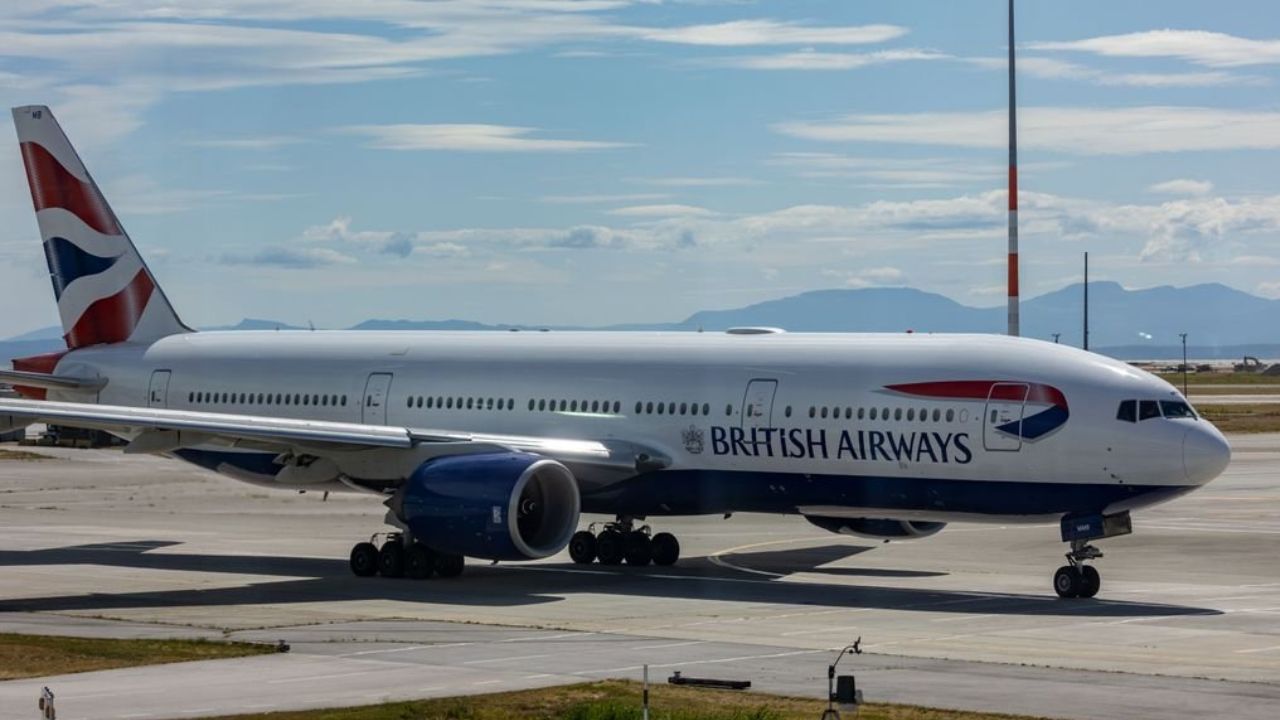
British Airways flight BA295 going from London to Chicago suddenly had to declare an emergency while crossing the Atlantic on Monday. When the Boeing 777-200ER aircraft was flying at an altitude of about 37 thousand feet over Ireland, it started descending rapidly and within a few minutes it descended to about 9 thousand feet. After this the pilots issued the 7700 emergency squawk code, which is the international signal for serious emergency in the aircraft.
The flight to Chicago was canceled and the plane changed direction and started flying back towards London Heathrow. BA295 was eventually diverted to return to Heathrow, according to flight-tracking data.
Why did the flight suddenly come down to 9 thousand feet from 37 thousand feet?
BA295 took off from London’s Heathrow Airport for Chicago. According to the report, after about an hour the plane had reached the cruise altitude of 37,000 feet. Then the plane suddenly started descending at high speed. Tracking data showed a descent of approximately 28,000 feet and the aircraft landing at about 9,000 feet.
In such a situation, a major reason for bringing the aircraft to a lower altitude can be a problem in cabin pressure i.e. depressurisation. Coming at low altitude provides a relatively safe environment for the people present in the aircraft to breathe. However, British Airways has not yet publicly clarified the official cause of the emergency, so depressurisation must be considered a possible cause for now.
Why did the pilot enter code 7700?
The appearance of Squawk 7700 on an aircraft’s transponder is a very important signal in aviation. This means that the aircraft has informed the air traffic control about a general emergency different from the normal situation.
In the case of BA295, code 7700 was issued after a steep descent up to 9 thousand feet. This signaled to air traffic control that the aircraft needed priority and necessary assistance.
The plane was over Ireland, then why did it return to London?
After the emergency, the plane had many options. It was possible to divert to airports such as Shannon or Dublin in Ireland, but the pilots ultimately decided to return to London Heathrow. According to the report, the plane took a U-turn and started flying back towards Britain at about 9,000 feet.
This decision may depend on many circumstances. Such as the actual technical condition of the aircraft, fuel quantity, weather, airport facilities and options available for handling the aircraft. Therefore, just by looking at the flight track, it would not be correct to say that Heathrow was chosen for any one reason only.
Why did the plane have to circle in the air?
During the return, information came to light that the aircraft was kept in holding pattern for some time. One reason for this was to reduce the weight of the aircraft. Aircraft carry large amounts of fuel for long distance flights and reducing weight can be useful in the event of an emergency landing. According to the report, the crew also used lowering of the landing gear while in the air to reduce weight.
Which plane was it?
BA295 was operated by a Boeing 777-236ER aircraft, registration G-VIIA. Flightradar24 also recorded flight BA295 of October 5 as a flight from London to Chicago and diverted to LHR.
Did the plane return to London safely?
The latest tracking information available shows the plane diverted to London Heathrow instead of Chicago. That is, while handling the situation, the plane changed its original destination. However, at this time, an official detailed statement regarding the full technical reason of the incident and the condition of the passengers/crew present on the aircraft should be awaited.
Complete timeline of BA295
- Flight from London Heathrow: Takeoff recorded at approximately 11:14 BST.
- Cruise: The plane reached about 37,000 feet.
- Sudden descent: The plane descended rapidly and reached about 9,000 feet.
- 7700 Squawk: Pilots signal general emergency.
- U-turn over Ireland: The plane changed its direction.
- Heathrow return: BA295 diverted to return to London instead of Chicago.
- Fuel reduction procedure: The aircraft was placed in a holding pattern and weight reduction procedure was carried out.
The most important thing at the moment is that despite the code 7700 and such a fast descent, the pilots of BA295 kept the aircraft under control and turned it back towards London. The actual cause of the emergency will become clear only after an official investigation/statement by British Airways.