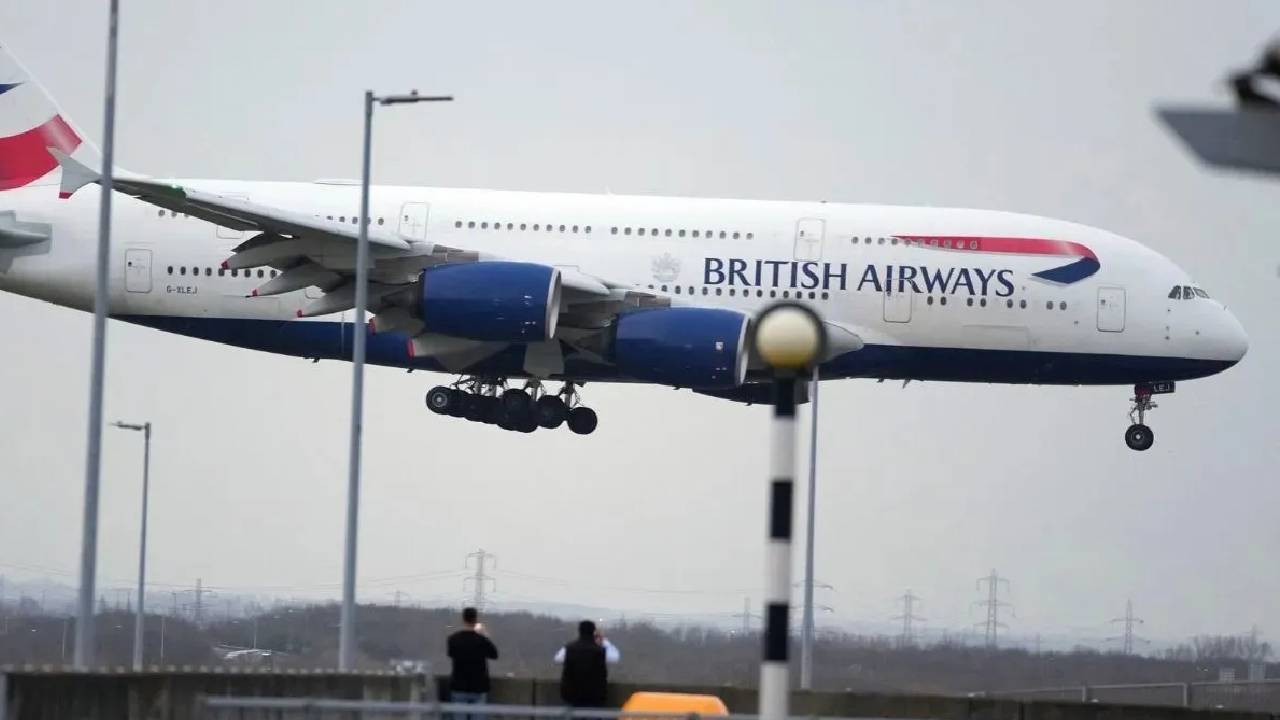
British Airways flight BA295 from London to Chicago was diverted from its scheduled route on Monday when the plane suddenly had to descend sharply during flight. The plane took off from Heathrow Airport at around 11:50 am and after some time reached an altitude of about 37,000 feet over Ireland. After this the altitude of the plane decreased rapidly and it came to around 9,000 feet. This loss of altitude to approximately 28,000 feet was a far cry from normal cruise flight.
Meanwhile, 7700 emergency squawk code was broadcast from the aircraft’s transponder. After this, the crew turned the plane back towards the British capital instead of taking it further towards America. At present, it is not clear from the available information what was the real reason for bringing the plane down so fast and changing the route.
The entire program changed after taking off from Heathrow.
BA295 started its flight from London’s Heathrow Airport to Chicago. As per the schedule, the plane was to reach America after completing a long international journey. In the initial phase the flight proceeded normally and the aircraft reached the scheduled cruise altitude. But after this the circumstances changed and the crew decided to reduce the altitude of the aircraft. Within some time the plane was diverted back towards Europe.
From 37 thousand feet straight to about 9 thousand feet
According to the information revealed by flight tracking, the plane was earlier flying at an altitude of about 37,000 feet. Later its height decreased to about 9,000 feet. That means the plane lost altitude of about 28,000 feet. During an emergency in the aviation sector, pilots can rapidly descend to a lower altitude, but the official reason why this was done in this case has not been revealed yet.
what does code 7700 mean
Special squawk codes are sent to air traffic control via transponders installed in aircraft. Among these, 7700 is a common emergency signal. When the crew activates this code, it signals to air traffic control that the aircraft may be experiencing some type of emergency and may require priority or additional assistance. However, simply looking at the 7700 code cannot determine whether the problem was technical, medical, or caused by some other cause.
Why was the plane turned back instead of Chicago?
Following the emergency signal BA295 was returned to London instead of continuing towards Chicago. In case of any serious problem involving the aircraft or passengers in a long haul flight, the crew may decide to return to an alternate airport or the airport of departure depending on the circumstances. In this case too, the plane returned to Heathrow, but detailed official information regarding the nature of the problem is not yet available.
Incident raising concern among passengers
This incident is in the news after information about suddenly falling thousands of feet from a height of about 37,000 feet came to light. However, loss of aircraft altitude is not in itself considered a sign of an accident. Pilots can change altitude under many operating conditions. The real question is why 7700 code was used in case of BA295 and what led to the decision to withdraw.
Recently another flight incident was in the news
A few days before this incident, a separate incident related to a flydubai flight was also in the news. In that case, a flight from Dubai to Tel Aviv was diverted and reports mentioned an alleged violent incident that took place inside the cockpit. Both the incidents are different and their reasons are also said to be different. In the case of British Airways BA295, at present no official statement has clarified the reason for the problem.
Therefore, it would be premature to attribute any specific reason until the investigation or detailed information comes from the airline. What is clear at this point is that the plane broadcast an emergency signal, made a major change in altitude and returned to London instead of continuing on to Chicago.