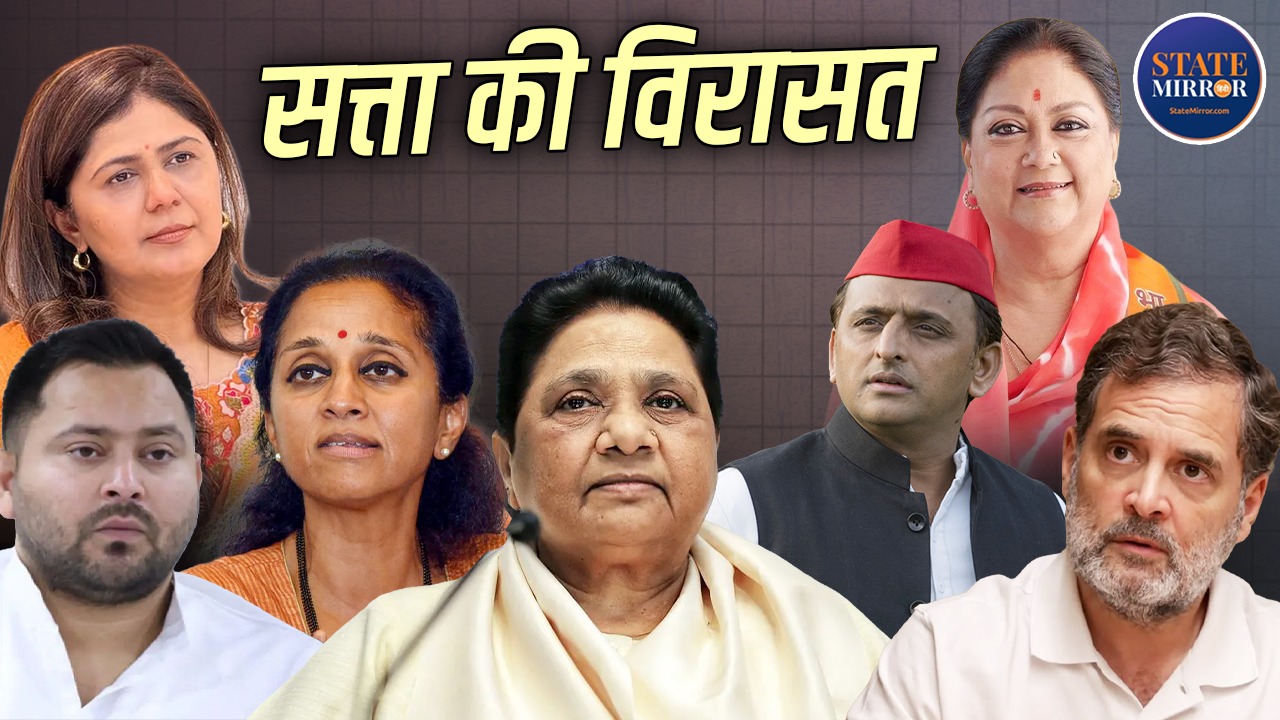
No matter how much any political party opposes dynasticism in the country's politics, it itself is not untouched by it. In the politics of Bahujan Samaj Party, Mayawati presented her distance from familyism as her distinct identity for a long time. But in September 2026, his decisions to separate his nephew Akash Anand from the party and then make nephew Ishaan Anand the national convenor gave a new turn to this debate. On September 12, Mayawati had said that both her nephews Akash and Ishaan would not hold any post in the party, but on September 23, she made Ishaan Anand the national coordinator. The question is big because Mayawati, who tried to keep the family away from politics, did she also have to return to the family on the question of organization and succession?
Is Mayawati's experiment of maintaining distance from her family now in question?
Mayawati's political model has been different from other big parties. Instead of making his family the political heir of the party, he kept himself the central face of BSP. But the events in 2026 showed that it is not easy to keep the family completely out of politics. Akash Anand first reached important responsibilities in the party, then in September his responsibilities were withdrawn from him. Mayawati also linked this to the events of Akash's father-in-law and former Rajya Sabha MP Ashok Siddharth's retirement from politics and said that for Akash, a question of priority had arisen between family and party. A few days later, with Ishaan Anand being made the national convenor, the question became bigger whether it is possible in practical politics to keep the family completely away?
Statistics show that nepotism is not just a disease of Congress or regional parties?
In a 2025 analysis by the Association for Democratic Reforms (ADR), out of 5,203 sitting MPs, MLAs and Legislative Council members, 1,106 or 21 per cent were found to be linked to political families. This share in the Lok Sabha was 31 percent, while in the state assemblies it was about 20 percent. That is, familyism is not limited to just one party or one ideology.
Party wise figures also clear the picture. ADR's analysis of national parties found that 32 per cent of Congress and 17 per cent of BJP MPs, MLAs and Legislative Council members had political family backgrounds.
Talking about regional parties, NCP-Sharadchandra Pawar stood at 42 percent, JKNC at 42 percent, YSRCP at 38 percent, TDP at 36 percent and NCP at 34 percent. Even in parties like Samajwadi Party, JDU and RJD, the share of representatives with family background was said to be around 30 percent or more. In comparison, this figure was 10 percent in AITC and 4 percent in AIADMK.
What story do the figures of nepotism in Congress-BJP tell?
The biggest example of Congress is the Nehru-Gandhi family. After Jawaharlal Nehru, Indira Gandhi, Rajiv Gandhi, till Sonia Gandhi, Rahul Gandhi and Priyanka Gandhi, this political family has remained an important part of the party's identity. But the figure of dynasticism is not limited to Congress only. According to ADR, compared to Congress's 32 percent share among the current representatives of national parties, 17 percent of BJP's representatives come from political families.
That is, BJP's political attack on dynasticism against Congress and regional parties has its place, but the figures do not say that there is no political family in BJP completely. The difference is that the central organization of BJP is not based on any one family. This is why it would not be right to look at BJP and Congress on the same scale. Still, the data definitely shows that familyism is not the problem of any one party in Indian politics.
Is family the identity of the party in SP and RJD?
Samajwadi Party in Uttar Pradesh is a big example of this. The transfer of leadership from Mulayam Singh Yadav to Akhilesh Yadav took place within the family and many members of the family have been in active politics. Lalu Prasad Yadav's family has been the prominent face of RJD politics in Bihar and Tejashwi Yadav has carried forward the political succession. In ADR's party-wise data, both SP and RJD have been placed among the parties with high family representation.
The examples of Sharad Pawar family in Maharashtra, Naidu family in Andhra Pradesh, Abdullah family in Jammu and Kashmir and Karunanidhi family in Tamil Nadu show that in regional politics, family sometimes becomes the permanent political brand of the organization. In the ADR data, NCP-Sharadchandra Pawar is seen on top with 42 per cent, JKNC 42 per cent, TDP 36 per cent and NCP 34 per cent with representatives from family background.
Do Shiv Sena, NCP and other parties point out familyism as strength and weakness?
Thackeray family and Pawar family in Maharashtra are important examples of this. Shiv Sena's politics revolved around the Thackeray family for a long time and the role of Sharad Pawar family was prominent in NCP. But if there is a conflict within the family regarding political succession, it can also lead to a split in the party. This is the reason why the family provides identity and continuity of leadership to the party, but when the question of succession comes, the same family can also become a crisis for the party.
The ADR report also shows that nepotism is not just about transfer of seats. While giving tickets, political parties give importance to winnability, local network, money, existing political influence and family identity. This means that a family based candidate sometimes becomes an easy and low risk electoral option for the party.
Is the real question in Mayawati's case not the family but the successor?
This is where Mayawati's case stands out. Unlike Congress, SP, RJD or the Thackeray family, there was no clear family succession system in BSP for long. Mayawati kept her distance from giving command of the party to the family. But in 2026, the continuously changing decisions regarding Akash Anand and Ishaan Anand showed that the question of family has not completely ended even in BSP.
On September 23, Mayawati decided to promote Ishaan Anand as the national coordinator, whereas a few days ago it was said that both the nephews would be kept away from politics.
A big political question arises from this whole incident – is distancing from the family an alternative to familism, or will a big leader have to create a strong second line outside the family as well? Mayawati's challenge lies here. If the leadership after him in the organization is not clear and strong, then the model of distance from the family will also not appear sustainable. The same question will arise on taking the family forward, from which Mayawati has kept herself away for decades.
ADR figures show that it is not just a coincidence that 21 percent of the current public representatives have a political family background. This is a complete system related to ticket distribution, probability of electoral victory, organizational hold and political legacy. Mayawati's current experiment is important because she has been the biggest example of an attempt to create a path different from this system. His decisions of 2026 are once again raising the question whether it is really possible to prepare the next generation of power and organization in Indian politics by maintaining complete distance from the family?