
Every software team has bugs. The question is whether the team has a systematic way to evaluate them, sequence them, assign them, and decide which ones must be fixed before a release ships and which can wait. Teams without a structured triage process answer that question by instinct and inertia: the most recently reported bug gets the most attention, the engineer who complains loudest gets their bug fixed next, and the release decision is made by gut feel.
A payment failure affecting 40% of users demands a different response than a misaligned tooltip in a rarely visited settings screen. Bug triage systematically enforces that distinction, so severity and business impact drive the fix order. That distinction sounds obvious stated plainly.
Maintaining it in practice, across a backlog of dozens or hundreds of reported defects, under the time pressure of an approaching release, requires a defined process, clear roles, and consistently applied classification criteria. This is a complete guide to building that process.
What Bug Triage Is and What It Is Not
Bug triage is a systematic process in software development for evaluating, prioritising, and assigning reported defects or issues. It involves analysing new bug reports to determine their validity, severity, priority, and appropriate resolution path. Effective bug triage ensures critical issues receive immediate attention while less important ones are scheduled appropriately.
The term comes from medical practice, where triage describes the process of sorting patients by urgency to allocate limited treatment capacity correctly. The software equivalent applies the same logic: limited engineering capacity must be allocated to defects in an order that reflects their actual impact, not the order in which they happened to be reported.
Bug triage is the process that decides when and by whom the decision to close a valid bug without fixing it is a separate, explicitly documented choice that requires justification.
The process involves evaluating each bug report, confirming whether it is reproducible, classifying it based on severity and priority, and then assigning it to the appropriate developer or team. By systematically managing bugs, teams can avoid confusion, reduce backlog clutter, and maintain a predictable release schedule.
Severity: The Technical Dimension
Severity is not affected by how many customers hit the defect, how visible it is to a specific account, or whether a release is due next week; those are all real considerations, and they all belong to priority. Keeping them out of severity is what makes severity comparable across defects. Severity is a technical assessment of what the bug actually does to the system.
The severity classification that most teams converge on uses four levels, though the labels vary.
- Critical (S1) covers crashes, data corruption, security vulnerabilities, and complete loss of primary functionality with no workaround; these conditions make the software unsafe or unusable for its stated purpose.
- High (S2) covers significant functionality impairment where a primary user workflow is broken or severely degraded, with a workaround that is technically possible but operationally unacceptable for regular use.
- Medium (S3) covers partial or intermittent functionality issues; features that behave incorrectly under specific conditions, secondary workflows that are impaired, or performance degradation that is noticeable but not blocking.
- Low (S4) covers cosmetic issues, minor UI inconsistencies, and edge-case behaviour that does not affect the application’s primary function.
The person who reproduced the defect sets severity, because it requires knowing what actually happens: which data is affected, whether the failure is recoverable, whether a workaround exists. It is a testable, evidence-based judgement, which is why it should be relatively stable once set. Severity is an observed technical fact that the tester documents. When severity is disputed, the dispute is resolved by reproducing the bug and examining what actually happens.
The bug types that recur in defect backlogs map naturally to severity levels. Functional bugs that deviate from specification range from S1 (core workflow broken) to S3 (edge case incorrect). UI bugs are almost always S3 or S4 unless the UI failure blocks a primary interaction. Performance bugs (latency, memory leaks, slow load times) are typically S2 if they degrade a primary workflow under normal conditions, S3 if they appear only under load. Security bugs are always S1 regardless of how narrow the exploit path appears, because the potential impact is unbounded.
Priority: The Business Dimension
Priority belongs to the product owner or whoever holds the roadmap, informed by the severity assessment. QA supplies the evidence; the business makes the call. This split is what prevents the two most common dysfunctions: testers setting priorities they lack the business context for, and product owners overriding severity assessments they have not reproduced.
Priority answers a different question from severity. Where severity asks “how badly does this break the system,” priority asks “how soon must this be fixed given everything else the team is managing.” A cosmetic bug on the checkout page of an e-commerce site one week before a holiday sales peak might be P1 despite being S4, because the visual inconsistency in a high-trust context (payment) creates a conversion impact that outweighs its technical severity. A data corruption bug in a feature used by 0.1% of users might be S1 but P3 if no user data has actually been affected and a hotfix to the affected records is already deployed as a workaround.
The project manager authorises deferred decisions when fix priority conflicts with release scope and tracks overall defect velocity and release readiness. The business analyst clarifies requirement ambiguities that cause rejected status disputes and determines whether “working as designed” claims are correct. These roles exist in the triage process because priority decisions require business context (customer impact, contractual commitments, competitive timing, resource availability) that engineering and QA alone cannot evaluate correctly.
Without defined ownership over severity and priority decisions, debates repeat weekly. Clear authority accelerates resolution. If priority depends on who argues loudest, the backlog loses credibility. The authority model that prevents this: the engineering lead has the final call on severity (a technical assessment), the product owner has the final call on priority (a business judgement), and the two are documented and stable between triage sessions.
Reproducibility: The Gate Before Classification
A bug that cannot be reproduced cannot be classified, assigned, or fixed with confidence. Reproducibility analysis, determining whether the reported behaviour can be consistently replicated with the provided steps, is the gate that happens before severity and priority classification, because those classifications require observing the actual behaviour.
Reproducibility analysis evaluates whether the bug can be consistently replicated with provided steps. A bug that reproduces consistently under defined conditions is classified and assigned. A bug that appears intermittently requires additional investigation to characterise the conditions under which it occurs before a severity assessment is possible.
The reproducibility states that belong in a defect tracking system are:
- Confirmed (reproduces consistently with provided steps)
- Intermittent (reproduces under some conditions but not reliably, requires additional investigation to characterise the reproduction path)
- Environment-Specific (reproduces in a specific environment but not others, requires environment investigation before fix)
- Unable to Reproduce (the steps provided do not produce the reported behaviour in any tested environment, requires the reporter to provide additional information or the bug is closed pending further evidence).
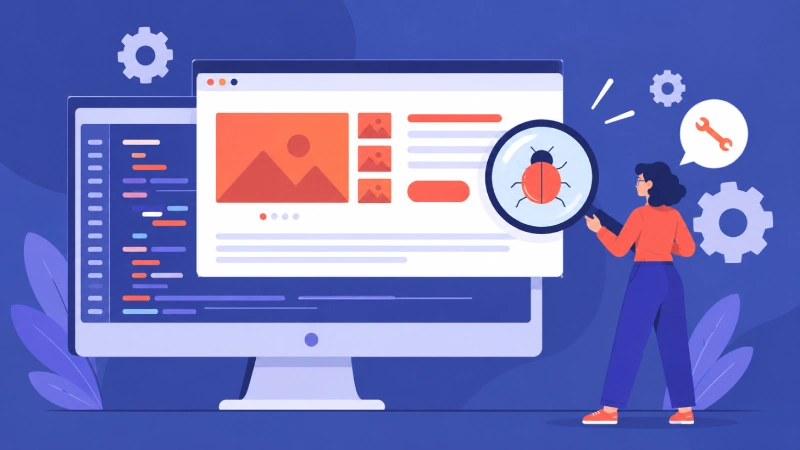
Intermittent bugs deserve particular attention because they are the category most frequently mishandled in triage. An intermittent bug that cannot be reliably reproduced cannot be confirmed as fixed, since a developer who fixes a bug they cannot reproduce is guessing at the root cause. Intermittent bugs should remain in triage status until a reliable reproduction path is established, even if that investigation takes longer than the team would prefer. Closing an intermittent bug because it “cannot be reproduced” is different from closing it because it “no longer reproduces after a specific code change“; the latter requires evidence that the fix addressed the root cause.
The Bug Report: Eight Fields That Make Triage Possible
A complete bug report must include eight mandatory fields: title, steps to reproduce, expected behaviour, actual behaviour, environment details, severity, priority, and supporting evidence. Without all eight fields, a developer cannot reproduce, confirm, or fix the defect, and the report becomes a source of back-and-forth.
Each field serves a specific purpose in the triage process. The title must be specific enough that someone reading only the title understands what broke and roughly where “Submit button on checkout form does not respond to click on iOS Safari 17.4” is. Steps to reproduce must be precise enough that a developer who has never seen the bug can trigger it following the steps as written.
Expected behaviour describes what the specification or reasonable user expectation says should happen. Actual behaviour describes what actually happened. Environment details capture operating system, browser version, device type, screen resolution, and any other variables that may affect reproducibility.
The supporting evidence field (screenshots, screen recordings, network logs, console output) is the field that most commonly receives insufficient attention. A well-documented bug with a screen recording that shows the failure occurring is resolved faster and with fewer back-and-forth cycles than the same bug documented only in text. QA testers provide clear reproduction steps and environment details, evidence such as logs, screenshots, and recordings, and initial severity assessment based on observed impact; these are the reporting standards that make triage efficient.
Release Decisions: Using Triage Data to Gate Deployments
The release decision is the downstream outcome that bug triage exists to support. A team that has triaged its defect backlog correctly can answer the release readiness question with data: how many open defects exist at each severity level, which are blocking versus non-blocking, and whether the current defect profile is within the team’s defined release criteria.
The project manager tracks overall defect velocity and release readiness, balancing fixes against release timelines and approving decisions to defer lower-priority issues. The release criteria that most teams converge on: zero open S1 defects without an accepted workaround or a documented risk acceptance, zero open S2 defects that affect primary user workflows without a planned fix in the next release, and a bounded number of open S3 and S4 defects with documented status and planned resolution sprint. Any deviation from these criteria requires explicit risk acceptance with documented justification.
The deferral decision, the choice to release with a known defect, is the most consequential release decision that triage data informs. A well-functioning triage process makes this decision transparent: the defect’s severity and priority are documented, the decision to defer is recorded with the justification, and the deferred defect is tracked in the backlog with a target resolution sprint.
What to Watch Next
The direction of bug triage in 2026 is toward AI-assisted classification that compresses the time between bug submission and triage decision. Current-generation tools can auto-classify severity based on error message patterns, suggest duplicates from the existing backlog, and identify the most likely owning component from the reproduction steps.
The teams benefiting most from these tools are the ones using AI to pre-populate the classification fields and human reviewers to confirm or adjust them, which keeps the quality of severity assessment high while reducing the mechanical work per report.
For teams building or improving their triage practice, the most durable investment is in consistency: clear, written severity definitions that are applied the same way by every team member who sets them, a documented priority mapping that connects severity and business context to a four-level priority scale, explicit ownership of each classification decision, and a defined release criteria document that specifies the defect profile that must exist before a release is approved. The software teams that build the most reliable products are the ones with the most systematic processes for deciding what those bugs mean and what to do about them.
(Source)