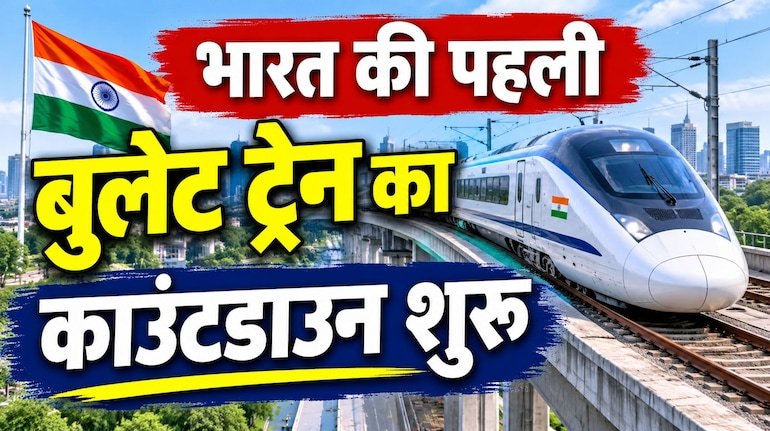
New Delhi/Surat (Bureau Report): The time to add a new golden chapter in the history of Indian Railways is now very close. Union Railway Minister Ashwini Vaishnav has shared a very important and encouraging update regarding the country's first high-speed rail i.e. Bullet Train project (Mumbai-Ahmedabad High-Speed Rail Corridor). According to the Railway Minister, the trial run of the country's first bullet train will start on the 50 km long elevated track prepared between Surat and Bilimora in Gujarat next year i.e. in May 2027. The special thing is that the initial trials will be conducted with the indigenously developed state-of-the-art 'B-28' bullet trainset, which has been designed to run at a cruising speed of up to 280 kilometers per hour. In a major milestone of this project, National High Speed Rail Corporation Limited (NHSRCL) has successfully charged the Overhead Electrification (OHE) system and started supplying power on both the Up and Down lines of Surat-Bilimora section on 20th November. Signaling work will be completed by January 2027, how are the technical preparations? Engineering and technical teams are working day and night to make the trial run successful on the 50 km long stretch of Surat-Bilimora. Railway Minister Ashwini Vaishnav informed that electrification work in this entire section has been completed and Bilimora traction sub-station under 2×25 KV traction system is also completely ready. Now in the next phase, the work related to signaling and telecom systems has been targeted to be completed by January 2027. After the signaling work is completed in January, integrated testing of the track, power supply, signaling and safety systems will be conducted, after which high-speed trials will begin by placing the B-28 trainset on the tracks in May 2027. This trial process will last for approximately two to four months so that all the safety parameters can be examined closely. 'B-28' train is special to deal with the challenge of storm speed and air pressure. Highlighting the complex science and engineering behind high-speed rail, the Railway Minister said that trains running at a speed of more than 240 kilometers per hour are kept in the 'high-speed rail' category. Aerodynamic pressure at such high speeds is the biggest technical challenge, so train coaches and railway track infrastructure are specially designed to withstand the extreme pressure. He said that the indigenous B-28 Bullet Train has successfully passed the rigorous 'Squeeze Test', in which the strength of the train was tested by applying almost double the air pressure to it during normal operation. Apart from this, construction of bridges on four major rivers in Surat-Bilimora section and a huge steel bridge over National Highway-53 has also been completed. When will the first bullet train service start for common passengers and what will be the stations? For crores of Indians who are dreaming of traveling in Bullet Train, the government has planned to start passenger service in a phased manner. According to the Railway Minister, after the successful trial run, the country's first commercial bullet train service will be started in the last quarter of the year 2027 (between October and December). In the initial phase, passenger trains will be run on a stretch of about 100 kilometers between Surat and Vapi, which will include three major stations, Surat, Bilimora and Vapi. After this, a target has been set to complete the Ahmedabad-Vapi section by the end of 2027 and extend it to Thane and Mumbai in Maharashtra by 2029. The entire corridor of 508 km and will reduce travel time between Mumbai-Ahmedabad. A total of 508 km long Mumbai-Ahmedabad High-Speed Rail Corridor with 12 stations in Gujarat, Maharashtra and Dadra and Nagar Haveli—Mumbai, Thane, Virar, Boisar, Vapi, Bilimora, Surat, Bharuch, Vadodara, Anand, Ahmedabad and Sabarmati—is proposed. Under this project, till now the construction of pillars in more than 456 kilometers and viaducts in more than 371 kilometers has been completed. Construction of a 21 km long underground tunnel is also going on at a fast pace in the Maharashtra part, which includes India's first undersea rail tunnel of about 7 km long to be built under the sea below Thane Creek. Once fully operational, the Bullet Train will cover the distance between Mumbai and Ahmedabad in less than two hours, providing an unprecedented boost to trade, tourism and employment between the country's two largest economic centres.