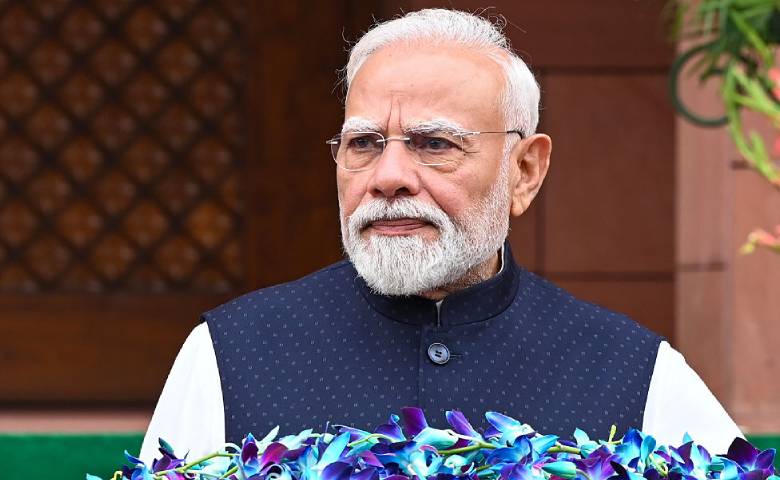
Business News : Prime Minister Narendra Modi has shown a mirror to the country's major industrialists and companies regarding employment and salary hike of employees. He said, the government has given tax relief to industries, income tax relief to the public and ease of doing business. But have companies passed on the benefits of these decisions to their employees? Have they increased salaries and created new jobs? The Prime Minister urged the industries to seriously consider these issues.
Prime Minister Modi was addressing the annual meeting and convention of the Federation of Indian Chambers of Commerce and Industry (FICCI) in New Delhi on Thursday. He said, it is not always possible for the government to fulfill its obligations while the industry depends only on the government. Companies should also play their part in the economic progress of the country.
Corporate tax hiked to 22%, yet why salaries haven't increased?
Prime Minister Modi reminded businessmen that in 2014, the basic corporate tax rate for companies was 30%, which the government reduced to 22%. Additionally, a 15% basic tax rate was introduced for new domestic manufacturing companies. He said that the government has given significant tax relief to the companies.
However, businesses must explain whether this relaxation has led to an increase in the number of employees and an increase in wages. The Prime Minister questioned whether companies had hired more people. He also questioned the mindset of industrialists who expect the government to take action first and then take their own decisions.
Tax relief on income up to Rs.12 lakh was mentioned
The Prime Minister also mentioned the income tax relief given to common people. He said that under the new tax regime, the government has made a provision to reduce tax liability on ordinary income up to Rs.12 lakh per annum. For salaried employees, this limit increases to Rs.12.75 lakh when standard deduction is included.
According to PM Modi, this relief has increased the purchasing power of the people. When people have more money to spend, market demand will increase, and businesses should benefit from this. He asked the industry whether companies are expanding their businesses and creating new jobs to take advantage of this increased demand.
Companies should not rely solely on the government
PM Modi said that both the government and the private sector should work together for the economic progress of the country. Companies should not only rely on government policies and tax exemptions, but also contribute to increasing investment, employment and employee income. He told the businessmen that farmers, small businesses, industries, wealth creators and taxpayers play an important role in the development of the country. Such persons should be respected, as the progress of a country cannot be achieved by government efforts alone.
Advice on improving product quality
The Prime Minister also questioned the quality of products manufactured by Indian companies. He said companies consider India's huge domestic market as their strength. They believe their products will somehow sell in the country's 1.4 billion-strong market. But now companies must move away from this mindset. Indian consumers should also receive the same high-quality products available in international markets. He criticized the idea of producing different quality products for export quality and domestic quality. PM said that the people of the country also have a right to good quality goods.
Make the local market a gateway to the global market
PM Modi told businessmen that India's domestic market should not just be a safe haven for companies. It should be used as a basis for preparing to compete in the global market. He said that Indian companies should improve their product quality, technology and production capacity to compete with companies from other countries. The Prime Minister also mentioned the Free Trade Agreement (FTA) between India and other countries. He said that these agreements have opened the door to large international markets for Indian companies. He asked the businessmen whether they had made any plans to take advantage of these new opportunities.
Businessmen are requested to develop a 20-year long-term plan
PM Modi advised companies to base their investment decisions on “India First” for the next 20 years. He said industries should invest in areas where India can reduce its dependence on imports by increasing domestic production capacity. Citing the pharmaceutical sector as an example, he said, while India is strong in manufacturing finished drugs, many of the raw materials and active pharmaceutical ingredients (API) used in making drugs still depend on imports.
Similarly, investment opportunities in sectors like agriculture, food processing and engineering also need to be explored. The Prime Minister asked FICCI members and industrialists to openly give suggestions on the problems being faced by business and industry in the country. He said that if the industry feels that a policy or regulation needs to be changed, they can directly write to them. The government is ready to consider suggestions for reforms.