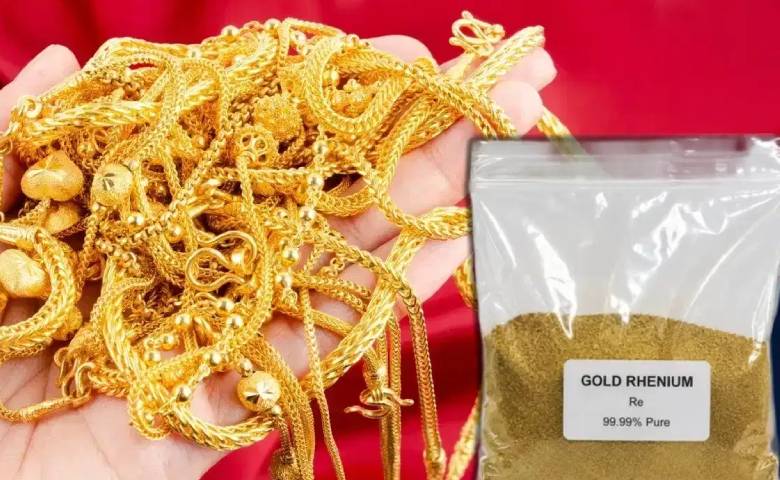
Business News : A new method of adulterating gold has emerged, making it difficult to detect through standard testing. Heavy metal powder is added to gold to increase its weight. This powder is being sold as gold powder. In fact, this adulterated powder is called rhenium. Let's know what is rhenium powder? Can it be detected by a standard test? Is there a way to detect rhenium impurities in gold?
What is Rhenium Powder?
Rhenium powder is a rare, heavy, silver-gray or gold-colored metal, a fine powder that has recently gained attention due to reports of its use to increase the weight of gold jewelry and evade purity tests. The addition of this low-cost, heavy metal can increase the overall weight of the jewelry, while reducing the actual gold content. The biggest challenge is that such adulteration is not easily detected by standard methods or superficial testing.
How is the confusion happening?
People involved in the gold trade import rhenium powder from China to India. According to reports, if a certain amount is mixed with gold, the purity of gold cannot be detected by normal testing. This can be understood by mixing 1 gram of rhenium powder with 7.83 grams of 24-karat gold, resulting in a total weight of 8.83 grams. If gold is tested for purity using normal, traditional methods, it will be declared 24-karat gold. However, the actual gold content can be as high as 90 percent, which is about the same as 22-karat gold.
The whole game has been running in the market for 2-3 years
According to Yogesh Singhal, President of Bullion Jewellers' Association, the gold adulteration game has been going on for the last two-three years. Complaints of heavy metals like rhenium, ruthenium, iridium and osmium being mixed in gold are coming to light. This adulterated gold powder is reaching the markets through Maharashtra and Bengal. It is suspected that it is being manufactured in China. Its price is said to be about ten percent less than the actual price of gold.
What does this mean?
The addition of rhenium increased the total weight of the gold, while testing revealed the purity to be greater than the actual amount. According to reports, these adulterated jewelery are passing tests at many jewelery showrooms and testing centres. However, this does not prove that all hallmarking centers or gold testing machines cannot detect rhenium adulteration.
How to identify purity of gold? Learn 5 simple testing methods
There are many methods to test the purity of gold. These range from checking BIS hallmarks and HUID codes to modern machines and acid tests. Some methods can be used for preliminary testing at home, while for determining the true purity, it is better to take the help of a recognized hallmarking center or modern testing machines.
-
Check BIS Hallmark and HUID Code
The easiest way to determine the purity of gold is to look for the BIS hallmark on the jewelry. It also has a purity code based on the carat. For example, 22-karat gold has 916 and 18-karat gold has 750. Additionally, the jewelry also has a 6-digit HUID code. Customers can check this code through official BIS portal or BIS Care app.
-
XRF machine and lab testing
An XRF (X-ray Fluorescence) machine is used to accurately determine the purity of gold. This machine can determine the amount of pure gold and other metals present in gold. A special feature of this test is that it does not require breaking or damaging the jewelry. This facility is available at jewelers and accredited testing centres.
-
Acid and touchstone test
In this method, gold jewelry is gently rubbed against a special black stone (touchstone). Then a few drops of nitric acid, or acid found in special test kits, are applied to the gold. The purity of gold is determined based on its reaction with acid. However, improper testing can damage the surface of the jewelry.
4. Preliminary test with magnet
Magnets can also be used to detect gold. Real gold is not attracted to a magnet. If jewelry is attracted to a magnet, it can become contaminated with another magnetic metal. However, lack of attraction to a magnet does not guarantee that the gold is completely pure.
5. Water, vinegar and ceramic test
Water is also used for preliminary testing of gold. Gold is a very solid metal, so when placed in water it settles to the bottom. However, other heavy metals may also be immobilized, so this is not a definitive test.