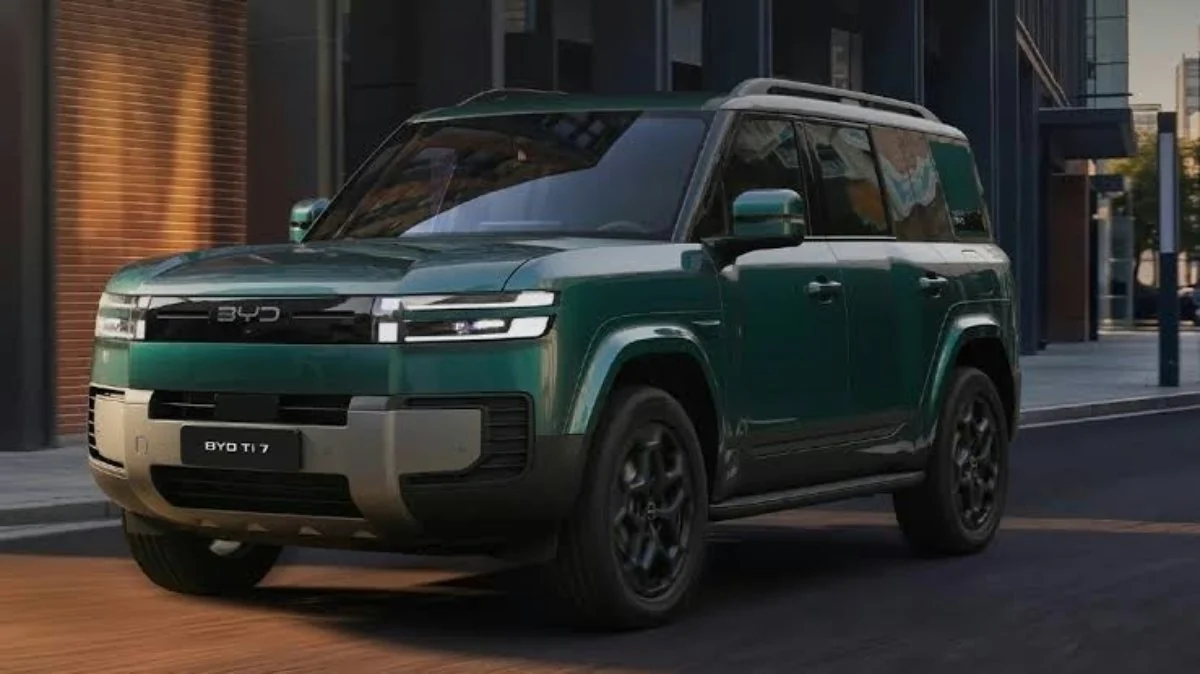
Automobile Desk: It is not a new thing to break out a legal war in the global automobile market regarding the design and look of vehicles, but this time the matter has heated up between two big giants. Britain's famous luxury vehicle manufacturer Jaguar Land Rover (JLR) has seriously accused Chinese electric vehicle manufacturer BYD of stealing the design of its popular off-roader SUV Defender. JLR claims that BYD has launched its new SUV Ti 7 in the market by making an exact copy of the Land Rover Defender 110. After this big controversy, the problems of the Chinese company seem to be increasing in Europe and legal action has started against its locations in the Netherlands.
Offices searched and digital records seized in Netherlands
According to reports, taking strict cognizance of Jaguar Land Rover's complaint, a team of court-appointed investigating officers conducted a surprise raid on BYD's two main offices in Schiedam and Hoofddorp in the Netherlands in August. During this period, the investigation team has taken possession of many sensitive documents, technical files and digital records from the offices. JLR suspects that BYD completely disassembled the Defender, understood its structure, components and details and prepared the structure of Ti 7 with the help of reverse engineering technology. However, the evidence is being examined in the court before reaching any final decision in this case.
Both companies in court, first hearing on November 11
Now all eyes on this entire incident are fixed on the court in Hague, Netherlands, where the initial hearing of this high-profile case is going to be held on November 11. On the other hand, BYD's legal advisors have expressed strong objection to this raid process. BYD's lawyers argue that this action amounts to a 'fishing expedition' conducted only with the intention of finding evidence without any concrete boundaries. However, despite the controversy gaining momentum, both the auto maker companies have refrained from issuing official statements to the media.
What is it in design that raises questions?
In China, BYD showcased this car under its sub-brand Feng Cheng Bao under the name 'Bao 7' during September 2025, which was later renamed Tai 7 and Ti 7. If we look at its exterior, its square (boxy) shape, upright front grille, aggressive square wheel arches and tailgate-mounted storage box are directly reminiscent of the Land Rover Defender. Talking about dimensions, this SUV with 4,999 mm length and 2,920 mm wheelbase comes in 5-seater option in China, while its 7-seater model has also been prepared for the European market. In terms of powertrain, it is offered in a 1.5-litre turbo petrol plug-in hybrid (PHEV) as well as an all-electric avatar with a range of 755 km.
The sky-rocketing difference in price became the reason
If we compare both the vehicles, BYD is preparing to launch Ti 7 in the market at a much cheaper price than Defender. In China, the starting price of its hybrid model has been kept at 1,79,800 yuan and the price of all-electric model has been kept at 1,99,800 yuan. In Britain, where its pre-booking has been started from 47,995 pounds (about Rs. 60.29 lakh), in contrast, the starting price of Land Rover Defender 110 is 68,465 pounds (about Rs. 86 lakh). This huge difference of about Rs 26 lakh in the British market and the possible delivery starting from January 2027 is believed to be the real reason for this dispute between the two companies.
JLR has won such cases before also
In the auto sector, JLR has been taking a very strict stance regarding the safety of its vehicle designs. Earlier in the year 2019 also, the company had won a long legal battle against another Chinese automaker Jiangling Motors (JMC). At that time, the court held that Jiangling's Landwind X7 car was a copy of the Range Rover Evoque and imposed a heavy fine on the company, including a sales ban. In such a situation, the controversy that started regarding BYD Ti 7 has once again heated up the debate on Intellectual Property Rights (IPR) in the auto industry.