
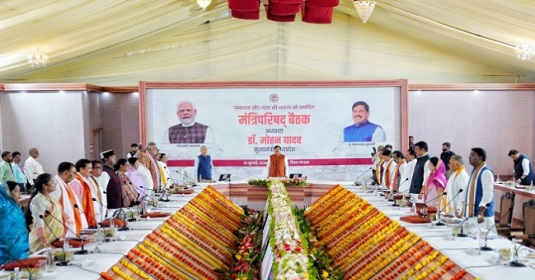
Cabinet approves UCC in Madhya Pradesh, ban on polygamy, Nikah Halala crime; Live-in registration is also mandatory, know complete information

Bhopal. The Mohan Yadav government of Madhya Pradesh has taken a big step towards implementing the Uniform Civil Code (UCC). The draft of UCC prepared by retired Justice Ranjana Prakash Desai Committee was approved in the cabinet meeting held in Jagdishpur under the chairmanship of Chief Minister Dr. Mohan Yadav. The Chief Minister said that this law has not been prepared against any particular religion, but with the aim of ensuring equal rights, equal justice and gender equality for all citizens.
Lakhs of suggestions received from the public-
The Chief Minister said that the seven-member committee constituted on April 27, 2026 studied the UCC model, existing laws and social aspects of various states. An online portal was created to take suggestions and more than 50 public consultation meetings were organized across the state.
According to the government,
More than 9.58 lakh online suggestions were received.
Opinion was taken from people by sending more than 3.5 crore SMS.
93.54% people supported the implementation of UCC.
One wife/one husband rule
Under the proposed UCC, there will be a provision for only one marriage (monogamy) at a time for all communities. The marriage age for men has been set at 21 years and for women at 18 years.
Verbal divorce is invalid, Nikah Halala is punishable.
Under the Code, oral divorce and decisions of informal panchayats will not have legal recognition. Divorce will be possible only on valid grounds laid down in law.
Also promoting, forcing or enforcing practices like Nikah Halala will be considered a punishable offence.
Registration of marriage and divorce is mandatory-
Registration of both marriage and divorce will be mandatory under UCC. Although the marriage will not be invalidated due to lack of registration, there will be a provision for legal action and fine if the rules are not followed.
New rules on live-in relationships also-
The government has also set clear rules regarding live-in relationships.
Registration will be mandatory within one month of living together.
If any partner is under 21 years of age, his/her parents will be informed.
Children born from live-in will be considered legitimate children and will get full rights in property.
The female partner will have the right to ask for maintenance if needed.
There is a provision of three to six months in jail and fine for staying for a long time without registration, giving wrong information or not giving information despite notice.
Son and daughter have equal rights in property-
In UCC, sons and daughters are given equal rights in ancestral property. Widows and widowers will be treated equally and both parents will get equal status in inheritance.
The word ‘illegitimate child’ abolished-
The government has completely eliminated the concept of ‘illegitimate child’ from the Code. All children born out of wedlock, live-in, adoption, surrogacy or other means will enjoy equal legal rights.
Scheduled Tribes will remain out-
The Chief Minister clarified that Scheduled Tribes and certain special traditional communities protected under the Constitution have been kept out of the purview of the UCC. He said that there will be no interference in the worship, religious tradition or belief of any religion.
Other major decisions of the cabinet-
Apart from UCC, many important proposals were also approved in the meeting, including-
Ease of Doing Business Bill-2026
Fire and Emergency Services Bill-2026
Private University Amendment Bill-2026
Proposal to create two health universities in medical education
amendment to highway law
labor law reforms
Decision to abolish old and irrelevant laws-
Chief Minister Mohan Yadav said that the purpose of the Uniform Civil Code is not to create division in the society, but to strengthen the basic spirit of equality, women’s respect, social harmony and the Constitution. The government hopes that all political parties and different sections of the society will support this initiative.

Comments are closed.