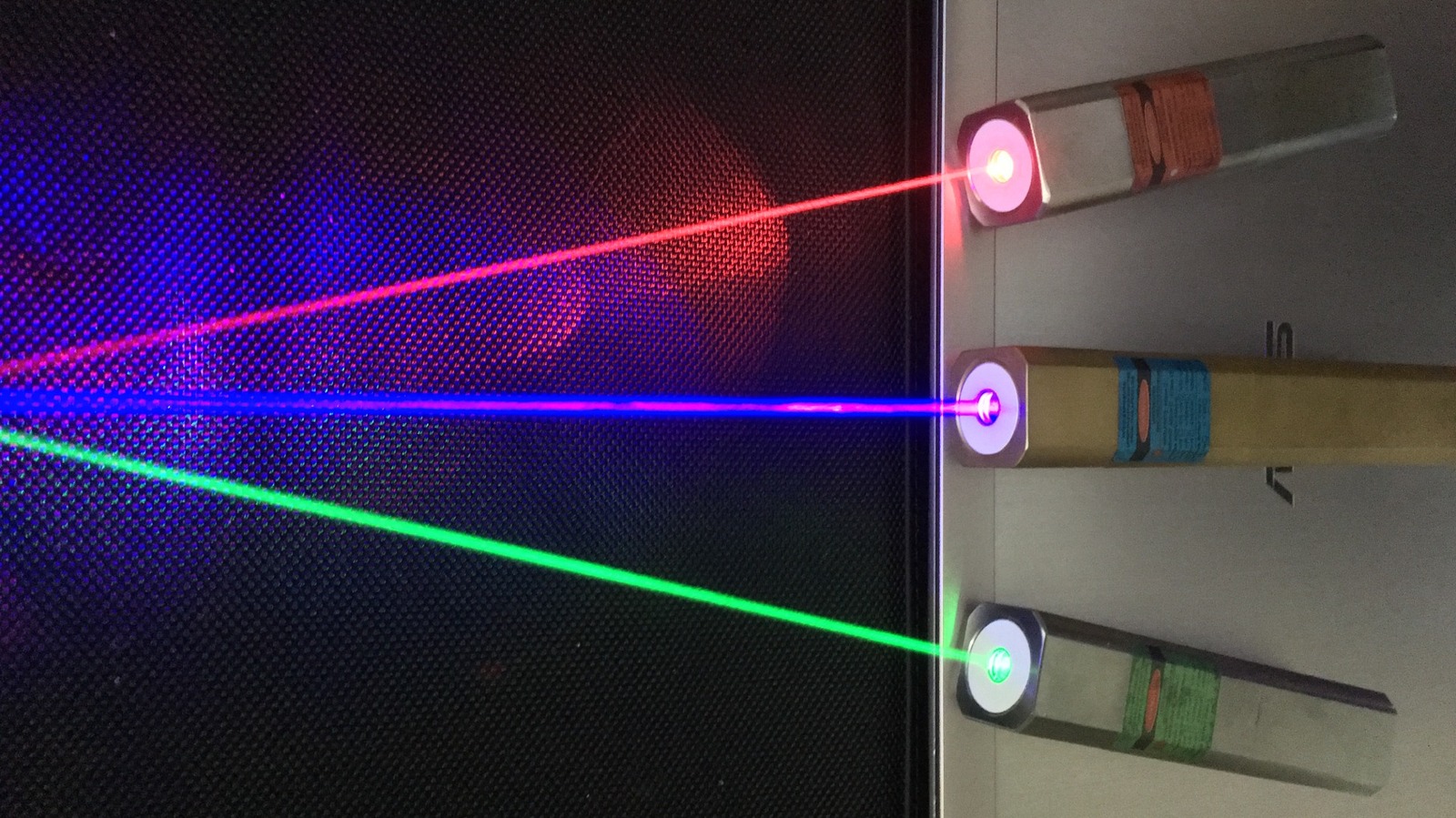
Laser pointers are found all over the world. People use them at work to point at screens during presentations; teachers use them for lessons; and members of the military utilize them during briefings. They’re ubiquitous, but potentially dangerous (if the stickers plastered on them are any indication). Most warnings explain why you shouldn’t point them at someone’s eyes, as the concentrated beam can damage their vision. This is also what makes it dangerous to point them at an airplane.
Whether they can be dangerous in other ways, like starting a fire, depends on what kind of laser you are talking about. In short, your standard laser pointers used in classrooms and other everyday activities generally do not have enough output power to spark a fire. While things like a laser’s divergence, its power output, and the atmospheric conditions it is operating in all play a role in its fire-starting potential, the vast majority of laser pointers lack enough energy to ignite something.
Some heavy duty laser pointers do have this potential, but the device will need to produce at least 500 mW of power output. This is reserved for Class 4 lasers used primarily for industrial work rather than laser pointers you can easily purchase.
A closer look at lasers with the ability to start a fire
Lasers are classified according to the hazards they pose. The Food and Drug Administration (FDA) recognizes Classes 1 through 4, including several subclasses, while the international IEC system uses similar but not identical labels. In the FDA’s system, Class 1 products are generally considered safe under normal operating conditions, while higher-powered lasers (e.g., Class 4) can pose serious eye and skin hazards and, in some cases, a fire risk. Some laser pointers can damage security cameras as well.
The National Fire Protection Association also publishes guidance on the use of lasers based on their fire-starting potential in its NFPA 115: Standard for Laser Fire Protection. Even though Class 4 lasers are the ones with a significant fire risk, a high-tier Class 3B laser may still be able to ignite something like paper or matches. These types of lasers also have the potential to heat up and smolder something like woodchips. Besides their power, Class 4 lasers also have a greater fire-starting potential because they often have the ability to adjust their focus, tightening the beam and increasing its power density.
Typically Class 4 lasers are not available for general consumer use because high-power laser pointers, like those capable of starting a fire, are dangerous. Class 4 lasers cause serious injury when used improperly. If you are operating a higher-class laser of any kind, it is important to wear the appropriate protective safety gear and follow the safety guidelines outlined by the applicable regulatory bodies.