The CFIA says it has no evidence the products reached Canada, but the discovery raises serious questions about unauthorized exporters, grey market supply chains and India’s wider food compliance problem.
By: The Obnews Editorial Team
The Canadian Food Inspection Agency is assessing whether an alleged food relabelling operation uncovered in Navi Mumbai presents a risk to Canadian imports after investigators found a Kurkure package carrying fabricated nutrition information in English and French. The CFIA says it currently has no information indicating that products connected to the operation entered Canada, and no related Canadian recall has been announced. Reuters reported the CFIA response on September 3.

The investigation was conducted at a warehouse operated by Sadhana Enterprises in the Turbhe industrial area of Navi Mumbai. Indian authorities seized thousands of cartons valued at approximately ₹75.5 lakh, or nearly US$80,000. The products included Lay’s and Kurkure snacks, Maggi noodles, Knorr soup, Hellmann’s mayonnaise and Coca-Cola products such as Thums Up and Limca.
Investigators allegedly discovered chemicals being used to erase original manufacturing and date information, along with equipment capable of printing replacement dates. Stickers containing altered ingredient and nutrition information were reportedly placed over the manufacturers’ original labels. One package had even been assigned a manufacturing date in October 2026, despite being found weeks earlier. Reuters documented the warehouse operation and relabelling equipment.
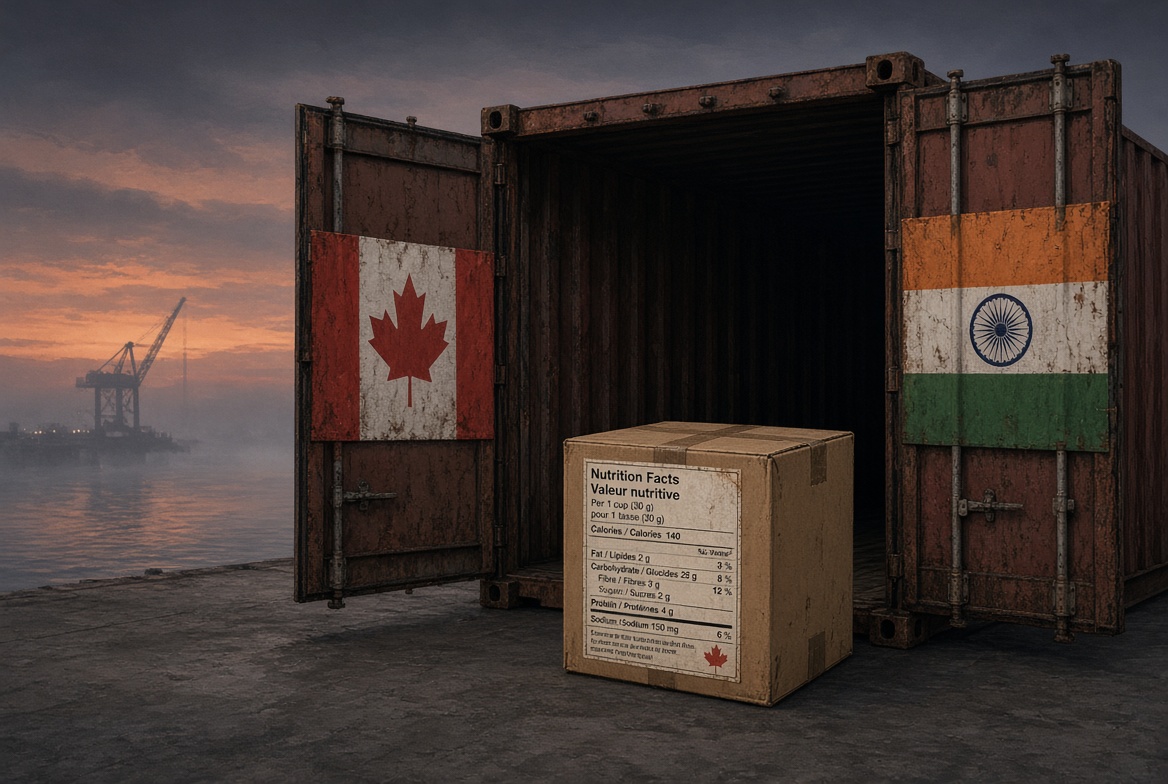
The clearest potential connection to Canada was a Kurkure package carrying a replacement nutrition label in English and French. The format resembled the bilingual presentation prescribed for most prepackaged foods sold in Canada. The replacement label reportedly changed the declared cereal content, calorie count and serving size.
That label makes Canada a plausible potential market, but it does not establish that Canada was the intended destination. English and French are used in other markets, the shipment destinations have not been publicly confirmed and Canadian authorities have found no evidence of these particular products entering the country. Under CFIA bilingual labelling requirementsmost mandatory information on consumer food packages must appear in both official languages, but the presence of a bilingual sticker is not proof that a product has been reviewed or approved by the CFIA.
PepsiCo, Nestlé, Coca-Cola and Unilever have not been accused of participating in the alleged scheme. The investigation concerns third party operators and exporters that apparently obtained genuine branded products and allegedly altered them without the manufacturers’ authorization. PepsiCo said it had no commercial relationship with the exporters identified in media reports and that snacks manufactured for the Indian market are not intended for export unless the company specifically authorizes it.
The case must also be distinguished from traditional food adulteration. Adulteration normally involves changing, diluting or contaminating the food itself. What investigators have established in this case is alleged misbranding, unauthorized repackaging and date manipulation. Officials have not announced laboratory findings showing that the ingredients inside the seized packages were chemically adulterated.
Nevertheless, India has a documented food compliance problem extending beyond this particular warehouse. Indian government figures show that 40,023 of the 223,808 food samples tested during the 2025 to 2026 financial year were classified as nonconforming, a rate of approximately 17.9 percent. During the previous financial year, 34,388 of 170,535 tested samples were nonconforming, or approximately 20.2 percent. The figures were released by India’s Ministry of Health and Family Welfare.
Those figures are significant, but they do not mean that one in five food products sold in India is adulterated. The government category includes adulterated, unsafe, substandard, misbranded and otherwise noncompliant products. Inspectors also conduct targeted and risk based enforcement drives, meaning the tested products are not necessarily a representative sample of everything available across India. The published data also do not provide a reliable national adulteration rate specifically for India’s grey food market.
Grey market goods are not automatically counterfeit or unsafe. The term generally describes genuine products distributed outside a manufacturer’s authorized network. The danger increases when unknown intermediaries erase dates, replace ingredient information, conceal the original source or store products under uncontrolled conditions. At that point, ordinary parallel trading can become food fraud and potentially create a public health risk.
If similarly manipulated products reached Canada, the most immediate concern would be inaccurate ingredient and allergen information. A false label could prevent consumers from knowing whether a food contains milk, wheat, gluten, nuts, mustard or another priority allergen. Altered lot numbers could also make it harder to trace a product during a recall, while false manufacturing information could hide how long an item had been stored and whether it had passed through unsuitable conditions.
Canadian rules distinguish between best before dates, which generally concern freshness and quality, and expiration dates, which are required for a smaller category of foods such as infant formula, meal replacements and nutritional supplements. An older snack is therefore not automatically dangerous simply because its best before date has passed. However, the CFIA says changing a date is illegal when it creates false or misleading information or results in unsafe food. The agency explains Canada’s date labelling rules here.
Canada’s import system places substantial responsibility on licensed importers. Commercial food importers must hold a valid Safe Food for Canadians licence and demonstrate that their foreign suppliers manufacture, store, package and label food under conditions providing protection comparable to Canadian standards. They must maintain preventive control plans, supplier records, complaint procedures and traceability information showing where products came from and where they were sold. CFIA’s food import guide outlines these obligations.
Those requirements provide an important barrier against unauthorized products, but no import system can inspect every individual package. The CFIA acknowledges that Canadian controls are risk based and operate at the foreign source, the border and inside the domestic marketplace. A sophisticated operation using genuine packaging, convincing bilingual labels and falsified documentation could therefore place pressure on the system if an importer failed to verify the actual supplier. There is no evidence that this happened in the present case. CFIA’s import framework explains how those risks are managed.
Canadian consumers should not stop purchasing Indian food or assume that products are unsafe simply because they were manufactured in India. Legitimate Indian producers and authorized Canadian importers operate within regulated supply chains and have not been implicated in this case. Warning signs that deserve further examination include multiple or overwritten date codes, residue where information appears to have been erased, damaged seals, stickers concealing original ingredient lists or packaging that differs substantially from the brand’s official Canadian version. An additional sticker on an imported product is not, by itself, proof of fraud.
Anyone who suspects that a product has been fraudulently labelled should retain the package, receipt, lot information and photographs before contacting the retailer. Concerns about misleading labels, undeclared allergens or food fraud can be submitted through the CFIA food concern reporting system or reported by telephone at 1-800-442-2342.
The Navi Mumbai discovery is a warning about weaknesses that can emerge when branded food moves through unauthorized export channels. It is not evidence that Canada’s supply of Indian food has been compromised, but it gives Canadian officials a credible reason to examine exporter identities, shipping records and importer relationships. India’s decision to uncover and seize the products is an important enforcement step. The decisive question now is whether investigators can determine where earlier shipments went and stop similar operations before falsely labelled food reaches consumers abroad.