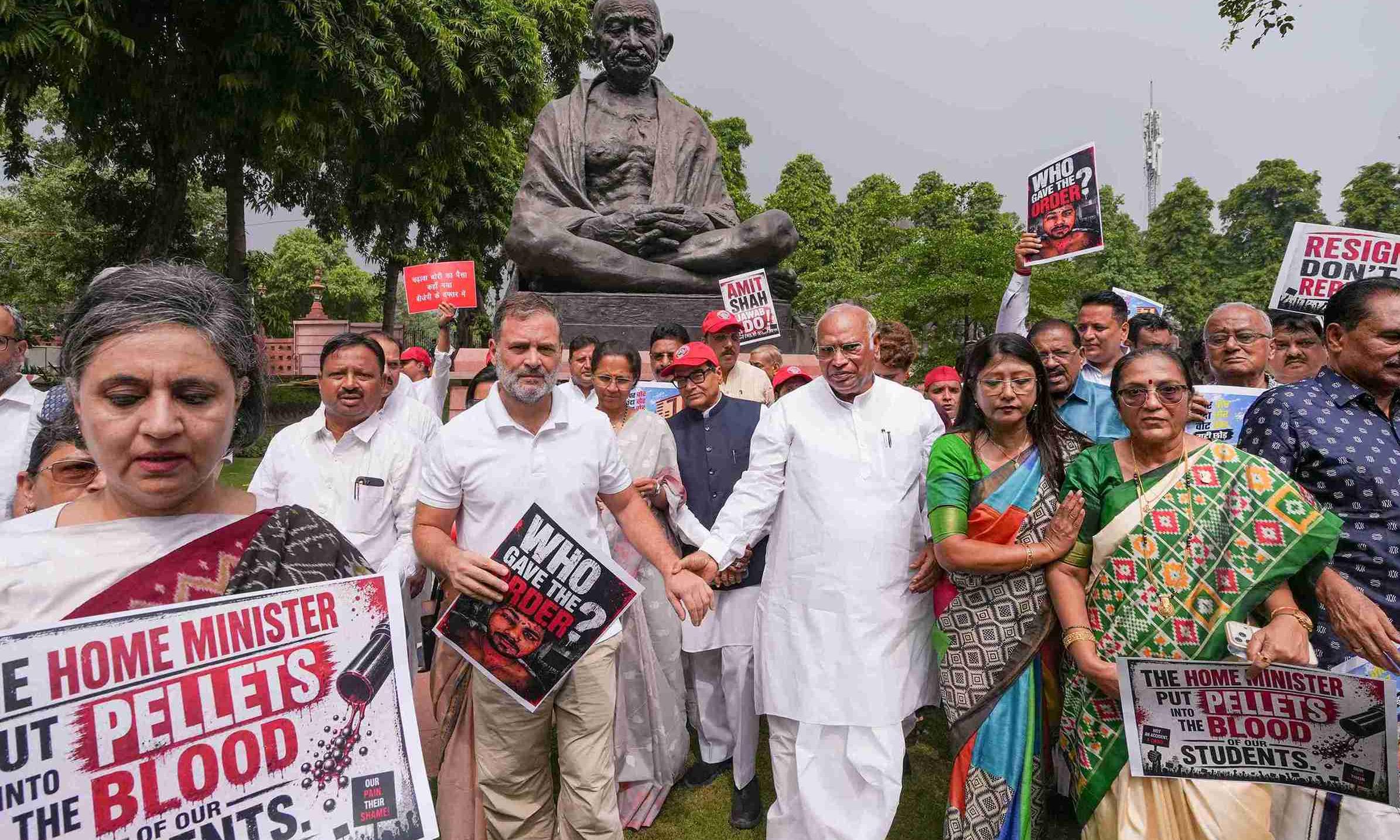
The ongoing deadlock in Parliament during the Monsoon Session is unlikely to end unless Union Home Minister Amit Shah addresses the House on the police crackdown against student protesters during the July 20 march and the alleged donation embezzlement at the Ayodhya Ram temple.
Parliamentary Affairs Minister Kiren Rijiju met Rahul Gandhi on Wednesday (August 5) in an effort to break the impasse, where he reportedly sought the Congress’ cooperation on key government legislations, including the Delimitation Bill and the Women’s Reservation Amendment Bill.
So what is the way out to end the logjam?
Amit Shah’s absence
According to senior journalist Javed Ansari, the stalemate can only be resolved if the government agrees to the Opposition’s principal demand.
“The only way to resolve the deadlock in Parliament is for Amit Shah to come to the House and respond. Parliament is bigger than individuals and their egos. The principle of parliamentary democracy is accountability,” Ansari said on The Federal‘s Capital Beat show.
Also read: Asking Amit Shah to resign: Why it is Congress’ boldest gambit yet
The parliamentary standoff has also brought the Opposition parties closer despite their political differences. The Congress, Samajwadi Party, Trinamool Congress, Dravida Munnetra Kazhagam (DMK) and other INDIA bloc partners have maintained a united stand, insisting that Parliament must first debate the student protest crackdown.
‘HM to take accountability’
The Opposition has repeatedly questioned Amit Shah’s absence from the Lok Sabha amid allegations that the Ministry of Home Affairs authorised the use of pellet guns during the police action against protesting students. Rahul Gandhi, in a post on X, alleged that the Home Minister was “hiding” because he was answerable for the police action against the students.
Senior journalist TK Rajalakshmi argued that accountability ultimately rests with the Home Ministry since the Delhi Police functions under its control.
Also read: Rahul Gandhi turns up heat on Amit Shah as Parliament showdown escalates
“If the Delhi Police did not have standing orders authorising the use of pellet guns, then it becomes an extremely serious issue. The Home Minister and the Ministry of Home Affairs must answer,” she said.
She added that the government’s continued silence had only deepened public suspicion. “By refusing to come to Parliament and explain what happened, the government is giving people reason to believe it has something to hide,” Rajalakshmi observed.
Hierarchy of command
Former Border Security Force (BSF) Additional Director General PK Sood also questioned the chain of command behind the use of pellet guns. He referred to official station records to argue that the use of pellet guns was not a decision taken at the local level.
“As per the General Diary (GD) entry in one of the police stations in Central Delhi, the orders were issued by the Deputy Commissioner of Police (DCP) concerned,” Sood said. He further explained that such operational decisions generally move through the established chain of command. While no written order from higher authorities has been made public, Sood argued that authorisation for such action would ordinarily have originated from senior levels within the Ministry of Home Affairs.
Also read: ‘Idiots’, ‘andhbhakts’, attack on Amit Shah: Rahul Gandhi’s speech triggers storm in LS
The deployment of the Rapid Action Force during the protest also came under the Ministry of Home Affairs’ jurisdiction. The reported use of pellet guns are not part of the standard equipment ordinarily authorised for routine Delhi Police operations, making the circumstances surrounding their reported use a central issue in the Opposition’s demand for a parliamentary explanation.