

Rohit Kumar
NEW DELHI, Apr 15: The Center has sought to allay he apprehensions of the non-BJP ruled states, particularly in South India, regarding the implementation of the women’s reservation law linked with the delimitation of constituencies excise assuring that no region would be disadvantaged when the move comes into effect.
The Center has clarified that the increase in parliamentary seats would be carried out in a balanced and proportionate manner for all states.
According to government sources, the proposed changes will ensure that each state sees a similar rise in representation. The Center has indicated that the number of seats could increase by around 50 per cent across states, addressing fears, particularly from southern states, that more populous regions such as Bihar and Uttar Pradesh might gain a disproportionate advantage.
A senior government functionary said, all states and union territories would have their number of Lok Sabha seats increase by half after delimitation and no state would lose its current proportional strength in Parliament. He said Home Minister Amit Shah would clarify this in Parliament when the debate on the “Constitution (131st Amendment Bill) and the Delimitation Bill” begin on Thursday.
The drafts of the Bills have raised concerns that the States which have stabilized their population are set to lose their relative strength when the composition of the Lok Sabha is reapportioned between States as per the latest census figures.
Mr Shah had assured party representatives, who met him in recent weeks, that the strength of the Lok Sabha would increase by 50%, to be distributed across States in their existing proportions — that is, a 50% increase in the number of Lok Sabha seats from each individual State. However, this is not mentioned in the drafts of the Bills circulated by the government. In fact, the Bills propose an inter-State redistribution of Lok Sabha seats, which could make it impossible for current proportional shares to be maintained.
The senior functionary said this was a misreading of the drafts, “Those who are reading bits and pieces and interpreting them as reducing the relative strength of the South are missing the big picture,” the senior functionary said.
The assurances come as the government prepares to introduce a significant constitutional amendment bill in Parliament on Thursday. The legislation aims to expand the strength of the Lok Sabha from the current 543 seats to nearly 850.
The proposed bill is part of efforts to implement 33 per cent reservation for women in the Lok Sabha as well as in state legislative assemblies. To make this possible, the Center plans to amend Article 81 of the Constitution, allowing up to 815 members to be elected from states and up to 35 from Union Territories.
The implementation of women’s reservation is expected to follow a delimitation exercise, which will redraw constituency boundaries based on population and other factors. This process had raised concerns among some states about a possible shift in political representation. The government said further details and clarifications on the bill will be shared during discussions in Parliament.
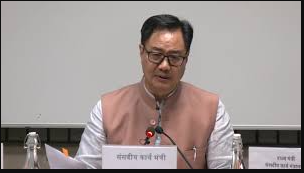
The Union Minister for Parliamentary Affairs, Kiren Rijiju, has warned against people misleading the southern states on delimitation. “Some people are trying to mislead the South Indian States on Women Reservation by providing wrong Delimitation figures. There should be no politics in giving reservations to Women in Lok Sabha & Legislative Assemblies. All political parties are united for Nari Shakti,” he posted on X.
Tamil Nadu Chief Minister MK Stalin on Wednesday announced a state-wide black flag protest to be held on Thursday opposing the Centre’s proposed delimitation exercise. He also cautioned the Union government that it would face serious consequences if Tamil Nadu’s concerns were ignored.
The announcement came after an emergency meeting led by Stalin, who is also the president of the Dravida Munnetra Kazhagam (DMK). The meeting, conducted via video conference, included party MPs and district secretaries to discuss the implications of the proposed changes.
During the discussion, Stalin expressed strong concern over the issue, stating, “the sword that hung over our heads has now descended upon us.”
He further said the DMK had begun reaching out to Members of Parliament from various states to build a joint response against what he described as a serious threat. According to him, efforts were underway to create a coordinated strategy to oppose the move.
Raising questions about the intent behind the exercise, he asked whether the move was effectively a punishment for the southern states, which he said have significantly contributed to the country’s development.

Comments are closed.