
Chalk against ‘Chitta’: Punjab’s classrooms become the frontline of the ‘war against drugs’

Chandigarh: As schools in Punjab are reopening after a month-long summer vacation, thousands of teachers are playing an important role in the campaign to make the state drug-free.
Now this fight has moved beyond police stations and de-addiction centers to schools and classrooms. Under the ‘Yudh Nashean Viruddh’ campaign led by Chief Minister Bhagwant Mann, a protective shield is being created around every child through trained teachers, aware principals and safe school environment. Children are being given information about the dangers of drug addiction as well as skills to cope with mental stress and options to make a complaint safely, confidentially.
Punjab government investment
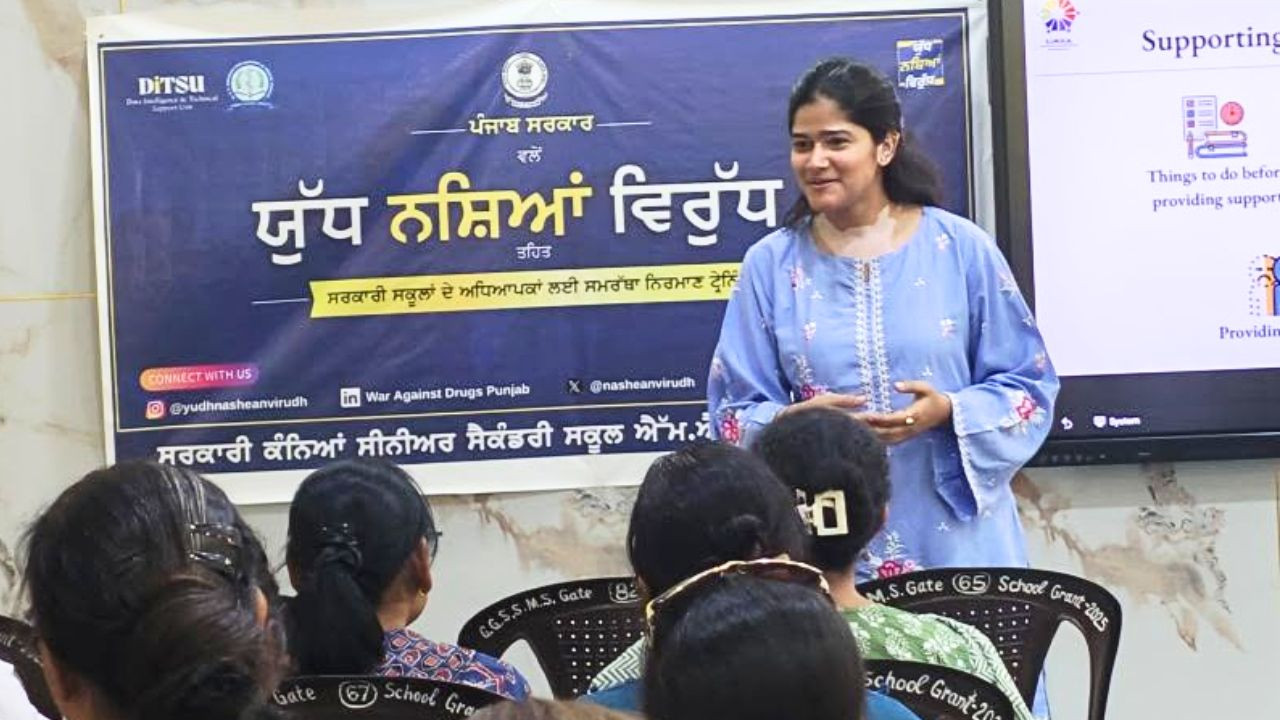
To strengthen this system, the Punjab government is investing in those who interact with teenagers on a daily basis. Over 1,400 school heads from nine districts (especially border districts) in collaboration with experts from Tata Institute of Social Sciences have been trained to recognize early signs of addiction, respond with empathy and manage mental health from a public health perspective.
Additionally, capacity building workshops have been conducted for more than 3,000 teachers from classes 9 to 12 in Amritsar. This training has yielded positive results. After the training, 75% of the teachers reported that they were inspired to create a healthy school environment, while 85% acknowledged that drug addiction among teens is linked to stress, peer pressure and emotional challenges. The program is now being expanded to all districts across the state.
Along with the awareness of school staff, the government is also addressing the root problems like stress and emotional imbalance among teenagers. The ‘Mindfulness Programme’, launched in government schools across the state, offers a 30-minute session every morning for students of classes 6 to 12, which includes breathing exercises, meditation, positive thoughts and gratitude exercises, to improve focus, emotional strength and mental health.
In this program implemented on pilot basis in about 210 government schools of Mohali, 83% students reported that they are now able to handle difficult situations better and feel less stressed.
Big statement of Minister Dr. Balbir Singh
Commenting on the importance of this initiative, Health and Family Welfare Minister Dr Balbir Singh said, “Every child rescued from drug addiction gets a secure family and a strong future. By making schools a place where children develop self-confidence, resilience and life skills, the government is laying the foundation of a healthy society. Our aim is not just to warn against the dangers of drug addiction, but to provide children with the knowledge, strength and understanding to take the right decisions.”
Punjab further strengthens its prevention strategy by launching India’s first evidence-based anti-drug curriculum for class 9 to 12 students across the state. Launched in August last year, the program covers around 8 lakh students from 3,658 schools and is taught by more than 6,500 trained teachers.
Developed in collaboration with J-PAL South Asia and behavioral scientists, the curriculum goes beyond traditional awareness campaigns and teaches students about addiction, peer pressure, decision-making and practical skills to overcome addiction.
Balwinder Kaur, a government school teacher in Amritsar who is guiding teenage children as part of the state’s anti-drug campaign, said, “We are getting an encouraging response from the children. They actively participate in discussions at the class and school level. This gives us confidence that teenagers and adolescents will stay away from drug problems in the times to come.”
As part of the Safe Help System for students, anonymous complaint boxes have been set up to report drug-related concerns, so that students can report confidentially without fear and anonymity.
Punjab Education Minister Harjot Singh Bains said that this initiative reflects the government’s commitment to make the young generation safe. He said, “Teachers have always played an important role in bringing change in the society and the anti-drug campaign being run under the leadership of the Chief Minister is showing positive results. It is a collective effort in which teachers and mentors play the most important role.”
Punjab has already become a leading state in education at the national level, securing the top position in the National Achievement Survey and NITI Aayog’s School Education System Report 2026. Now the state is also setting a new example in the fight against drugs. This is showing that drug addiction can be controlled not only through law enforcement, but also through awareness, sensitivity, scientific thinking and timely prevention. By making teachers, school heads and classrooms the center of this campaign, Punjab is creating a model that aims to keep children safe before they fall into the trap of drugs.

Comments are closed.