
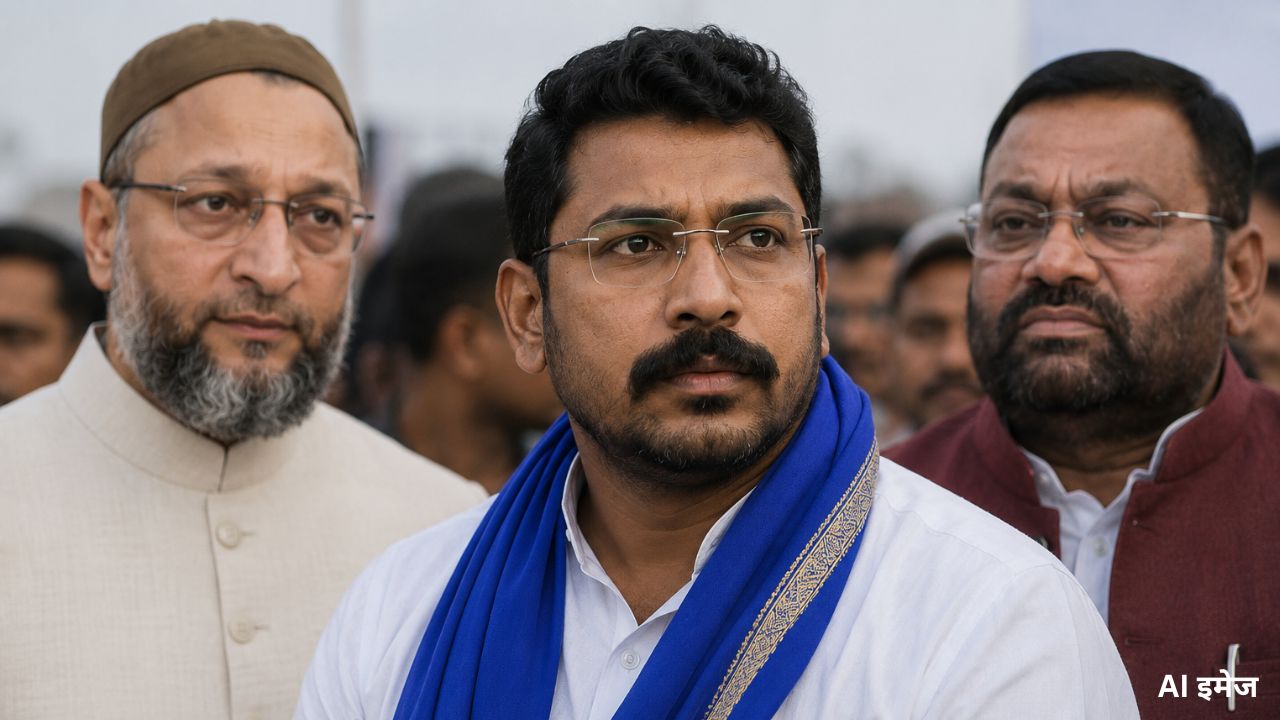
Chandrashekhar, Owaisi and Sanjay Singh on one stage, will the electoral equations of UP change?

The discussion about new political equations has intensified in the politics of Uttar Pradesh before the 2027 assembly elections. The presence of Azad Samaj Party (Kanshi Ram) chief and MP Chandrashekhar Azad, All India Majlis-e-Ittehadul Muslimeen (AIMIM) chief Asaduddin Owaisi and Aam Aadmi Party MP Sanjay Singh during the protest in Delhi is disturbing everyone.
Chandrashekhar Azad’s meeting with Rashtriya Shoshit Samaj Party President Swami Prasad Maurya a few days ago has given new air to the speculations of a third front. No formal alliance has been announced yet, but these political activities have attracted the attention of both the Bharatiya Janata Party and the Samajwadi Party.
Is the foundation of a third front being laid?
After the common platform of Delhi and the political meetings held before that, the discussion is intensifying whether the parties pursuing social justice politics before 2027 are trying to come on one platform. If this happens, then the direct contest on many seats in Uttar Pradesh can become triangular or quadrangular.
The biggest eye is on these votes
The largest base of possible equation could be Dalits, Muslims and non-Yadav backward classes. In Uttar Pradesh, Dalit population is about 21 percent, Muslims are about 19 percent and non-Yadav OBCs are considered a large social group. Maurya, Kushwaha, Shakya, Saini, Nishad, Pal, Kashyap, Lodh and many other communities fall in this category.
The influence of Chandrashekhar Azad is considered to be among the Dalit youth, especially in the Jatav community. Swami Prasad Maurya has long been the big face of non-Yadav backward class politics, while Owaisi appeals to a section of Muslim voters. Aam Aadmi Party MP Sanjay Singh is also an active face in the politics of Uttar Pradesh.
Also read: Big job game exposed due to fake TET-Ded: 7 teachers dismissed, FIR ordered
Which areas may be affected?
Dalits, Muslims and non-Yadav OBC voters are in a position to influence the election results in many assembly seats of Western Uttar Pradesh, Rohilkhand, Awadh and Purvanchal. If some part of these classes moves towards a new political platform, then the margin of victory and defeat on many seats may change.
Why might the challenge from BJP and SP increase?
BJP has created a strong base among the non-Yadav OBC and non-Jatav Dalit class in the last two assembly elections. Whereas Samajwadi Party is trying to integrate these classes with itself through PDA (Backward, Dalit, Minority) strategy. In such a situation, if the third option creates influence among these social groups, then the election strategy for both the parties may become more challenging. However, its real impact will be revealed only when any formal alliance and seat sharing is announced.
Also read: ‘Stop politics, find a solution’, Mayawati said on NEET movement
Currently there are more indications, no announcement
So far, no official announcement of any electoral alliance has been made between Azad Samaj Party (Kanshi Ram), AIMIM, Rashtriya Shoshit Samaj Party and Aam Aadmi Party. But the ever-increasing political closeness, common platforms and meetings definitely indicate that all the parties are keeping an eye on the possibility of creating new equations in the politics of Uttar Pradesh before 2027. If this political chemistry turns into an electoral alliance then the electoral contest in Uttar Pradesh could be more interesting than before.

Comments are closed.