
OpenAI officially introduced ChatGPT for Financial Services on September 10, confirmed directly on OpenAI’s own announcement page, and it’s worth being precise about what this actually is before anything else: a specialized ChatGPT Work product built for financial institutions, not a new way for ordinary users to get investment advice from ChatGPT. Reuters, Business Insider, Fortune, and Quartz have all covered the launch since, largely framing it as “ChatGPT comes to Wall Street.” That framing is accurate as far as it goes, but it undersells what’s actually changed architecturally.
What ChatGPT for Financial Services Actually Is
OpenAI officially introduced ChatGPT for Financial Services on September 10 as a tailored ChatGPT Work experience for financial institutions. The product combines built-in financial data with GPT-6 Astra’s reasoning capabilities to help teams develop research, financial models, and customized client materials. OpenAI says the product was shaped through a design partnership with Morgan Stanley and Evercore, with the initial focus on investment banking and equity research workflows.
The distinction from consumer ChatGPT matters. ChatGPT for Financial Services is not positioned as a consumer personal-finance or investment-advice product. It is designed for eligible financial institutions and their professional workflows, where analysts and other financial-services teams need to work with specialized datasets, internal information, financial models, research, and client-facing materials. OpenAI’s Financial Services Terms also state that its financial services provide information and tools for research and analysis.
The product is built around ChatGPT Work. That matters because its value comes less from simply answering finance questions and more from combining model reasoning, financial data, enterprise connections, and workflow outputs in one environment.
Financial Data Is a Key Differentiator
One of the most important differences between ChatGPT for Financial Services and a general-purpose ChatGPT workflow is the way financial data is incorporated. OpenAI says the product includes certain premium datasets natively, with the data indexed and hosted by OpenAI to support retrieval and granular citations.
The financial-data ecosystem can be separated into three broad categories:
- Built-in datasets
The built-in datasets include Daloopa, PitchBook, LSEG News, and Crunchbase. These datasets are indexed and hosted by OpenAI as part of the financial-services experience. Because these sources are built into the product, eligible firms do not need to separately configure a connector for access to those particular datasets. OpenAI says hosting and indexing these datasets directly can improve retrieval, latency, and source visibility.
- Subscription integrations
The product also supports connections to services that financial institutions may already subscribe to, including S&P Capital IQ, LSEG, MSCI, Dow Jones Factiva and Moody’s. These integrations allow firms to work with their existing financial-data subscriptions.
- Broader connectors
Beyond the built-in datasets and subscription integrations, OpenAI says it has optimized commonly used financial MCP connections, while its broader connector ecosystem includes more than 50 integrations. These include services such as Datasite, Box, Preqin, FactSet and Intapp, alongside other enterprise applications used in financial workflows.
This distinction is important because not every source available through the product is being provided in the same way. Built-in datasets are part of the financial-services experience itself, while subscription integrations and broader connectors allow firms to bring additional licensed or enterprise information into their existing workflows.
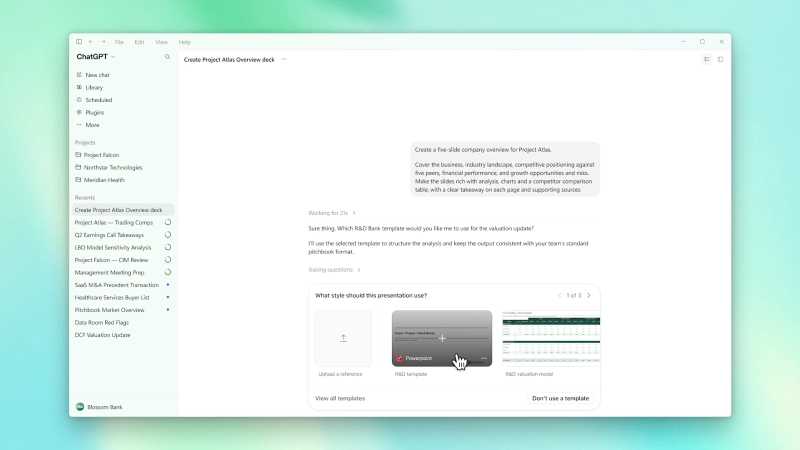
Granular citations are another important part of the data architecture. OpenAI says bankers can trace figures and claims back to their sources and check the underlying evidence while developing their analysis. For financial research, where a single number can affect a valuation, model, or client presentation, that source visibility is considerably more useful than an answer that simply presents a figure without showing where it came from.
The key difference is that ChatGPT for Financial Services includes certain premium financial datasets natively. For the built-in datasets, OpenAI handles the indexing and hosting, while other information sources can still be accessed through subscriptions and connectors.
What GPT-6 Astra Does in Financial Workflows
OpenAI positions GPT-6 Astra as the reasoning engine behind the financial-services experience. The company describes Astra as state-of-the-art across the capabilities required for this type of work, including retrieving information from dense documents, reasoning over financial data, and producing useful outputs from that analysis.
OpenAI also reports that Astra scored 69.9% compared with 60.2% for GPT-5.6 Sol on its OfficeQA Pro benchmark, which tests an AI agent’s ability to find and analyze information across U.S. Treasury Bulletins, including complex tables and footnotes. These figures are an OpenAI-reported benchmark, so they should be understood in the context of OpenAI’s own testing methodology.
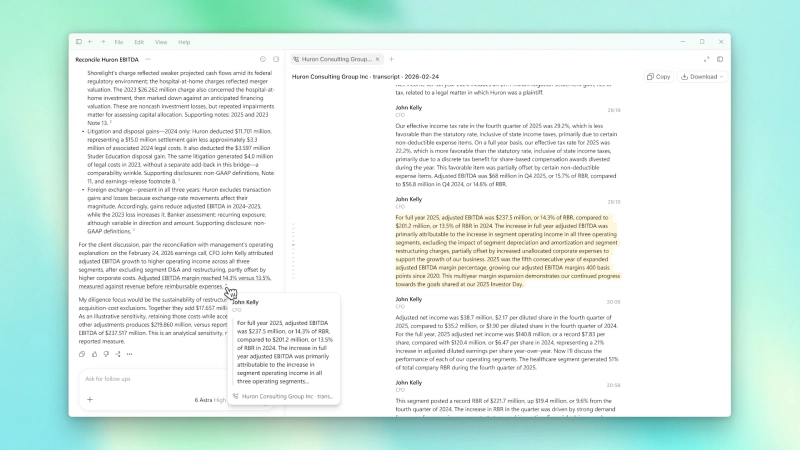
The importance of that capability becomes clearer when looking at the actual workflows OpenAI is targeting. The company says ChatGPT for Financial Services can support tasks such as LBO and valuation modeling, buyer screening, earnings analysis, and pitchbook preparation. The resulting work can be produced in formats including Excel, Word and PowerPoint, using a firm’s pre-configured templates and style guides.
That changes the role of the chatbot from simply answering a financial question to helping produce the work product that follows from the question. An analyst might need to collect information from several financial sources, compare companies, structure the findings, develop analysis, and then turn that analysis into a client-ready document. The product is designed around that broader workflow.
Security and Confidential Data
Financial institutions also operate under requirements that make data access and information barriers particularly important. ChatGPT for Financial Services builds on enterprise controls including SAML SSO, SCIM provisioning and role-based access controls, while OpenAI says business data is not used to train its models by default. The platform also supports encryption at rest and in transit, configurable retention settings and compliance log exports through OpenAI’s Compliance Platform.
Firms can create separate workspaces to support information barriers between teams, helping organizations manage access where different groups may need to be isolated from particular information. OpenAI also says firms can manage access to apps and skills by role and control supported read/write actions, adding another layer of administrative control over how users interact with connected tools and data.
These controls matter because the value of a financial AI system depends not only on what information it can retrieve but also on who is allowed to retrieve it and what actions can be performed with that information. A workflow that combines proprietary company information, market data, and internal documents needs permissions and governance to remain part of the system.
Could This Change Junior Banker Work?
The potential effect on junior-level financial work is one of the more interesting implications of the product, but it should not be confused with a confirmed employment outcome.
Many of the workflows OpenAI describes involve tasks traditionally performed by junior analysts, including research, information gathering, financial analysis, and document preparation. If these activities become faster through AI-assisted workflows, the amount of time analysts spend on repetitive research and formatting could decrease.
However, that is an analysis of the product’s potential impact. Morgan Stanley’s statement focuses on helping employees research companies, develop analysis, and prepare advice; it does not make claims about headcount.
OpenAI’s public materials do not claim that the product replaces human judgment, client advice, or final decision-making. The more immediate possibility is therefore workflow compression: analysts may spend less time collecting and formatting information and more time reviewing outputs, interpreting findings and working on higher-value parts of the process. Whether that ultimately changes staffing levels is a separate question that will depend on how individual financial institutions deploy the technology.
Availability
ChatGPT for Financial Services is available to eligible financial institutions through OpenAI’s financial-services sales and account teams. It is not presented as a self-serve consumer product, and OpenAI’s announcement directs interested organizations to contact its financial-services sales team.
That positioning reinforces the product’s intended audience. The focus is not on giving individual ChatGPT users another finance mode but on providing financial institutions with a controlled environment for research, modeling, data access, and professional work.
What to Watch Next
The clearest next signal will be which financial services categories OpenAI expands into beyond investment banking and equity research, since the company has explicitly framed this launch as a starting point informed by its Morgan Stanley and Evercore partnership. It’s also worth watching whether other major AI labs respond with their own vertical financial products, and whether real-world adoption inside banks actually shifts junior-level workflows the way OpenAI’s framing suggests it could.
For banks and other financial firms, the real test will not simply be whether ChatGPT can answer financial questions. It will be whether the product can reliably fit into the existing chain of research, analysis, modeling, review, and client preparation without compromising data controls or professional judgment. That is ultimately what will determine whether ChatGPT for Financial Services becomes another enterprise AI tool or a meaningful part of the financial analyst workflow.
(Source)