In Indian culture, festivals are not just an occasion to celebrate, but they also teach us the way of life. There is some tradition, belief and philosophy of life hidden behind every festival. Chhath festival is also such a unique festival, in which there is faith, penance, sacrifice, gratitude towards nature and also the wish for a happy life of the family. This festival reminds us of our roots, our traditions and the relationships on the basis of which our life moves forward.
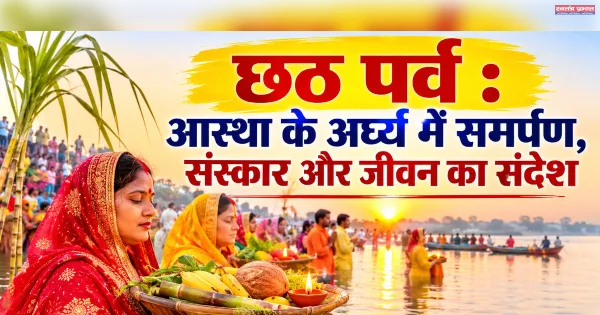
As soon as the name of Chhath festival comes to mind, decorated ghats on the banks of river or pond, women carrying puja baskets on their heads, melodious sounds of folk songs, devotees standing in water offering arghya to the Sun and an atmosphere lit with lamps come to the fore. This scene is not just a religious event but a beautiful picture of Indian folk life.
The most special thing about this festival is that both the setting and rising sun are worshipped. Usually we salute the rising sun, because it is a symbol of new morning, new energy and new hope. But Chhath festival teaches us to bow our heads even before the setting sun. What a beautiful message this is from our culture that respect should not only be for success and heights but also respect for the declining times and difficult situations of life. The one who is setting today has also once illuminated the world with his light.
Perhaps what could be a bigger lesson for life than this? When a person is successful, there is a crowd of people around him, but when his times change, then very few people are seen standing with him. Chhath festival teaches us that just as we welcome the rising sun, we should also greet the setting sun with the same reverence. As important as it is to be happy seeing someone's success in life, it is equally important to stand with him in his struggles and difficult times.
Another emotional aspect of this festival is the sacrifice and dedication of the mother. Women follow strict rules for several days, wishing for the happiness and prosperity of the family, long life of their children and prosperity at home. Keeps Nirjal fast, makes preparations for the puja and reaches the ghat with full devotion. Tiredness may be visible on their faces, but in their hearts there is faith in the happiness of the family. It is not easy to express this sacrifice of a mother in words. She does not ask for anything for herself, her every prayer includes the welfare of her family and loved ones.
Preparations for Chhath also create a different world in themselves. From cleaning the house to making Prasad, special attention is paid to purity and discipline in every task. Thekua cooked on an earthen stove, seasonal fruits, sugarcane, coconut and prasad arranged in a bamboo basket are not just the ingredients of puja, but also contain age-old traditions and family sentiments. More than the sweetness of Prasad, it contains the love of mother's hands and the fragrance of family rituals.
A special identity of Chhath festival is its folk songs. In these songs, somewhere mother's love is heard, somewhere the pain of daughter's departure, somewhere the wish for the prosperity of the family and somewhere the connection with one's village and soil is visible. Listening to these songs, one feels that our culture does not live only in books, it also lives in people's lives, their voices and their feelings.
Today, when people have started living away from their villages and homes in cities and other states in search of employment and a better future, then Chhath festival becomes an emotional occasion for them to return home. People who stay away from their families throughout the year, try to reach their village, their home and their people on this festival. For them, it is not just worship but also an opportunity to reconnect with their soil. The streets of the village, the courtyard of the house, the offerings made by the mother and the memories of childhood give a different peace to the mind.
The social aspect of this festival is also very important. Rich and poor, small and big and people of different classes are seen standing together at the ghat of Chhath. Everyone has the same objective and the center of everyone's devotion is the Sun God. No one is bigger or smaller than anyone else. People help each other in arranging puja. Someone clears the road, someone decorates the ghat, someone delivers puja material. This collectivity shows that society becomes stronger not only by its own rights, but by cooperation and sensitivity to each other.
One of the biggest features of Chhath festival is that nature has been made the basis of worship in it. Rivers, ponds, water, sun, fruits and plants are integral parts of this festival. Life is not possible without nature, yet modern man has exploited nature the most in the race for development. Rivers are getting polluted, ponds are shrinking and trees are continuously being cut. At such a time, Chhath festival reminds us that nature is not just an object for our use, but is the basis of our existence. It is our duty to be grateful to the sun from which we get energy, the water from which life sustains and the earth from which we get food.
There is no requirement of any grand temple or special place in this festival. The bank of the river or pond itself becomes the place of worship. The sun is in front and the devotees express their faith by standing in the water. This tradition tells us that to worship God, purity of heart and true feelings are more important than external appearances.
In today's busy life, when family members are getting less time for each other, festivals like Chhath provide an opportunity to reconnect relationships. When the new generation sees its parents and elders celebrating this festival with full rules and devotion, it not only learns the method of worship but also learns values like patience, discipline, sacrifice, cooperation and responsibility towards the family. Traditions are not just meant to be followed, it is also our responsibility to pass them on to the next generation.
Chhath festival also teaches us how important patience and faith are in life. After offering Arghya to the setting sun in the evening, devotees wait for the rising sun the next morning. This waiting is not just a religious tradition, but a symbol of hope. No matter how many difficulties come in life, no matter how long the night is, a new morning definitely comes. All that is needed is to maintain faith and keep moving forward with patience.
Today there is also a need that we should not limit the spirit of Chhath festival to just one day of worship. If we worship the Sun then understand the importance of energy, if we consider rivers sacred then take a pledge to keep them clean, if we wish for the happiness of the family then give time and respect to the family members. If we talk about social harmony then we should implement it in our behavior also.
Perhaps the real message of Chhath festival is that life is not meant to be lived only for oneself. This includes making sacrifices for others, expressing gratitude towards nature, managing relationships, and maintaining hope even in difficult times. Next morning, when the devotees standing in the river water offer Arghya to the rising sun, not only a puja is completed, but a new energy and faith is infused in the mind. With the first ray of the sun comes the message that no matter how deep the darkness is, the path to light is never closed.
Chhath festival not only teaches us to offer Arghya to the Sun, but also teaches us to be grateful to all those people, relationships and nature who illuminate our lives. Perhaps this is the biggest beauty and biggest message of this festival.
Virendra Hiralal Patharia