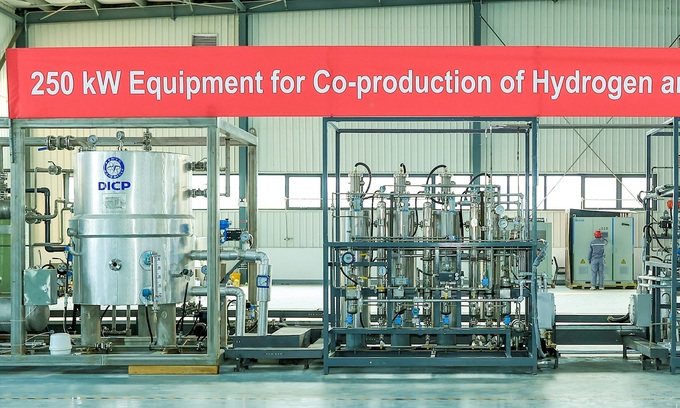
The team, led by professor Deng Dehui and associate professor Liu Yanting of the Chinese Academy of Sciences’ Dalian Institute of Chemical Physics, published the results on Sept. 15 in the peer-reviewed journal Nature Energy.
The plant produces 48 standard cubic meters of hydrogen and 31.6 kg of fresh water an hour, according to the paper.
That is equivalent to about 380,000 standard cubic meters of hydrogen at 99.9999% purity and 256 metric tons of fresh water a year, the South China Morning Post reported.
The concentrated brine left over can also be used to recover salt, uranium and bromine, the academy said in a statement, which gave no recovery figures for those materials.
Direct electrolysis of seawater exposes the anode to corrosion from chloride ions and the cathode to scale from calcium and magnesium ions, while the established alternative of desalinating seawater before electrolysis requires costly equipment and heavy electricity use, according to the SCMP.
Commercial alkaline electrolyzers run at 80 to 90 degrees Celsius and lose about 30% of their electricity as low-grade heat, which is usually carried away by cooling water. The Dalian team instead feeds that heat into a vacuum distillation tower, where seawater boils at 40 to 50 degrees Celsius and the vapor condenses into fresh water, enough to supply the electrolyzer with some left over, the newspaper reported.
The plant ran for 40 days of daily start-stop cycles with no obvious decline, and an earlier 20 kW pilot ran stably for 100 days, according to the academy.
|
The 250-kilowatt plant that produces hydrogen and fresh water from seawater at the Dalian Institute of Chemical Physics in China. Photo and graphics by Dalian Institute of Chemical Physics |
The paper estimates the system could produce hydrogen for $2.10 per kg using onshore wind power at $0.033 per kilowatt-hour, or $2.90 per kg using solar power at $0.049 per kWh, against a market price of about $3.90 per kg.
Its cost analysis found the combined process more profitable than desalinating seawater first and electrolyzing it afterward.
Deng said in the academy statement that the approach offers “a potential pathway for more efficient hydrogen production from seawater.”
He wrote in the paper that future work should target better catalysts, greater recovery of electrolyzer waste heat and the use of artificial intelligence to optimize operating parameters.
The team first demonstrated the technology on a pilot unit in October 2023, the China Petroleum and Chemical Industry Federation rated it as internationally leading that December, and the 250 kW plant started up in late August 2024, China Science Daily reported.
A separate Chinese team led by Laoshan Laboratory researcher Tang Bo is pursuing direct seawater electrolysis, and its pilot unit in Rizhao, Shandong Province, has run for more than 1,000 hours while producing hydrogen, fresh water and what it calls strategic elements, Xinhua reported on Sept. 28.
China produced about 36.5 million tons of hydrogen in 2024, more than a third of global output, according to the National Energy Administration.