
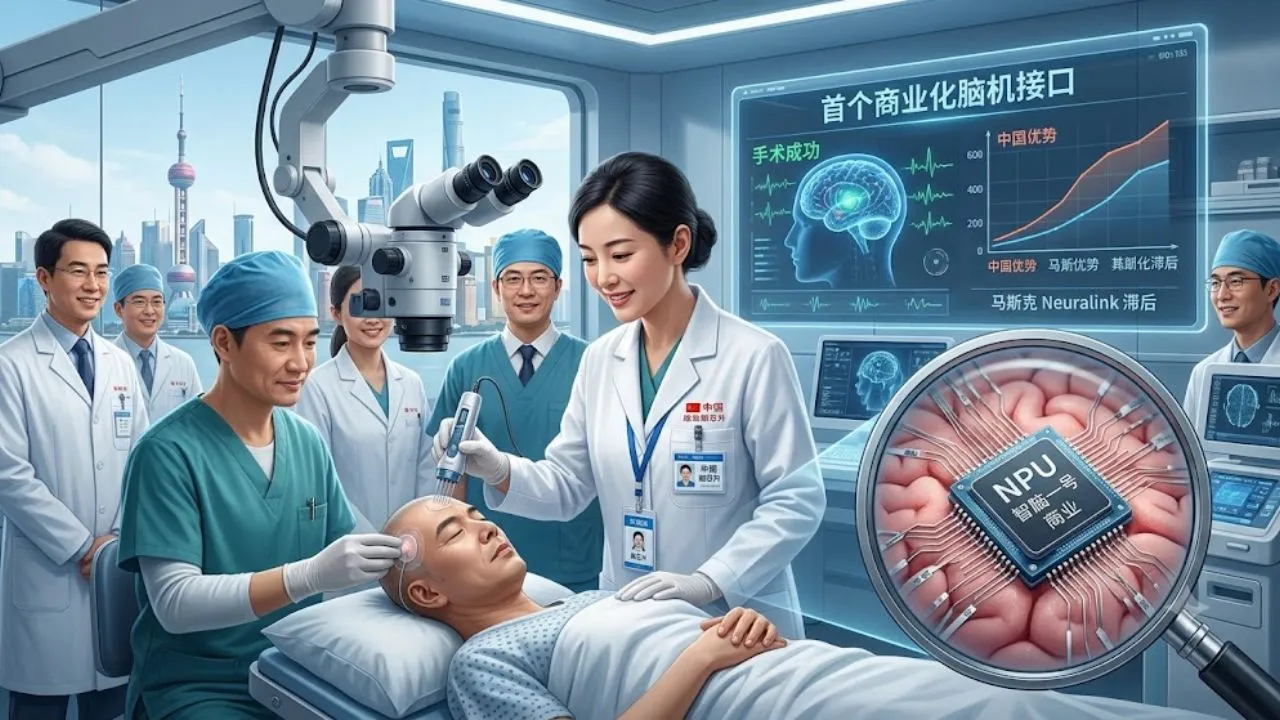

China First Commercial Brain Computer Interface Implant: China has claimed to have achieved a major achievement in the world of brain-computer interface technology. According to the report, China has approved the first commercial brain chip to be implanted in the human brain. With this step, China seems to be ahead in the race for commercial use of brain chip technology.
At the same time, Neuralink, one of the world’s most talked about brain chip projects, is still in the phase of clinical trials being conducted on humans. The company has been working on this technology for many years, but it has not yet received approval from the US regulator US Food and Drug Administration (FDA) for commercial use.
China claims first commercial BCI implant
According to Chinese media reports, doctors in Shanghai performed the world’s first commercial brain-computer interface implantation. In this process, a device was used which has been approved by the Chinese authority.
This brain chip was implanted in a patient who had trouble in hand movement due to spinal cord injury. The purpose of this implant is to understand the signals coming from the patient’s brain and use them to control an external device.
BCI technology advanced through clinical trials
Brain-computer interface technology aims to create a direct connection between the human brain and the machine. Till now, most of the technologies in this field were limited to research and clinical trials, but this step of China is being considered as a step forward in the direction of medical use.
With the help of this technology, patients suffering from paralysis or neurological problems can control computers, robotic equipment or other digital devices through their thoughts.
On which patient was the implant done and who created the technology?
According to the report, the surgery was performed at Shanghai-based Huashan Hospital, which is affiliated with Fudan University.
The patient had suffered a spinal cord injury in a car accident about ten years ago. Despite long-term treatment and rehabilitation, he was not able to use his hands normally.
The patient was selected for the Neural Electronic Opportunity (NEO) system. This is a brain-computer interface technology developed by Shanghai company Neurocal Medical Technology.
What is China’s NEO system?
The NEO system reads electrical signals from the brain and converts them into commands for the machine. This implant is placed on the surface of the brain instead of deep inside it.
When the patient thinks about an activity, such as trying to move an arm, the device captures brain signals and sends them to a computer. The computer then converts these signals into commands to control devices such as a robotic glove.
The goal of this technology is to help people affected by paralysis regain hand movement and become more independent in everyday tasks.
What is the difference between Neuralink and NEO?
Elon Musk’s Neuralink is also developing similar brain chip technology. The company’s first product was “Telepathy” It aims to enable people suffering from paralysis to control computers, smartphones and other digital devices using only their thoughts.
Neuralink has begun testing its implant in humans, but the procedure is still part of a clinical trial. On the other hand, China’s NEO system has been claimed to have received approval for commercial use, so that it can be used to treat patients in hospitals.
Also read: Big allegation on YouTube and
Increasing global competition in brain chip technology
Brain chip technology is no longer just a fantasy of the future, but is beginning to be used in medical science. Both China and America are progressing rapidly in this.
While Neuralink is working towards developing this technology on a larger scale, China’s NEO system appears to be reaching the commercial stage due to approval for medical use. In the coming times, this field can bring a big change in the world of health services and human-machine interface.

Comments are closed.