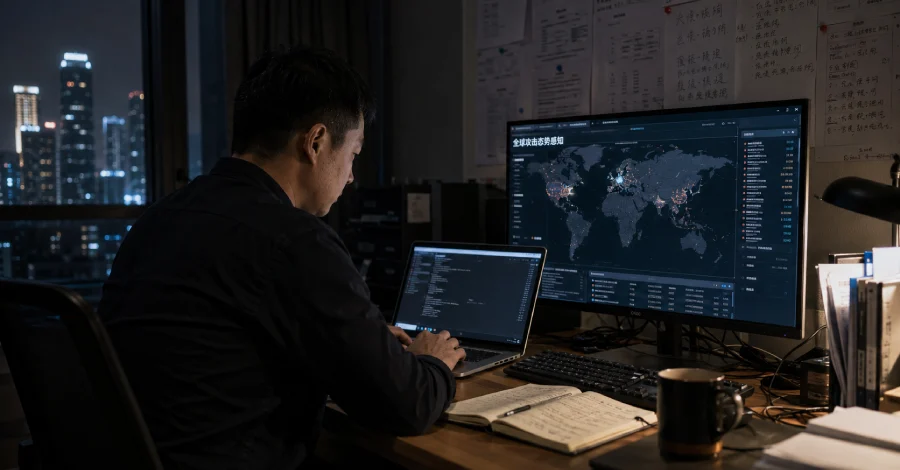
China is taking another major step toward reducing its dependence on American technology. According to a Bloomberg report, the Chinese government has ordered some state agencies to replace Windows 10 China Government Edition with domestically developed Linux distributions.
The move is part of Beijing’s broader push for digital sovereignty — the idea that critical systems should rely on technology that a country can control domestically rather than depending on foreign companies.
Chinese officials reportedly cited data security concerns surrounding Windows, although they did not provide specific details. Microsoft, meanwhile, said it was not aware of any security incident affecting the government edition and noted that the software continues to receive security updates.
Credits: zdnet
Why China Is Moving Away From Windows
China’s decision is not simply about switching operating systems. It reflects a much larger effort to replace foreign technology in sensitive government and infrastructure systems with domestic alternatives.
Beijing has been pursuing technological self-reliance for years, particularly in areas involving government data and national security. Tensions between China and the US have accelerated that process, encouraging Chinese authorities to reduce their dependence on American companies such as Microsoft.
Windows 10 China Government Edition was itself a specialized product designed specifically for Chinese government requirements. It was developed by C&M Information Technologies, a 2016 joint venture between Microsoft and state-owned China Electronics Technology Group.
The operating system included localized activation and update systems, removed certain consumer services and supported Chinese cryptographic standards.
Ironically, that specialized version of Windows was already scheduled to reach the end of its life in February 2027. The latest move could bring that deadline forward to later in 2026.
Kylin OS and UOS Are the Leading Candidates
China has not officially revealed which Linux distributions will replace Windows. However, two names stand out: Kylin OS and UnionTech OS (UOS).
Both operating systems are already positioned as domestic alternatives to Windows for government agencies, state-owned enterprises and critical infrastructure.
Kylin Software develops Kylin OS for desktop and server environments, along with specialized versions for different institutional requirements. Its open-source project, openKylin, also provides a freely available alternative.
UnionTech’s UOS has roots in Deepin and the Debian Linux ecosystem. Like Kylin, it has primarily focused on enterprise and government deployments rather than competing directly with Windows in the consumer PC market.
The market reacted quickly to reports of the government transition, with shares of Kylin Software and Tongxin Software Technology, the company behind UOS, reportedly jumping.
Huawei is another potential player. Its HarmonyOS is being developed for PC use, but it is not considered ready for large-scale government desktop deployment yet. For now, Kylin and UOS appear to be the most mature options.
Replacing Windows Is Easier Said Than Done
Moving thousands of government computers from Windows to Linux is far more complicated than installing a different operating system.
Government agencies would need to test applications, validate printers and other peripherals, integrate identity and authentication systems, ensure documents remain compatible and retrain employees.
The biggest challenge could be software. Many organizations rely on Windows-specific applications built around Microsoft’s ecosystem. Replacing those programs or adapting them to Linux could take significant time and money.
China’s centralized IT infrastructure may make such a transition easier to coordinate, but the technical challenges remain substantial.

Credits: SkillTrans
Is China Banning Windows?
Not exactly.
The reported directive does not mean that Windows is being completely banned across China. It also does not appear to apply to every government agency or every computer.
Windows Home China 11 remains available to consumers, while the precise scope of the government directive has not been disclosed.
Instead, the development appears to be another step in China’s long-term strategy to reduce reliance on foreign technology in sensitive environments.
If the transition succeeds, it could have consequences beyond China. The country has one of the world’s largest government and enterprise technology ecosystems, and a successful shift to domestic Linux could encourage other nations to consider similar approaches.
For Microsoft, meanwhile, the message is clear: in an era of growing geopolitical tensions, even decades-old software dominance can no longer be taken for granted.